
Proportional solenoid valve and control method therefor
a solenoid valve and proportional technology, applied in the direction of transducers, fluid pressure control, instruments, etc., can solve the danger of the motion of the valve element becomes unstable, and the self-induced vibration of the valve element is caused, so as to improve the resistance to oscillation, reduce the self-induced vibration range of the valve element, and improve the effect of resistance to oscillation
- Summary
- Abstract
- Description
- Claims
- Application Information
AI Technical Summary
Benefits of technology
Problems solved by technology
Method used
Image

Examples
first embodiment
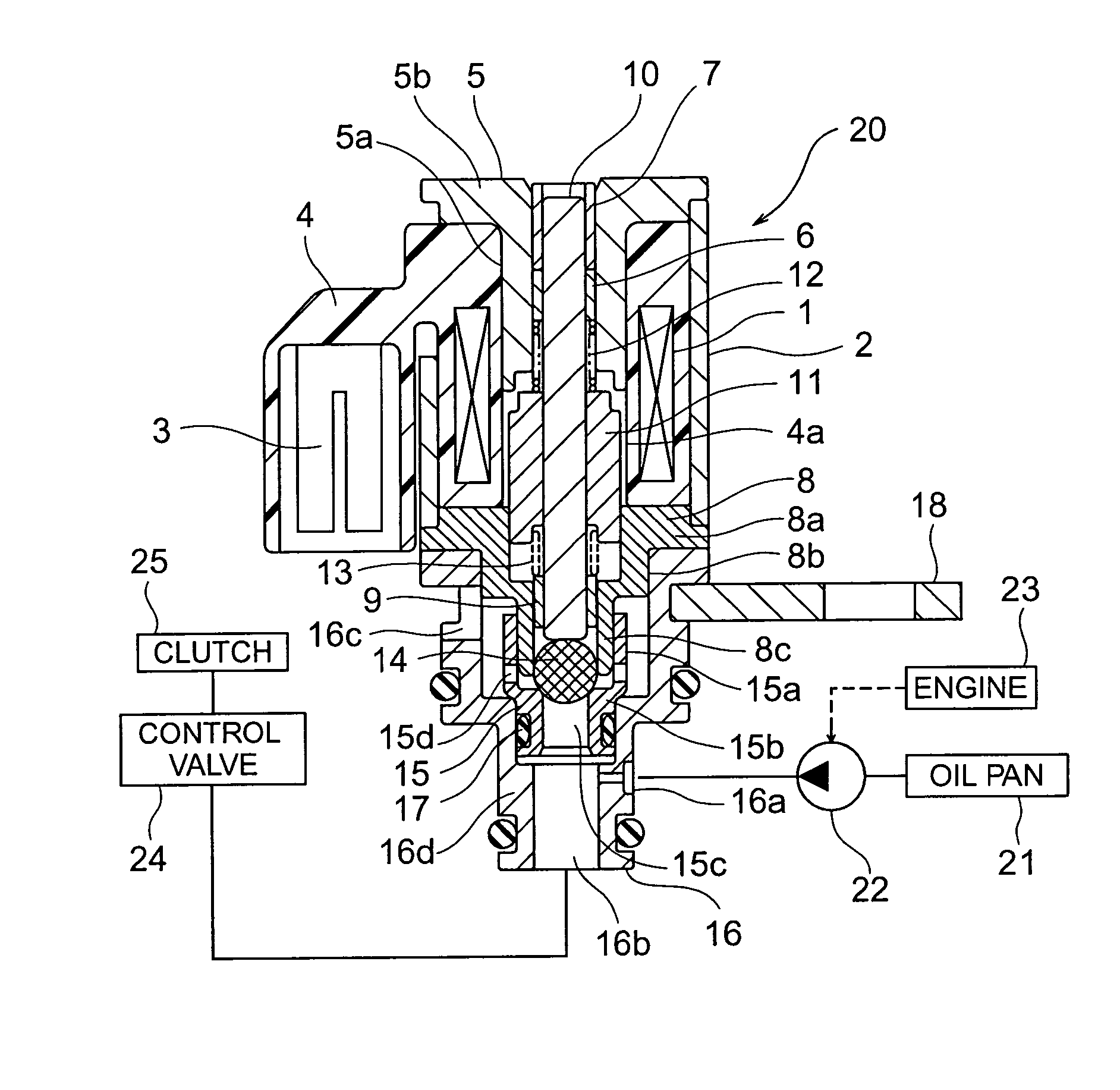
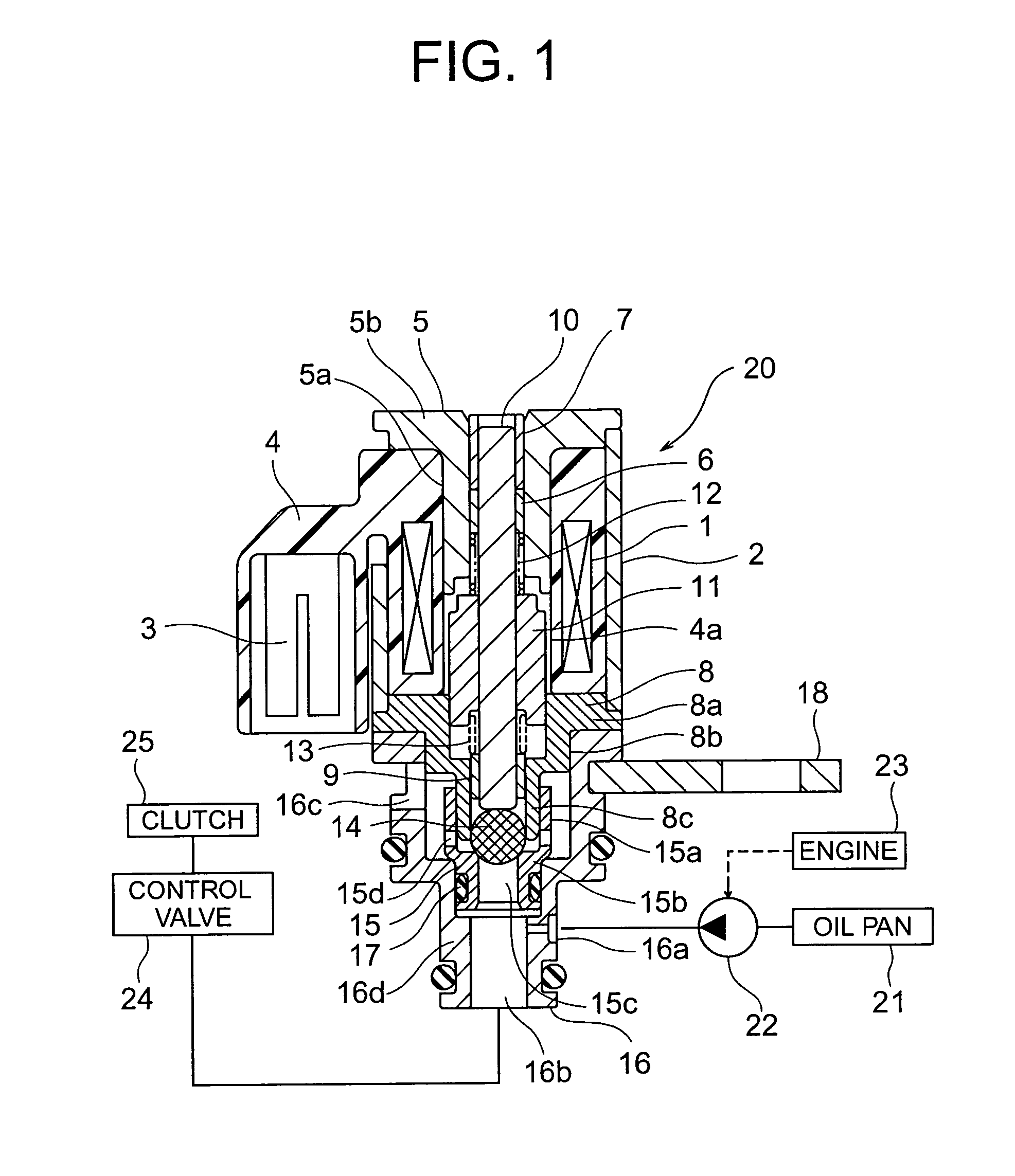
[0020]A proportional solenoid valve according to a first embodiment of the present invention is a hydraulic circuit of an electronically controlled automatic transmission for an automobile (hereinafter simply referred to as an “automatic transmission”), and is used to change the operating oil pressure in an operating portion of the automatic transmission.
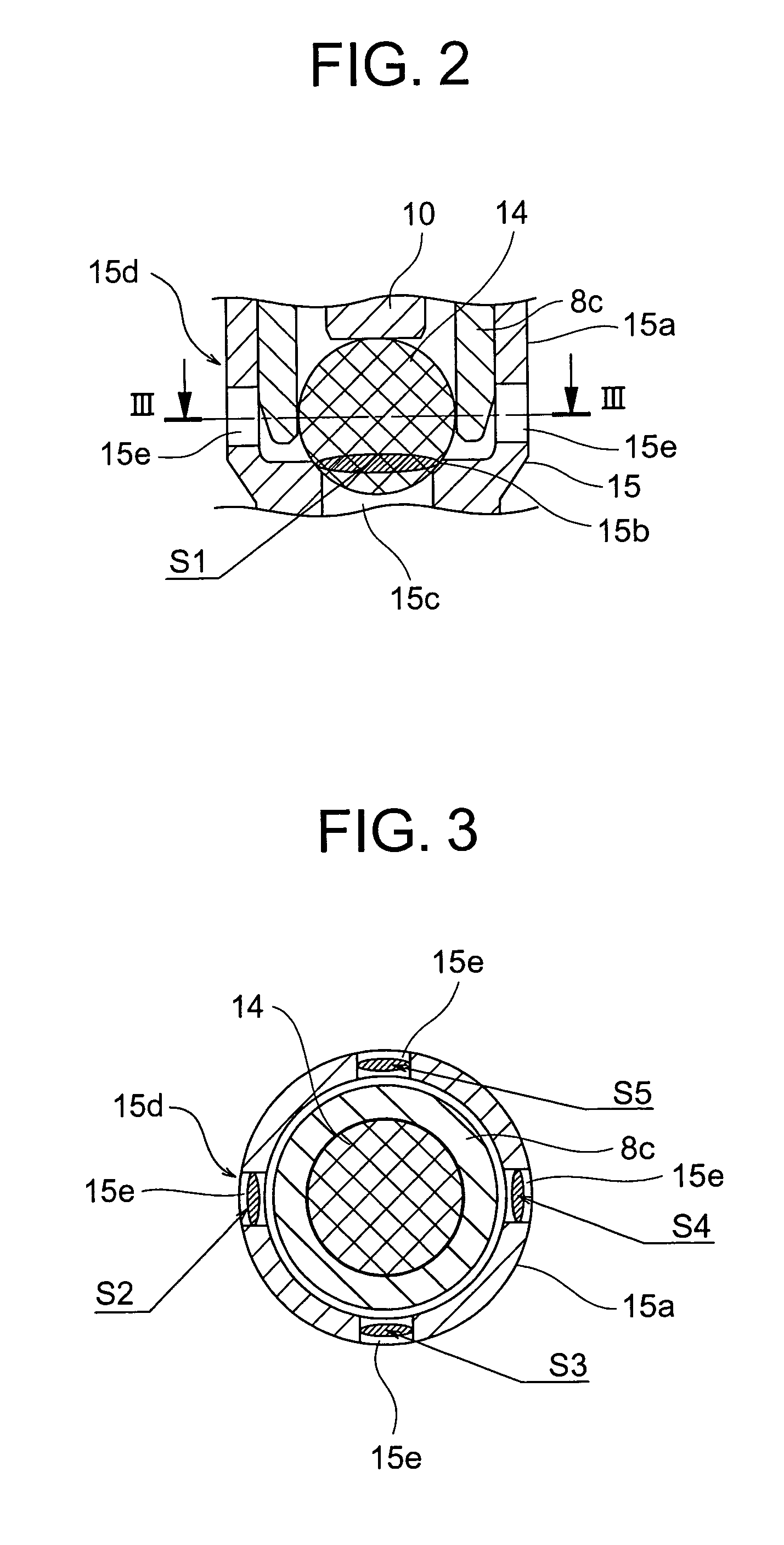
[0021]FIG. 1 is a cross-sectional view of the proportional solenoid valve according to the first embodiment of the present invention. Note that in this drawing, a proportional solenoid valve of normally high type is illustrated. In the drawing, a coil 1 is accommodated in a cylindrical case 2 made of metal and a terminal 3 for connecting the coil 1 to a power supply is arranged outside of the case 2. Further, the coil 1 and the terminal 3 are molded in a resin portion 4 and a plunger accommodating cavity 4a that passes through the hollow portion of the coil 1 while extending in the axial direction of the coil 1 is provided in the re...
second embodiment
[0040]Next, a second embodiment of the present invention will be described. FIG. 5 is a cross-sectional view of the main portion of a proportional solenoid valve according to the second embodiment. In the drawing, the length of the valve guide portion 8c is set so that when the valve element 14 is brought into contact with the seat portion 15b, the tip portion of the valve guide portion 8c protrudes from the center of the valve element 14 towards the seat portion 15b side by 4% to 14% of the diameter of the valve element 14. Other constructions are the same as those in the first embodiment.
[0041]FIG. 6 shows a relationship between the length of the guide tip of the valve guide portion 8c (the length of the protrusion of the tip portion of the valve guide portion 8c from the center of the valve element 14 towards the seat portion 15b side under a state where the valve element 14 is brought into contact with the seat portion 15b) and the self-induced vibration range of the valve eleme...
third embodiment
[0043]Next, a third embodiment of the present invention will be described. FIG. 7 is a cross-sectional view of the main portion of a proportional solenoid valve according to the third embodiment. In the drawing, the input port 16a is provided with an input port orifice 31 and the input / output-side passage 15c is provided with an input / output-side passage orifice 32 having a sectional area that is two to six times as large as the sectional area of the input port orifice 31 (sectional area measured perpendicular to the direction in which the oil flows). Other constructions are the same as those in the first embodiment.
[0044]In such a proportional solenoid valve, since the input port 16a is provided with the input port orifice 31 and the input / output-side passage 15c is provided with the input / output-side passage orifice 32 having a sectional area that is two to six times as large as the sectional area of the input port orifice 31, it becomes possible to lower the self-induced vibratio...
PUM
 Login to View More
 Abstract
Description
Claims
Application Information
 Login to View More