
Speaker for super-high frequency range reproduction
a super-high frequency range and speaker technology, applied in the field of speakers, can solve the problems of high cost, low sound pressure level, and the inability of speakers for high frequency in accordance with the third prior art to reproduce such high-definition and ultra-wideband sources efficiently, and achieve the effect of wide directional pattern and better sound pressure frequency respons
- Summary
- Abstract
- Description
- Claims
- Application Information
AI Technical Summary
Benefits of technology
Problems solved by technology
Method used
Image

Examples
embodiment 1
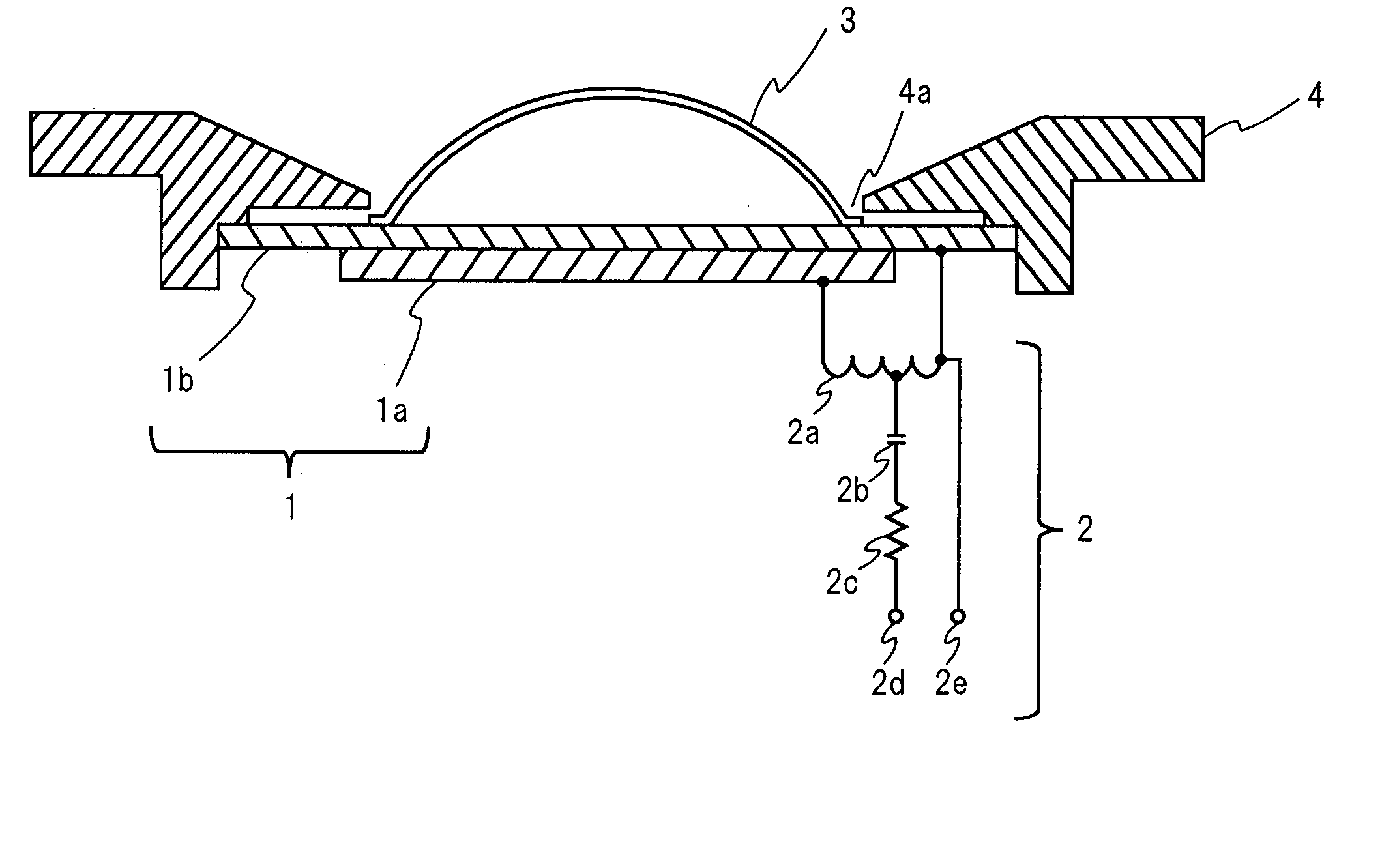
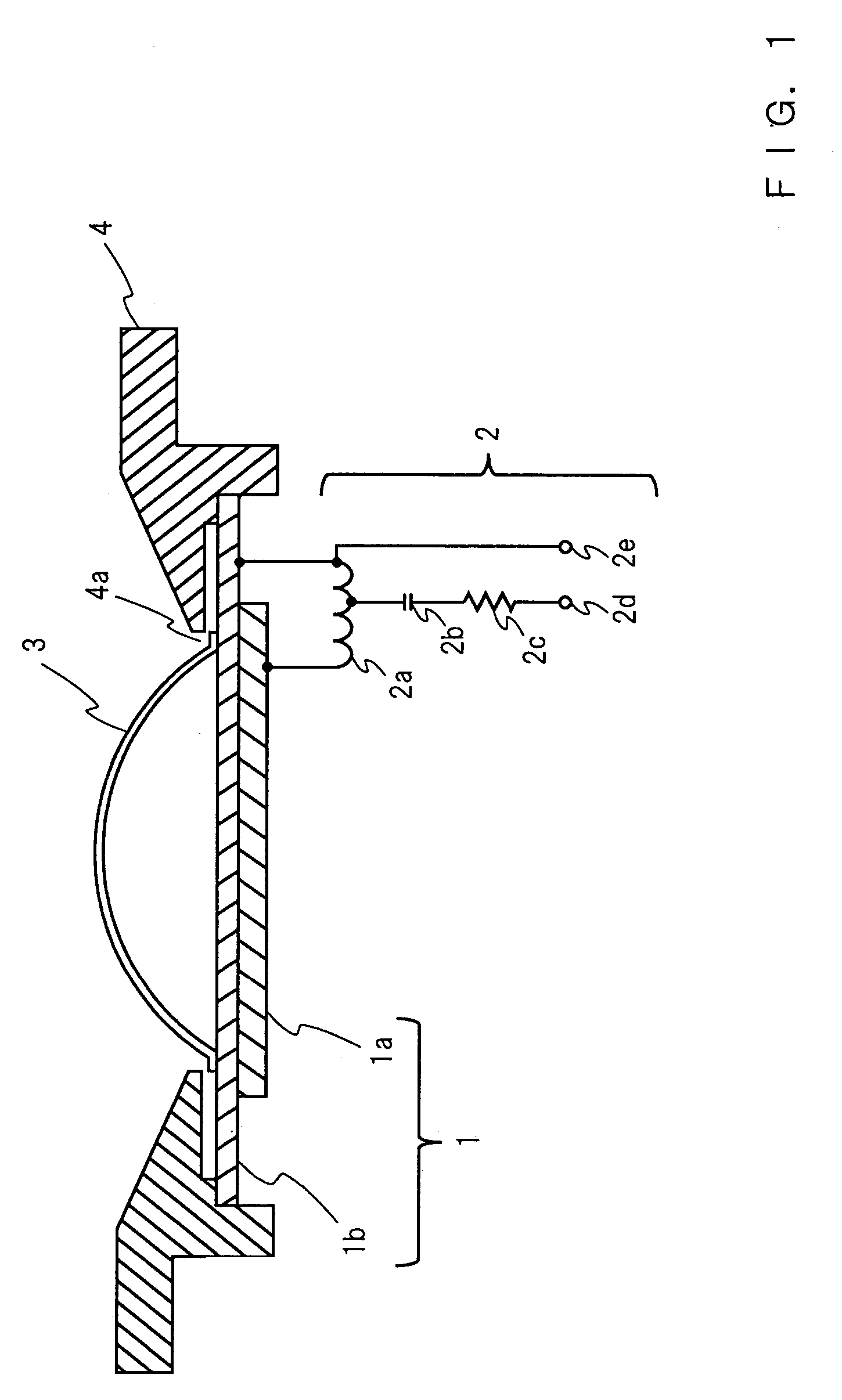
[0043]A speaker for reproducing ultrahigh frequencies in accordance with Embodiment 1 of the present invention will be described with reference to FIG. 1 to FIG. 12. FIG. 1 shows a structure of a speaker for reproducing ultrahigh frequencies in accordance with Embodiment 1. In FIG. 1, a numeral 1 shows a piezoelectric ceramic vibrator, a numeral 2 shows a voltage boosting circuit, a numeral 3 shows a dome-shaped diaphragm, and a numeral 4 shows a panel of a front face of a frame.
[0044]The piezoelectric ceramic vibrator 1 has a structure wherein a circular shaped piezoelectric ceramic 1a polarized in the through-thickness direction and a circular shaped metal substrate 1b are coaxially bonded. The piezoelectric ceramic 1a has 15 mm diameter and 0.2 mm thick. The piezoelectric ceramic 1a is an all-purpose circular shaped compact piezoelectric ceramic used very broadly. The metal substrate 1b is made of brass material and has 20 mm diameter and 0.15 mm thick. The metal substrate 1b has...
embodiment 2
[0079]A speaker for reproducing ultrahigh frequencies of Embodiment 2 in accordance with the present invention will be described with reference to FIG. 13.
[0080]A speaker for reproducing ultrahigh frequencies of Embodiment 2 has the same configuration as that of a speaker for reproducing ultrahigh frequencies of Embodiment 1 shown in FIG. 1. The detailed explanation thereof is omitted.
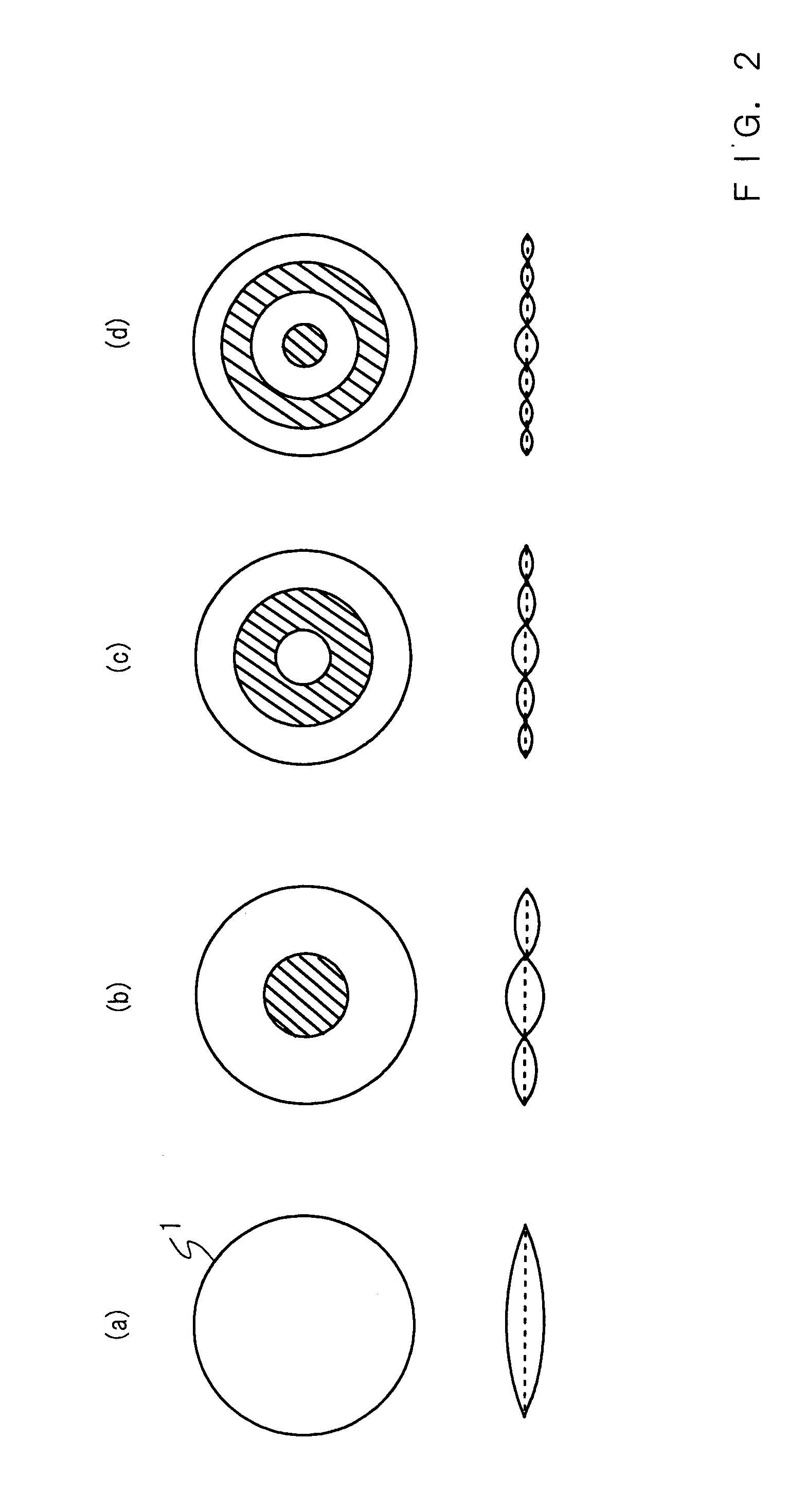
[0081]In Embodiment 1, the primary resonance frequency at high frequencies of the piezoelectric ceramic vibrator 1 is about 7 kHz, the secondary resonance frequency at high frequencies is about 25 kHz, the tertiary resonance frequency at high frequencies is about 50 kHz, and the primary resonance frequency at high frequencies of the dome-shaped diaphragm 3 is about 20 kHz.
[0082]In Embodiment 2, the primary resonance frequency at high frequencies of the dome-shaped diaphragm 3 is designed to be higher than the secondary resonance frequency at high frequencies of the piezoelectric ceramic vibrator 1. The...
PUM
| Property | Measurement | Unit |
|---|---|---|
| frequencies | aaaaa | aaaaa |
| thick | aaaaa | aaaaa |
| diameter | aaaaa | aaaaa |
Abstract
Description
Claims
Application Information
 Login to View More