Stress has been, and still is, a difficult thing to measure.
One difficulty in measuring stress comes directly from the lack of a concise definition for stress.
Another difficulty in measuring stress is in its diagnoses.
Stress is difficult to diagnose because it reveals itself by a
constellation of common symptoms with varying degrees of specificity.
Another difficulty is the complexity of the human stress response.
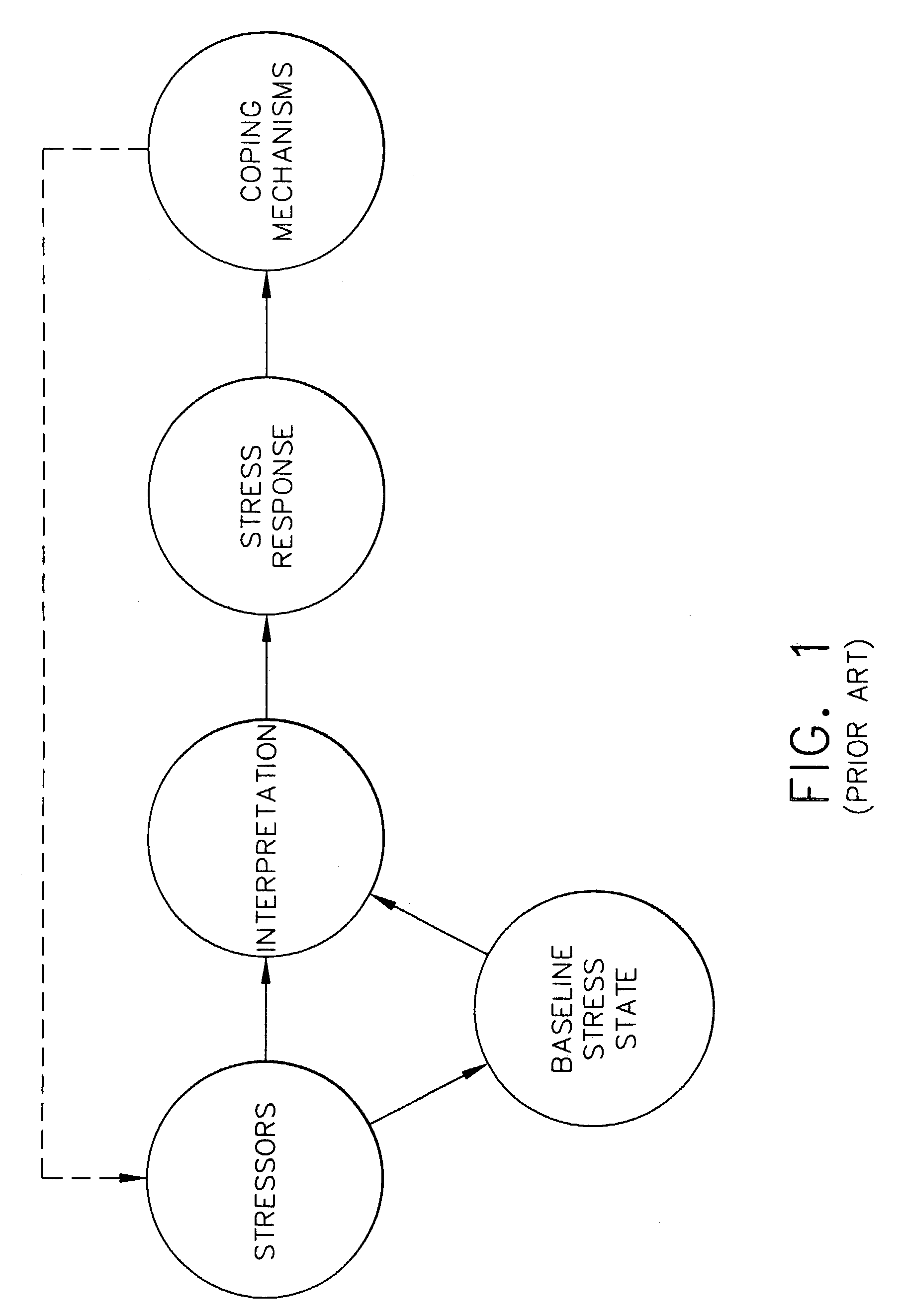
Stress has both psychological and physiological components; measuring only one component is insufficient to provide a complete understanding.
Aromatherapy has existed as folklore for centuries, but there has been very little rigorous scientific investigation of aromatheraputic effects on human psychology and
physiology.
(1) Aromatheraputic claims tend to be broad and ill-defined, using somewhat ambiguous words like soothing, harmonizing, happiness, sensuality, well being, etc.
(2) Stress is also somewhat ambiguous and ill-defined. There is no
standard definition of stress and, consequently, there are no widely accepted standards for measuring stress. One reason for this is that every person's psychological and physiological response to stress is different and can change over time.
(3) The magnitude of aromatheraputic effects is probably small, making them difficult to isolate.
(4) The mind-body connection is particularly strong here. There is much scientific evidence that a person's
physiological reaction to an odorant may depend on their psychological response to the odorant, i.e., whether or not the person likes the
odor.
(5) Animal studies by Buchbauer indicate that only specific varieties of essential oils—indeed, in some cases only specific enantiomers of fragrance molecules—produce an aromatheraputic effect. This could explain some of the contradictory findings in the scientific literature regarding
aromatherapy. A generic
lavender, for instance, might not contain the correct amounts, proportions, or
chemical species of the various components which are needed to produce an effect.
Unfortunately, this methodology is rather invasive (as would be blood or
urine samples), and is not desirable as it increases the test subject's stress and adds complexity to the measurements.
The adrenocorticol hormones are released in a secondary step, and have a
short life in acute stress, and further may not get released in sufficient amounts to be measured.
They are very difficult to measure in acute stress due to their short half-life.
However, one measurement is not determinative, and no one has found a relation between most of the above basic emotions and
blood pressure.
One of the failings of the majority of previous “stress-measuring” methodologies is that only one type of stress component was being evaluated: either physiological attributes or psychological attributes, but not both.
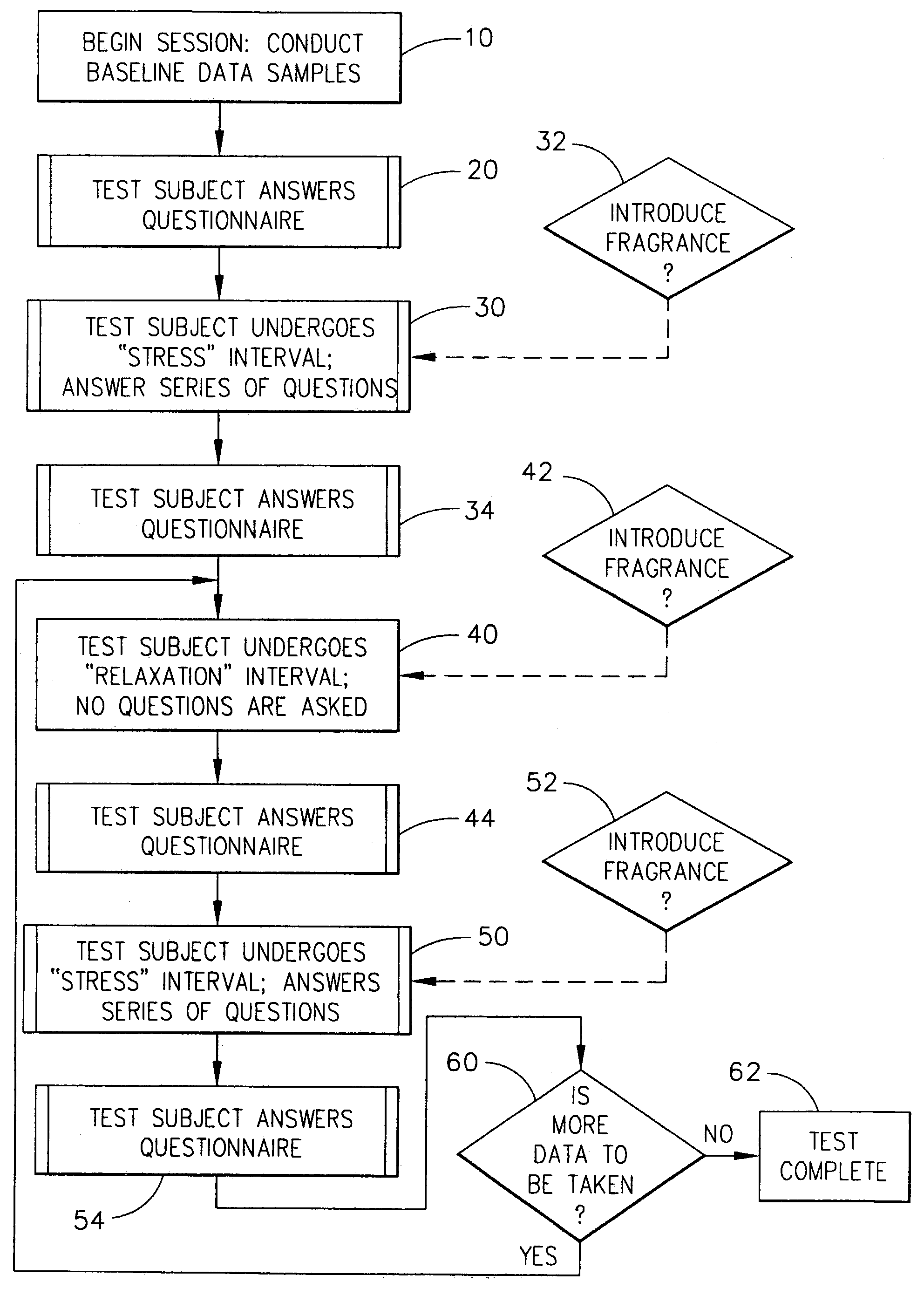
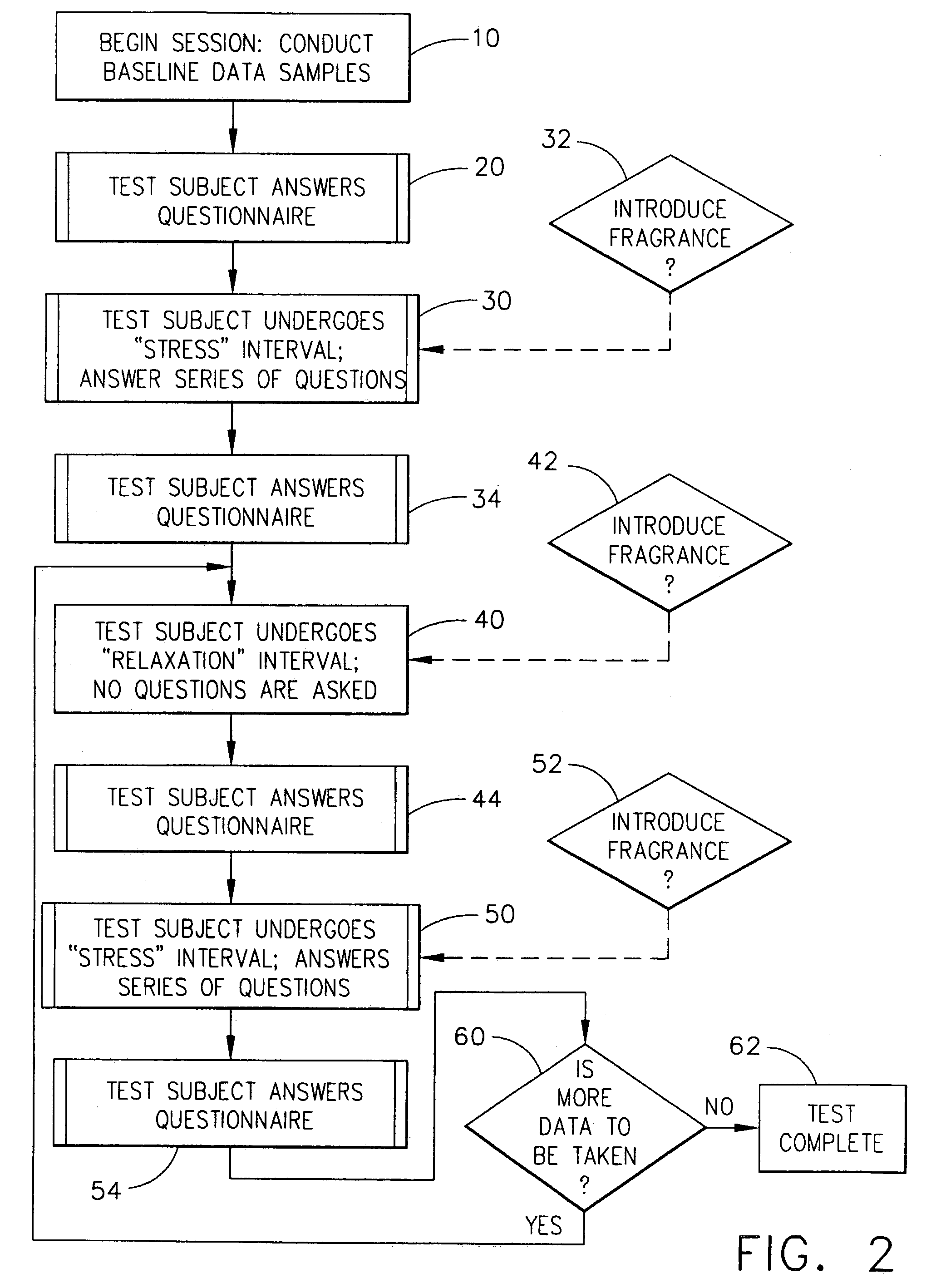
However, even this paper did not provide a methodology for measuring the effects of fragrances in both “stress” and “relaxation” cycles.
However, Vernet-Maury, et al. do not use these measurements to measure stress; instead, the measurements are used in an attempt to classify a subject's response to an odorant to one of the basic emotions (i.e., happiness, surprise, sadness, fear, disgust, or
anger).
This paper does not provide a methodology for evaluating stress, and also does not use odorants in “stress” and “relaxation” cycles.
The methodology described in this paper does not evaluate the effects of odorants during stress, and does not utilize “stress” and “relaxation” cycles.



 Login to View More
  Login to View More