[0030]As an auxiliary
advantage of the present invention, the organization which desires to incorporate an advertising or promotional message in place of all or portions of the ring-back, or even overlaying the message on the ring-back signal, of the telephone caller can quickly gather experience in how to provide
targeted advertising or promotional messages. Thus, for example, this organization can determine where and how much money would have to be expended in order to obtain a desired result from its publicity. Further, company data generated about buying patterns and
customer information could be quite valuable to any company attempting to target a particular marketing promotional message.
[0031]In a normal
telephone communication system, a caller initiating a
telephone call will initially generate a signal indicative of a call in process. The signal is transmitted to the central switching
station of the telephone recipient, and that central switching
station of the telephone recipient then generates the ringing signal so that the telephone recipient will recognize the presence of an awaiting telephone call. The second switching station transmits an out-of-band signal, as previously mentioned, on the SS7 line advising the first
telephone switching station to generate a ring-back signal to the caller. The first switching station will thereupon generate that ring-back signal.
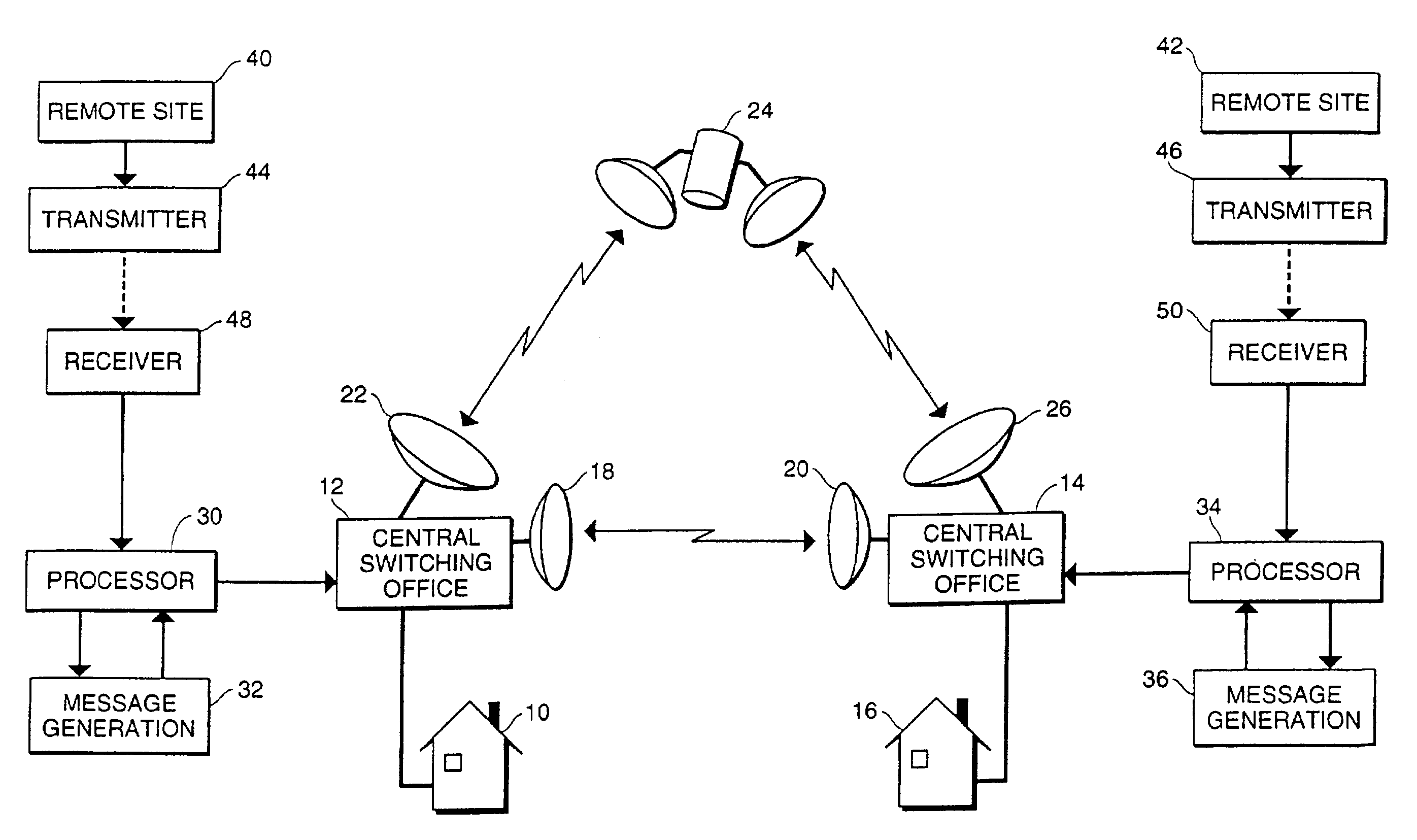
[0032]The system of the present invention utilizes that conventional switching arrangement and ringing signal and ring-back signal generation system. However, the system of the present invention can be broadly described as a telephone located at a first location, such as a telephone caller's location. A signal is generated to a central switching office associated with that telephone caller's location. The call in process and message or
data signal is then connected to an antenna or similar
transmitter via a
satellite to a receiving station. The signal at the receiving station is then sent to a second central switching office. Alternatively, the message received at the first central switching office from the initiating telephone call location can be transmitted terrestrially with the use of a transmitting antenna in combination with a receiving antenna located in proximity to the second central switching office.
[0033]A messaging device is connected to the second central switching office and a similar messaging device is connected to the first central switching office. The message to be delivered to the telephone caller is actually generated by the messaging device associated with the first central office switching station, although it could be generated at the second switching station, if preferred. Moreover, the telephone call from the caller is then sent to a telephone at a second location, such as a receiving location. The second central switching office generates a ringing signal for that second location, and also generates the out-of-band signal to cause generation of the ring-back signal. The second station, however, sends the data message to that first location, via the first switching station. However, this arrangement can be altered, if desired, so that the message generation could occur at the first switching station or the like.
[0034]In the meantime, in place of, or in addition to, the ringing signal, the first central switching office will cause a message, such as an advertising or promotional message from the second messaging device to be delivered, back through the telecommunication link, to the first central switching office and back to the telephone caller, as aforesaid. Thus, and in this way, the caller at the first location will hear the promotional or advertising message.
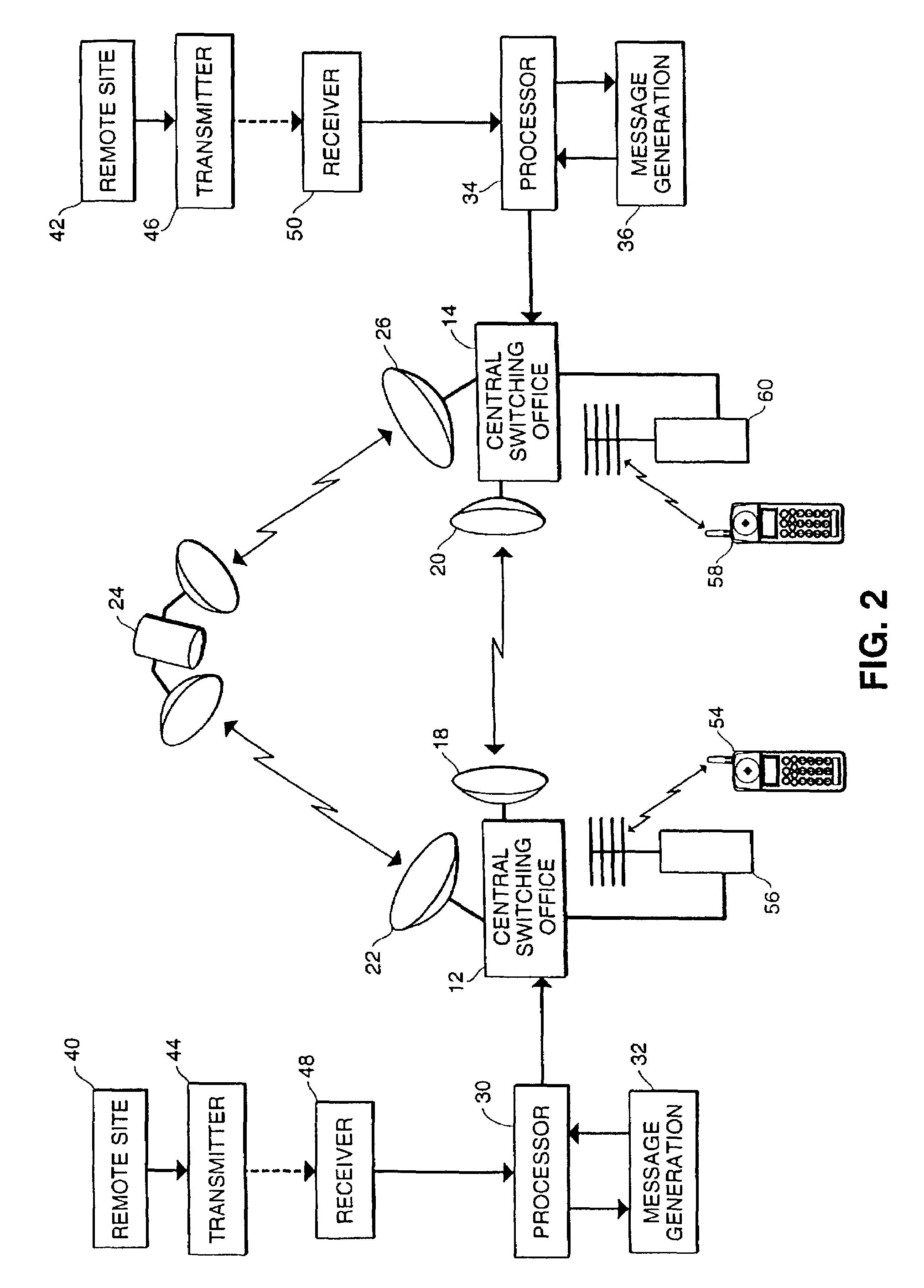
[0035]The present invention also provides a
telephone communication system similar to that previously described, except with cellular telephones. Thus, and in this case, the party initiating the telephone call may be using a
cellular telephone system, or otherwise, the recipient party receiving the call may be operating with a
cellular telephone system. In like manner, a caller using a hard-wired telephone could also access a receiving party using a
cellular telephone. A messaging device similar to that previously described would form part of or would be associated with the
telephone switching stations and the remainder of the system would be similar to that previously described.


 Login to View More
  Login to View More