
Printed circuit board test access point structures and method for making the same
a technology of access point structure and printed circuit board, which is applied in the direction of printed circuit testing, inspection/indentification of circuits, instruments, etc., can solve the problems of increasing difficulty in hitting reliably and repeatably, increasing difficulty in matching length and symmetries, so as to reduce the width of the trace at the test access point
- Summary
- Abstract
- Description
- Claims
- Application Information
AI Technical Summary
Benefits of technology
Problems solved by technology
Method used
Image

Examples
Embodiment Construction
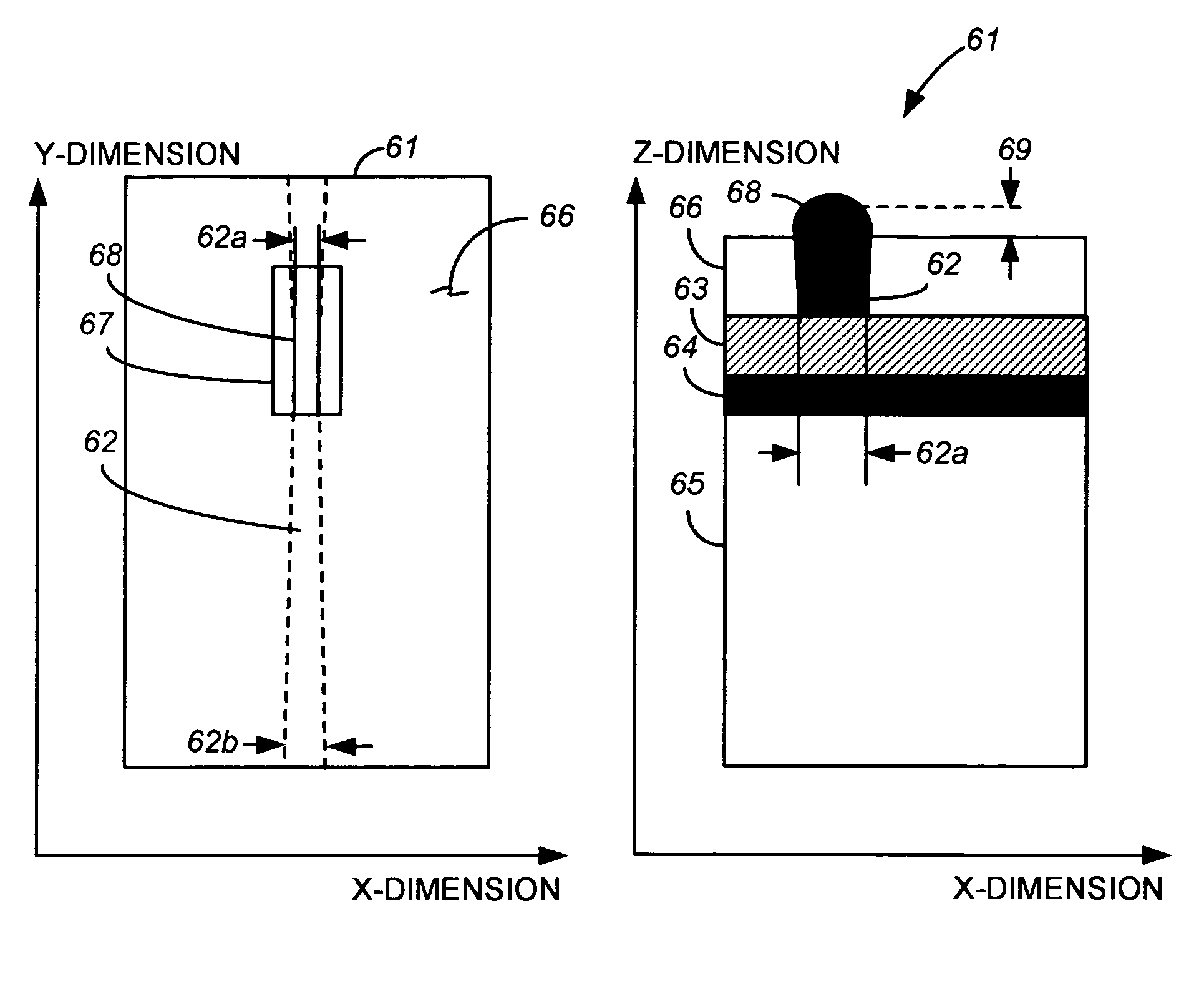
[0043]Turning now in detail to the invention, on a trace defined in an x-, y-, z-coordinate system where the x-dimension represents the trace width, the y-dimension represents the trace length, and the z-dimension represents the trace thickness, it will be recognized by those skilled in the art that present techniques for test access point placement on a printed circuit board utilize only the x- and y-dimensions. The present invention takes a different approach by taking advantage of the z-dimension, that is, the trace thickness. In this regard, the test access point structure of the invention is a localized “high point” on a printed circuit board trace that does not significantly perturb the impedance of the trace and that can be targeted with a probe.
[0044]FIGS. 3A-3C illustrate an exemplary embodiment of a test access point structure implemented in accordance with the invention. As shown in FIGS. 3A-3C, a printed circuit board 1 includes a substrate 5, a ground plane 4, and at le...
PUM
 Login to View More
 Abstract
Description
Claims
Application Information
 Login to View More