Method and system for implementing low overhead memory access in transpose operations

US7457937B1Active Publication Date: 2008-11-25NVIDIA CORP
22 Cites 1 Cited by

Patent Information

Authority / Receiving Office
US · United States
Current Assignee / Owner
Publication Date
2008-11-25

Smart Images

  • Figure 1
    Figure 1
  • Figure 2
    Figure 2
  • Figure 3
    Figure 3
Patent Text Reader

Abstract

Embodiments of the present invention recite a method and system for accessing data. In one embodiment of the present invention, a plurality of instances of data are stored in a memory device which comprises a plurality of memory modules disposed as an array of parallel columns. In response to receiving an indication that said plurality of instances of data is being accessed as a row of data, a first address translation table is accessed which describes the same row address in each of said plurality of memory modules wherein an instance of data is stored. Then, in response to receiving an indication that said plurality of instances of data is being accessed as a column of data, a second address translation table is accessed which describes a successive row address in each successive memory module wherein an instance of data is stored.
Need to check novelty before this filing date? Find Prior Art

Description

RELATED U.S. APPLICATION

[0001] This application claims priority to the co-pending Provisional Patent Application No. 60 / 651,830, entitled “METHOD AND SYSTEM FOR IMPLEMENTING LOW OVERHEAD MEMORY ACCESS IN TRANSPOSE OPERATIONS,” by Cheng et al., with filing date Feb. 9, 2005, and assigned to the assignee of the present application.FIELD OF THE INVENTION

[0002] Embodiments of the present invention relate to the field of computer memory devices.BACKGROUND OF THE INVENTION

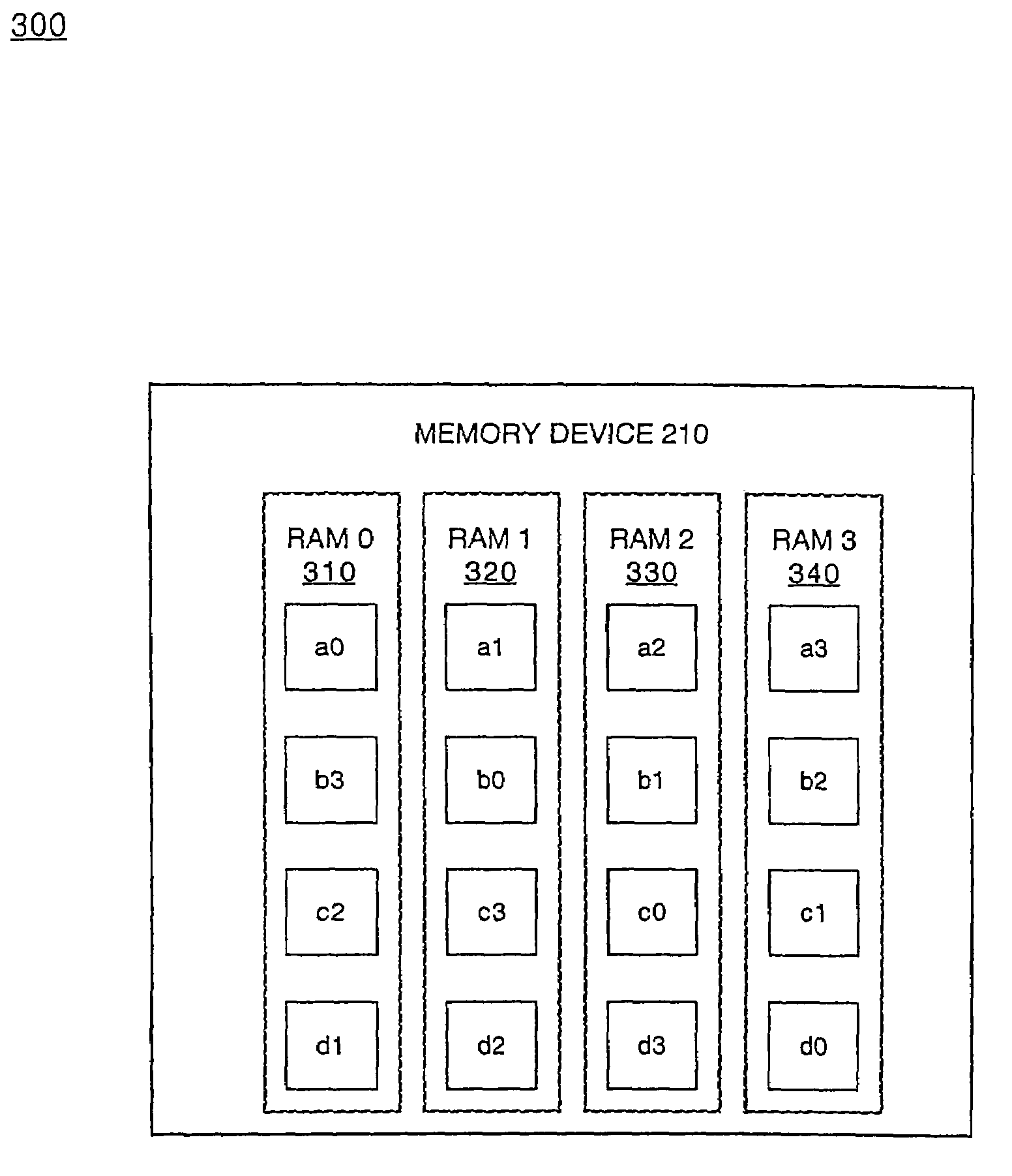
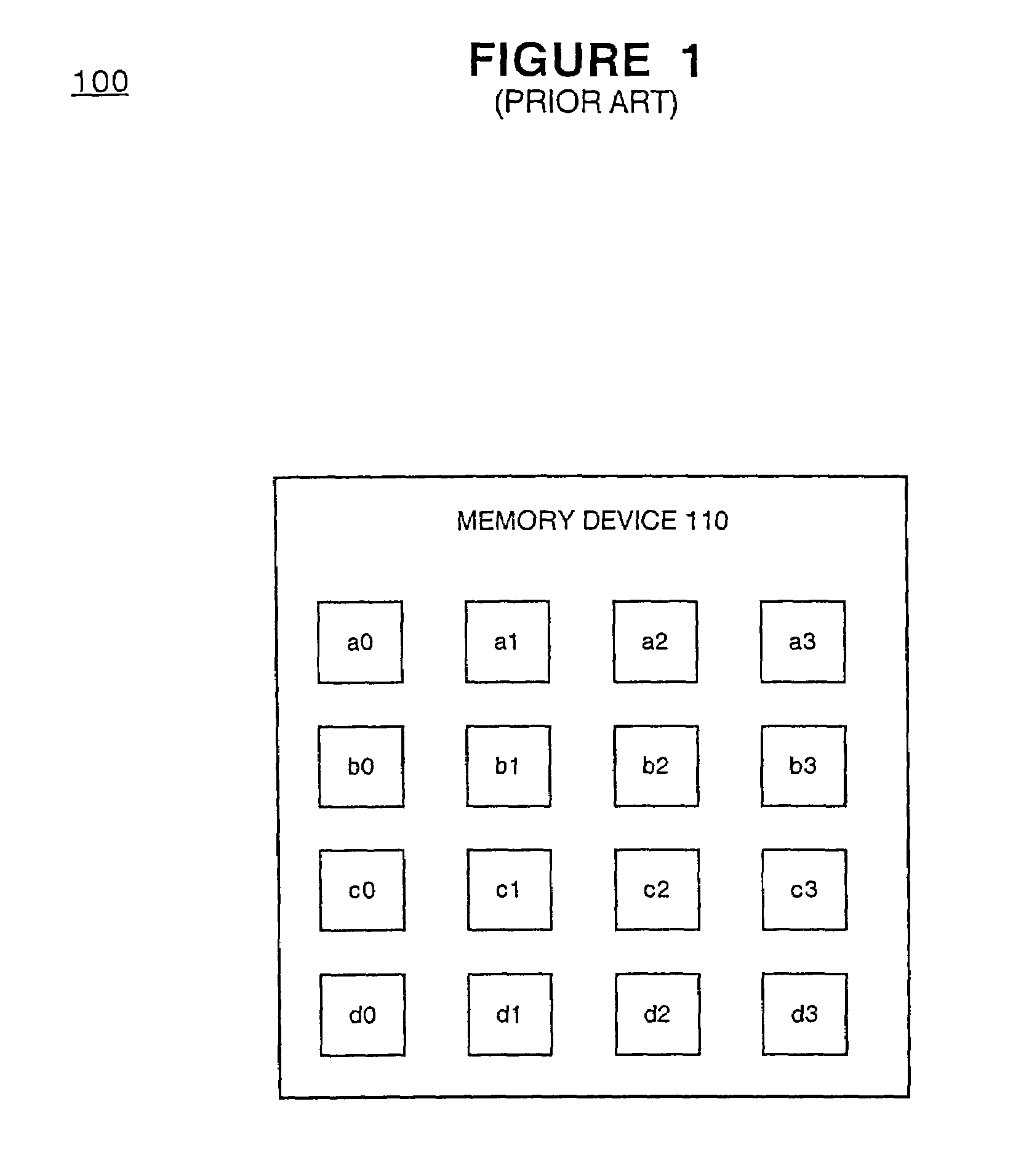
[0003] Computer memory devices typically arrange stored data in a two-dimensional matrix comprising rows and columns of data. For example, referring to FIG. 1, memory device 110 comprises a 4×4 matrix. In FIG. 1, rows of data are indicated by letters (e.g., a, b, c, and d) and columns of data are indicated by numbers (e.g., 0, 1, 2, and 3). To access a particular instance of data, an address translation table is accessed to determine the row and column locations of that particular instance of data (e.g., row b, column 1).[0...

Examples

Embodiment Construction

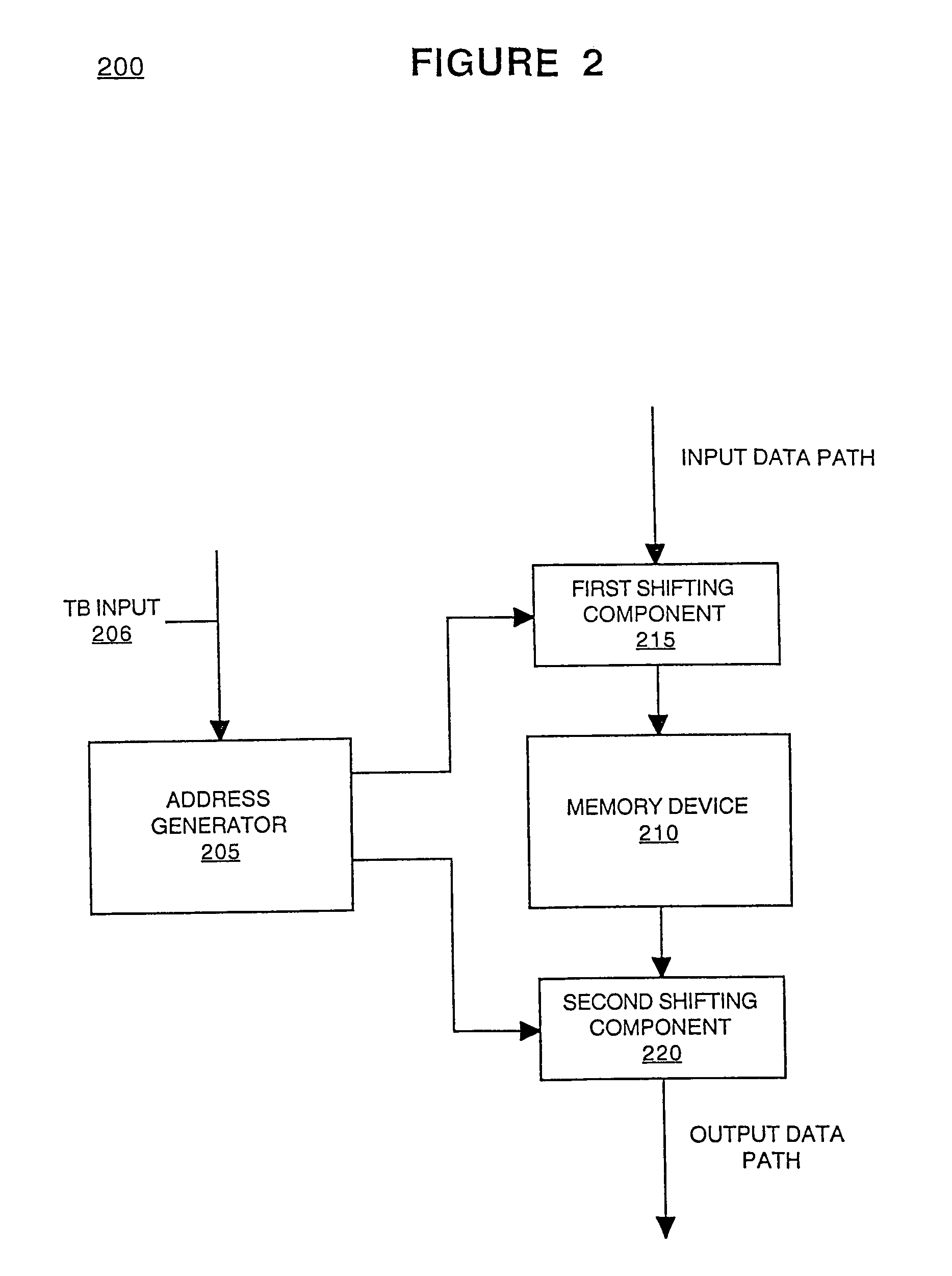
[0023]Reference will now be made in detail to embodiments of the present invention, examples of which are illustrated in the accompanying drawings. While the present invention will be described in conjunction with the following embodiments, it will be understood that they are not intended to limit the present invention to these embodiments alone. On the contrary, the present invention is intended to cover alternatives, modifications, and equivalents which may be included within the spirit and scope of the present invention as defined by the appended claims. Furthermore, in the following detailed description of the present invention, numerous specific details are set forth in order to provide a thorough understanding of the present invention. However, embodiments of the present invention may be practiced without these specific details. In other instances, well-known methods, procedures, components, and circuits have not been described in detail so as not to unnecessarily obscure aspe...