Unlock instant, AI-driven research and patent intelligence for your innovation.

Image recognition

a technology of image recognition and image, applied in the field of image recognition, can solve the problems of high error rate, increase in figures, and inability to achieve the level of accuracy required for many commercial and industrial applications

Inactive Publication Date: 2010-03-30
THE UNIV OF YORK
View PDF7 Cites 48 Cited by
  • Summary
  • Abstract
  • Description
  • Claims
  • Application Information

AI Technical Summary

Benefits of technology

[0008]Preferred embodiments of the present invention aim to provide me

Problems solved by technology

Despite significant advances in face recognition technology, it has yet to achieve the levels of accuracy required for many commercial and industrial applications.
Although some face recognition systems proclaim extremely low error rates in the test environment, these figures often increase when exposed to a real world scenario.
The reasons for these high error rates stem from a number of well-known sub-problems that have never been fully solved.
Face recognition systems are highly sensitive to the environmental circumstances under which images are captured.
Variation in lighting conditions, facial expression and orientation can all significantly increase error rates, making it necessary to maintain consistent image capture conditions between query and gallery images for the system to function adequately.
However, this approach eliminates some of the key advantages offered by face recognition: a passive biometric in the sense that it does not require subject co-operation.

Method used

the structure of the environmentally friendly knitted fabric provided by the present invention; figure 2 Flow chart of the yarn wrapping machine for environmentally friendly knitted fabrics and storage devices; image 3 Is the parameter map of the yarn covering machine
View more

Image

Smart Image Click on the blue labels to locate them in the text.
Viewing Examples
Smart Image
  • Image recognition
  • Image recognition
  • Image recognition

Examples

Experimental program
Comparison scheme
Effect test

Embodiment Construction

[0068]In the figures, like references denote like or corresponding parts.

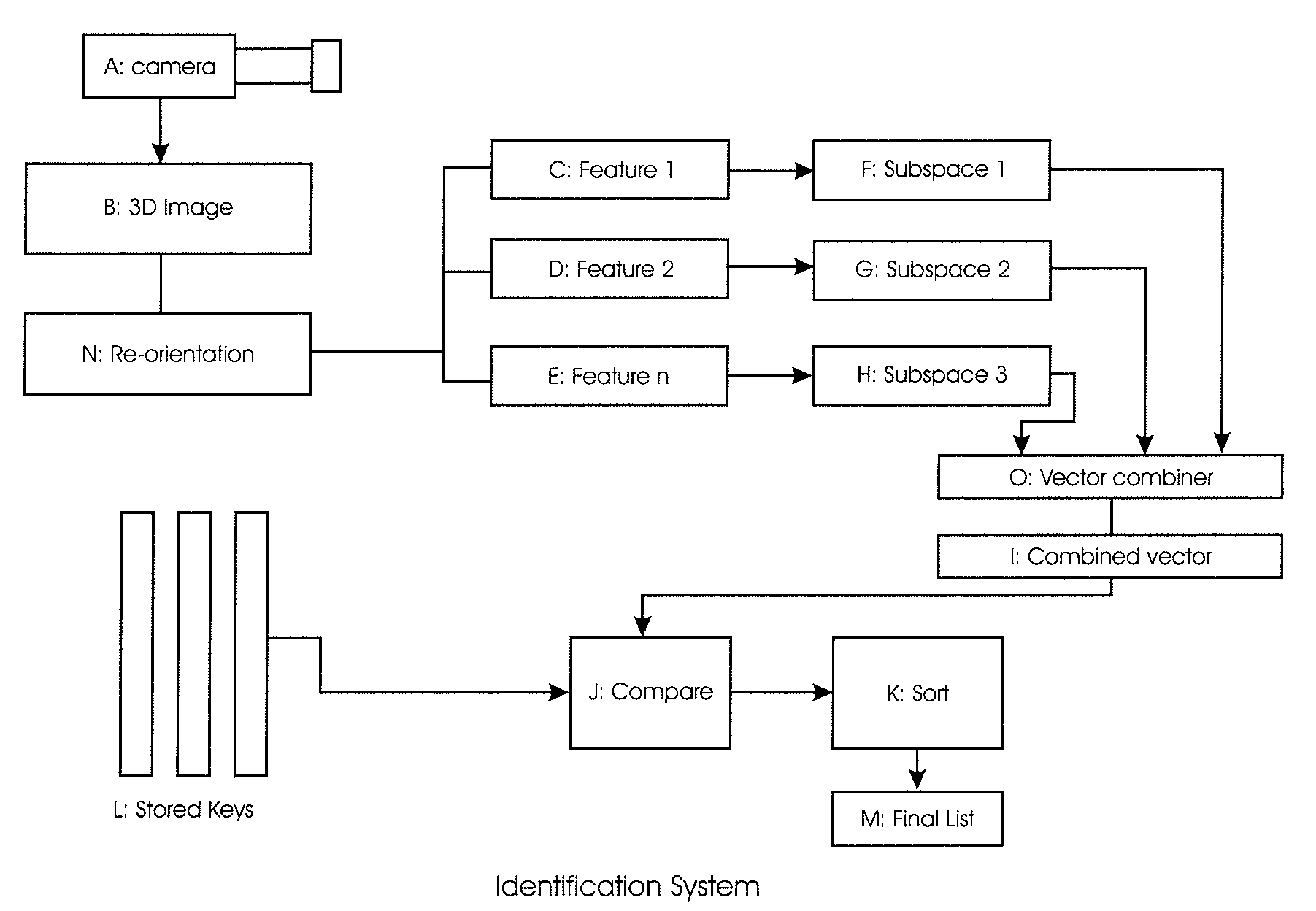
[0069]In FIG. 1, a camera A captures a 3D image of a face and transmits it to a processor B which generates a 3D depth image, together with a 2D texture image (colour or greyscale data). Preferably, the 3D and 2D data are registered with one another. At N, the image is rotated, scaled and repositioned—if necessary—to ensure that it faces front and is centred in the image space. (In general, it may be rotated to any predetermined angle of rotation, scaled at any predetermined depth and positioned at any predetermined position in the image space.)

[0070]At C, D and E, the image is processed in three respective, different ways to extract features from the face. Many different image processes may be adopted—e.g. edges, lines, wavelets, etc. Many image processes will be known to the skilled reader. One of the processes C, D and E could be a null process—i.e. the raw image is passed through from N. The feature extract...

the structure of the environmentally friendly knitted fabric provided by the present invention; figure 2 Flow chart of the yarn wrapping machine for environmentally friendly knitted fabrics and storage devices; image 3 Is the parameter map of the yarn covering machine
Login to View More

PUM

No PUM Login to View More

Abstract

A camera A produces a 3D natural image B which is re-oriented and repositioned at N to predetermined parameters. Different processes C, D, E extract different features from the image to provide different processed images. The data space occupied by the processed images is reduced, for example by Principle Component Analysis, at F, G, H and the reduced processed images are combined at O to provide an image key I representative of the image B. The image key I is compared at J with stored image keys L of known images, and the output comparison is sorted at K to produce a final list M of potential matches. In a verification process, just a single image key L may be compared. The processed images at C, D, E may alternatively be combined prior to a single subspace reduction and / or optimisation method. 2D data may be combined with or used instead of the 3D data.

Description

BACKGROUND OF THE INVENTION[0001]1. Field of the Invention[0002]This invention relates to the recognition of images and is concerned with the recognition of both natural and synthetic images.[0003]By “natural image” is meant an image of an object that occurs naturally—for example, an optical image such as a photograph, as well as images of other wavelengths—such as x-ray and infra-red, by way of example. The natural image may be recorded and / or subsequently processed by digital means, but is in contrast to an image—or image data—that is generated or synthesised by computer or other artificial means.[0004]2. Description of Related Art[0005]The recognition of natural images can be desirable for many reasons. For example, distinctive landscapes and buildings can be recognised, to assist in the identification of geographical locations. The recognition of human faces can be useful for identification and security purposes. The recognition of valuable animals such as racehorses may be very...

Claims

the structure of the environmentally friendly knitted fabric provided by the present invention; figure 2 Flow chart of the yarn wrapping machine for environmentally friendly knitted fabrics and storage devices; image 3 Is the parameter map of the yarn covering machine
Login to View More

Application Information

Patent Timeline
no application Login to View More
IPC IPC(8): G06K9/00G06K9/46
CPCG06K9/00221G06V40/16G06V10/42G06V10/20G06V10/10G06F18/00
Inventor AUSTIN, JAMESPEARS, NICHOLASHESELTINE, THOMAS
Owner THE UNIV OF YORK