Camera glare reduction system and method

a technology of glare reduction and camera, applied in the field of selective light transmitting and receiving systems and methods, can solve the problems of affecting the clarity of taken images, glare directly from the sun or by way of reflective objects, and the use of polarized filters does not protect well against glare emanating from most man-made light sources, so as to reduce unwanted glare and/or other light emission

a technology of glare reduction and camera, applied in the field of selective light transmitting and receiving systems and methods, can solve the problems of affecting the clarity of taken images, glare directly from the sun or by way of reflective objects, and the use of polarized filters does not protect well against glare emanating from most man-made light sources, so as to reduce unwanted glare and/or other light emission

US7729607B2Inactive Publication Date: 2010-06-01TECH4ALL

Image

Smart Image Click on the blue labels to locate them in the text.
Viewing Examples
Smart Image
  • Camera glare reduction system and method
  • Camera glare reduction system and method
  • Camera glare reduction system and method

Examples

Experimental program
Comparison scheme
Effect test

Embodiment Construction

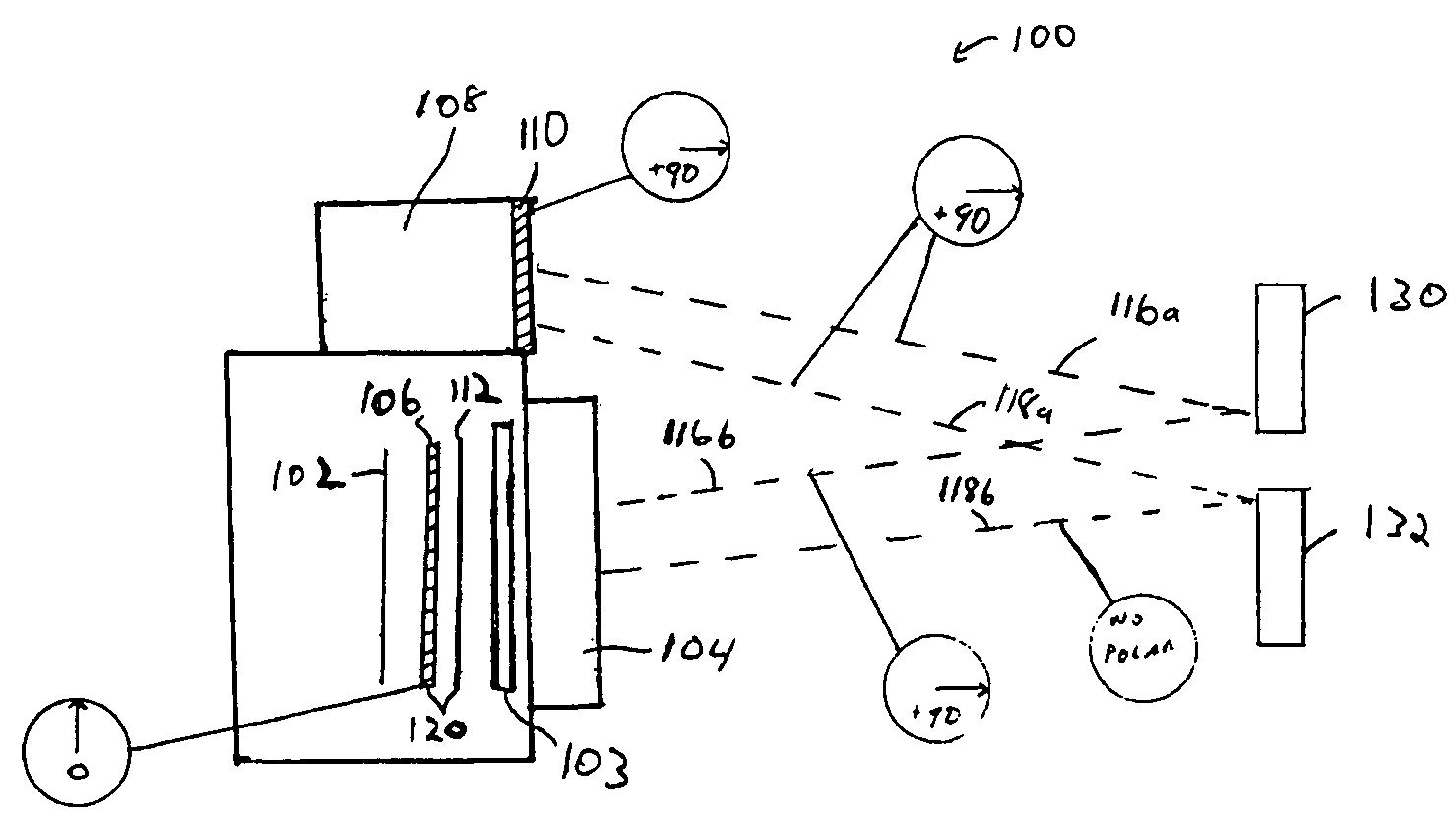
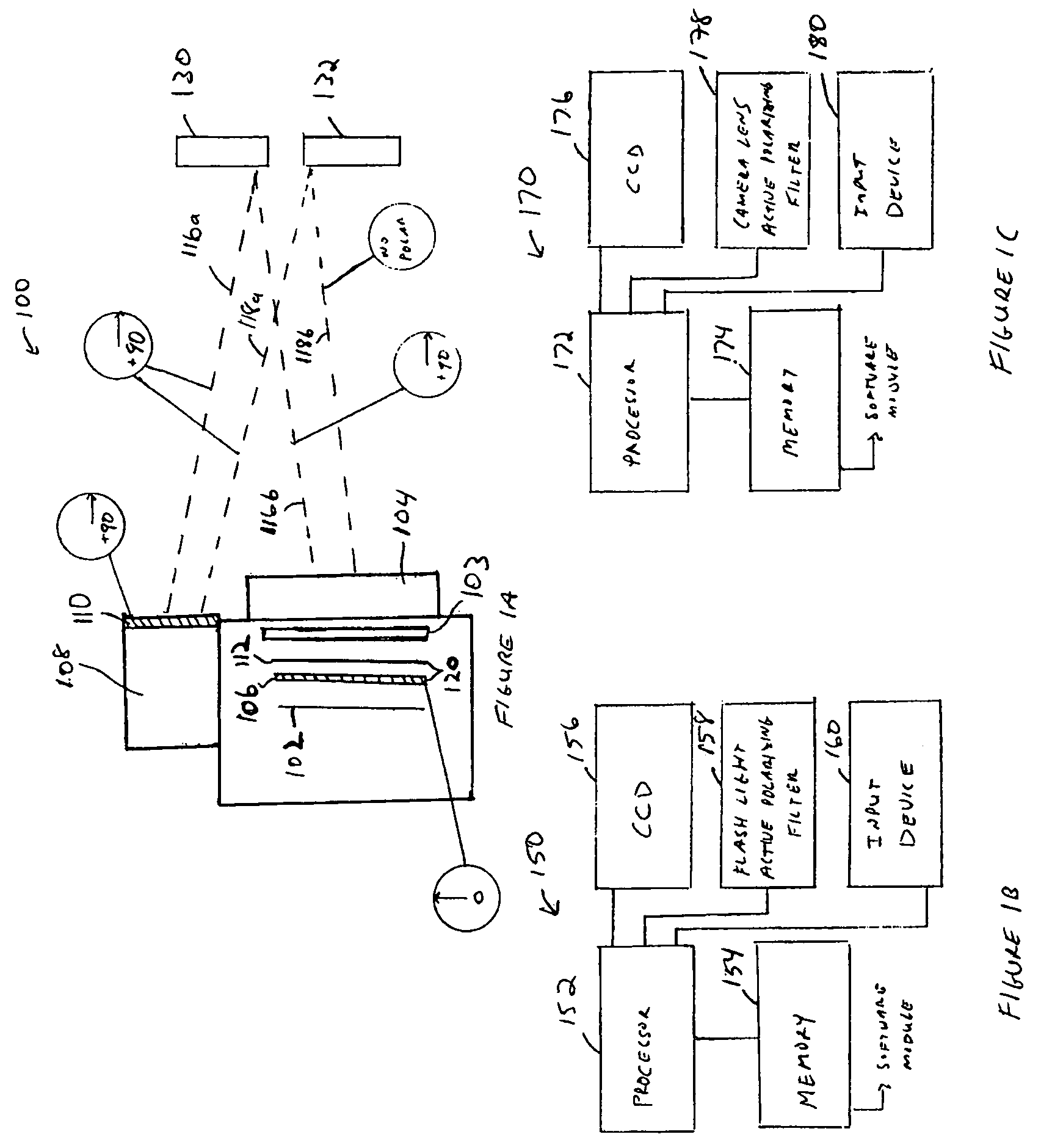
[0026]FIG. 1A illustrates a side view of an exemplary camera glare reduction system 100 in accordance with an embodiment of the invention. The camera glare reduction system 100 comprises an image-capturing device 102 (e.g., a film or a charged coupled device (CCD)), a shutter 103, a lens 104, a flash light source 108, a first polarized filter 110, and an active polarized filter 120. The active polarized filter 120 comprises a liquid crystal layer (LCL) 112 and a second polarized filter 106. The first polarized filter 110 polarizes the light emanating from the flash light source 108 in a substantially horizontal orientation (e.g., +90 degrees). The second polarized filter 106 has a substantially vertical (e.g., zero (0) degree) polarization. In combination with the second polarized filter 106, the LCL 112 selectively adjusts the effective polarization θ of the active polarized filter 120 by rotating the polarization of the incident light. In an exemplary embodiment, the effective pol...

the structure of the environmentally friendly knitted fabric provided by the present invention; figure 2 Flow chart of the yarn wrapping machine for environmentally friendly knitted fabrics and storage devices; image 3 Is the parameter map of the yarn covering machine
Login to View More

PUM

No PUM Login to View More

Abstract

Various image-capturing systems are disclosed that use polarized filters to reduce or control glare effects on captured images. In one embodiment, the system includes a light source, a first polarized filter adapted to polarize light emanating from the light source; a second polarized filter adapted to perform polarized filtering on received light; and an image-capturing device adapted to receive the filtered light. In another embodiment, the system further includes an actuator to selectively move any of the polarized filter into and out of the light path. In yet another embodiment, a method of forming a resultant image comprises recording a first image with a filter set to a first polarization angle, recording a second image with the filter set to a second polarization angle, and blending the first and second images. The recording of the first and second images may be performed simultaneously or at different times.

Description

FIELD OF THE INVENTION[0001]This invention relates generally to selective light transmitting and receiving systems and methods, and in particular, to a selective light transmitting and receiving system and method that use polarized filters to remove unwanted camera glare and / or other light emissions.BACKGROUND OF THE INVENTION[0002]Photography is an immensely popular activity. The works of professional still-picture photographers are illustrated everyday in newspapers, magazines, and advertisements, and the works of professional moving-picture photographers are present in television and films. Countless amateur photographers take pictures to capture many life's events. Further, with recent technological advances in cameras, along with accompanying price drops, even the most mundane activities and events are now recorded.[0003]An early problem encountered in photography was glare directly from the Sun or by way of reflective objects. A small portion of sunlight is polarized when it p...

Claims

the structure of the environmentally friendly knitted fabric provided by the present invention; figure 2 Flow chart of the yarn wrapping machine for environmentally friendly knitted fabrics and storage devices; image 3 Is the parameter map of the yarn covering machine
Login to View More

Application Information

Patent Timeline
01 Jun 2010
Publication
US7729607B2
IPC
G03B15/03; G03B7/099; H04N5/225
CPC
G03B15/03; G03B11/00
Inventors
KARIM, JOHN H.