Unlock instant, AI-driven research and patent intelligence for your innovation.

Tire forming mold

a technology of forming molds and tires, applied in the field of tire forming molds, can solve the problems of generating defective molding, affecting the quality of tire components, and difficult to discharge air in a place, so as to reduce the air resistance of laminated blades, shorten the diametrical distance of tires, and construct simple

Inactive Publication Date: 2011-01-25
TOYO TIRE & RUBBER CO LTD
View PDF5 Cites 11 Cited by
  • Summary
  • Abstract
  • Description
  • Claims
  • Application Information

AI Technical Summary

Benefits of technology

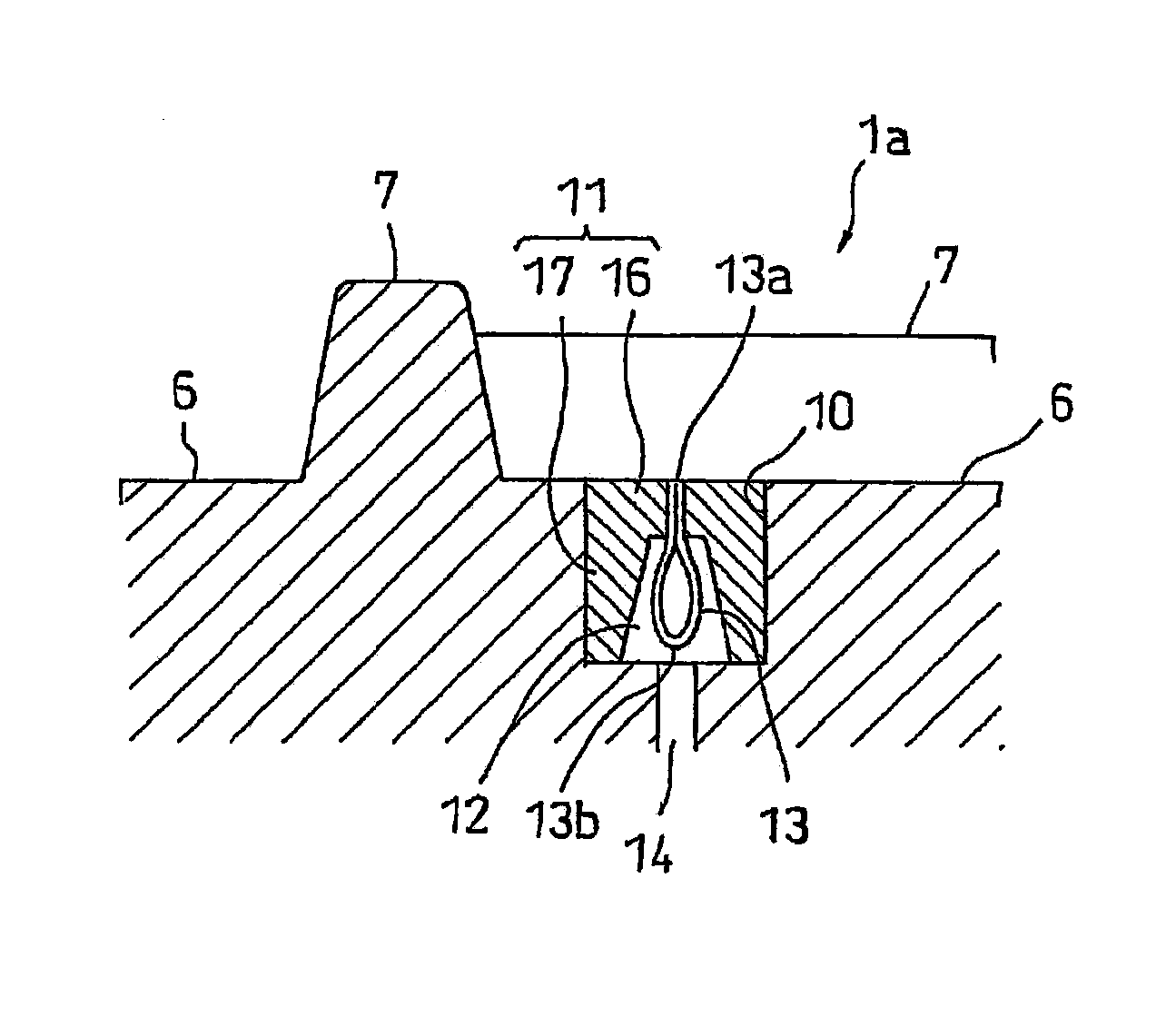
The present invention provides a tire forming mold that can efficiently and smoothly discharge air during the curing process of a tire. By using a laminated blade in the mold and a micro gap, air resistance is reduced and the air discharging effect is not affected by the position of the laminated blade. The mold also includes an exhaust hole that allows air to be discharged to the outer side of the mold, regardless of the position of the laminated blade. The mold is easy to set and regulate, and the air discharging effect is not affected by the arrangement of the laminated blade.

Problems solved by technology

At this time, air existing between the tread surface and the molding surface is compressed into the depression for forming the land portion, however, if the curing is carried out with the air left, there is a problem that a concave chip called as lightness is generated in the tread surface and a defective molding is generated.
However, since a lot of rubber projections called spew are formed in the tread surface, an ablating work is necessary and there is a problem that the dropout spew is mixed as a foreign material into the mold, which results in a defect.
However, in the case of using the laminated blade in which one end portion is exposed to the molding surface and the other end portion is exposed to a mold back face, such as the following patent document 1, since a tire diametrical distance in which the air moves within the micro gap becomes long and air resistance is increased, an air discharging effect may be obstructed, and thus there is room for further improving this.
On the other hand, if the gap of the laminated blade is enlarged in order to improve this, the rubber makes an intrusion into the gap, so that the same problem as that in a case where the vent hole is provided is generated.
Further, in the case of using a laminated blade in which a side end is exposed to the molding surface and an end portion is exposed to a mold split surface (for example, a split surface between segments) such as the following patent document 2, there is a tendency that it becomes hard to discharge the air in a place which is away from the mold split surface, and there is a defect that the air discharging effect depends on an arranged position of the laminated blade.
Further, since the laminated blade is directly embedded in the depression in both the following patent documents, a work for setting and regulating the micro gap is complicated.

Method used

the structure of the environmentally friendly knitted fabric provided by the present invention; figure 2 Flow chart of the yarn wrapping machine for environmentally friendly knitted fabrics and storage devices; image 3 Is the parameter map of the yarn covering machine
View more

Image

Smart Image Click on the blue labels to locate them in the text.
Viewing Examples
Smart Image
  • Tire forming mold
  • Tire forming mold
  • Tire forming mold

Examples

Experimental program
Comparison scheme
Effect test

Embodiment Construction

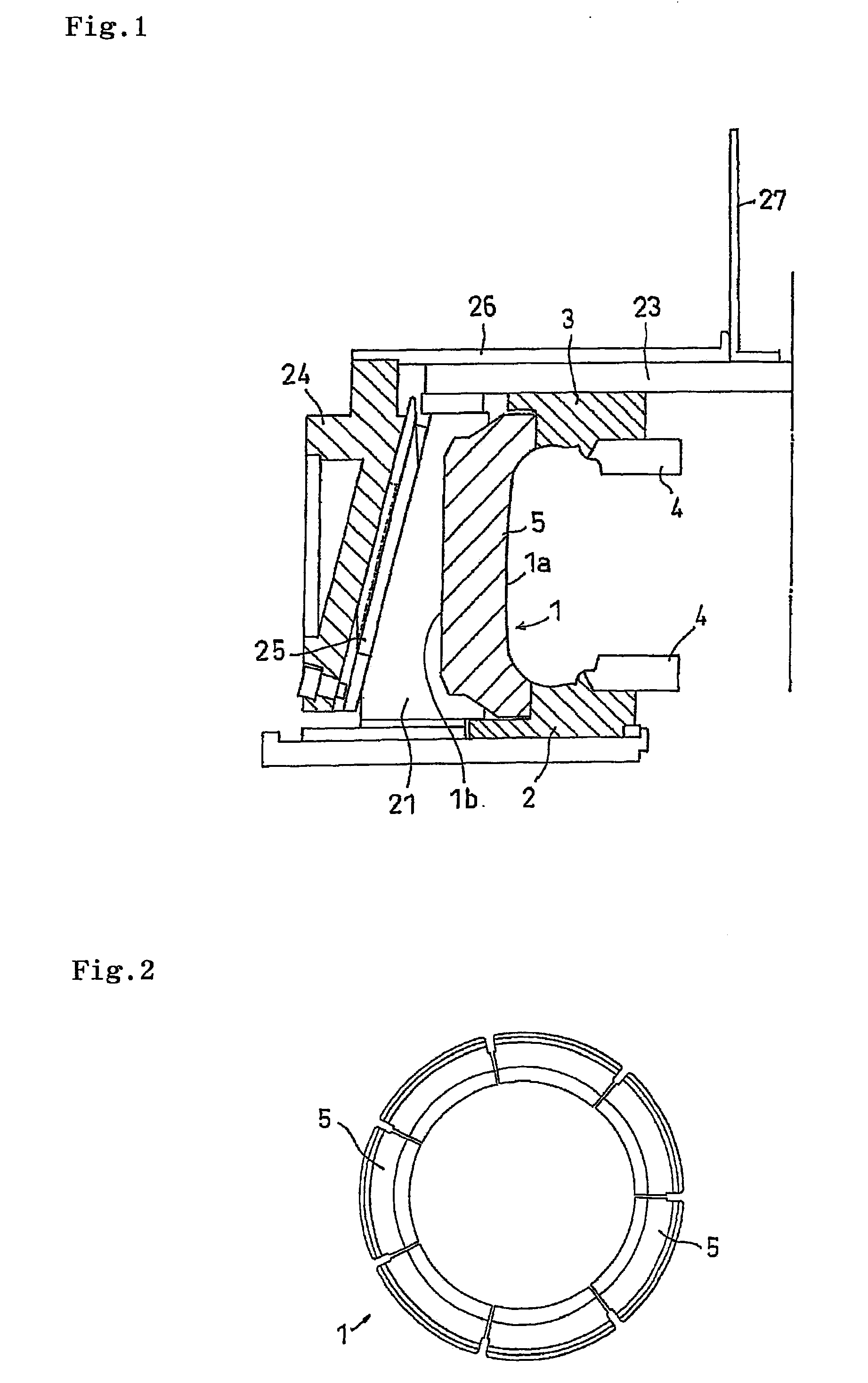
[0049]An embodiment of the present invention will be explained with reference to the drawings. FIG. 1 is a vertical cross sectional view showing an example of a tire forming mold in accordance with the present invention, and shows a mold clamping state. In FIG. 1, a green tire (not shown) is set in such a manner that a tire axial direction is arranged up and down, a right direction in FIG. 1 corresponds to an inner side in a tire diametrical direction, and a left direction in FIG. 1 corresponds to an outer side in the tire diametrical direction. In the present embodiment, there is shown an example in which the forming mold is of a segmented type.

[0050]The tire forming mold (hereinafter, often refer simply to as a forming mold) is provided with an annular mold portion 1 having the molding surface 1a brought into contact with a tread portion of the tire, a lower mold portion 2 with which a lower side wall portion comes into contact, and an upper mold portion 3 with which an upper side...

the structure of the environmentally friendly knitted fabric provided by the present invention; figure 2 Flow chart of the yarn wrapping machine for environmentally friendly knitted fabrics and storage devices; image 3 Is the parameter map of the yarn covering machine
Login to View More

PUM

PropertyMeasurementUnit
depthaaaaaaaaaa
depthaaaaaaaaaa
thicknessaaaaaaaaaa
Login to View More

Abstract

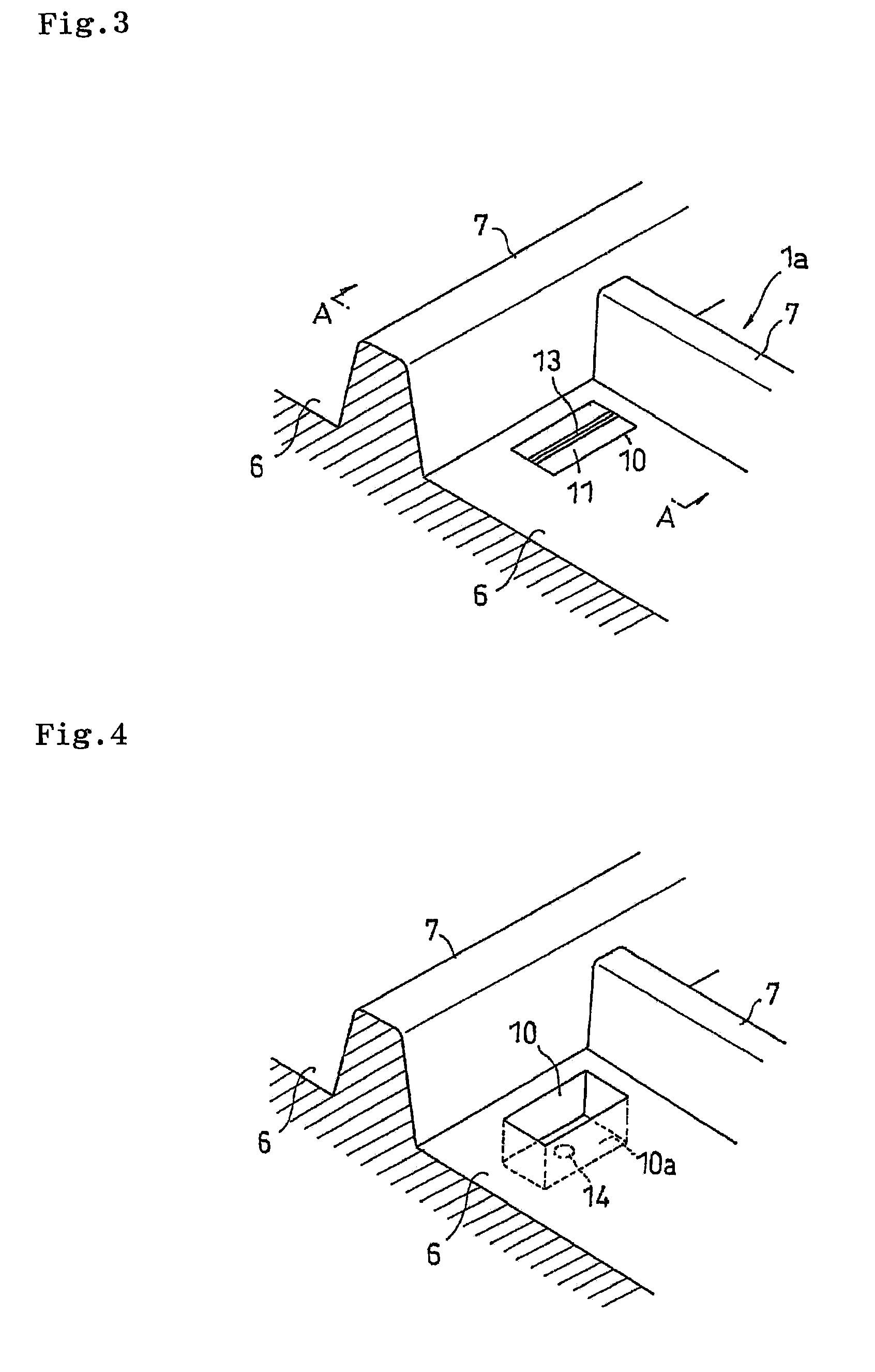
A tire forming mold in which a depression for forming a land portion of a tread surface is provided in a molding surface forming a tread pattern of a tire. The tire forming mold has a pocket provided in the depression, a block fitted into the pocket to form an exhaust chamber in an inner portion of the pocket and holding a laminated blade, which is formed by superposing thin plates, so that one end portion is exposed to the molding surface and the other end portion is exposed to the exhaust chamber, and an exhaust hole having one end portion is communicated with the exhaust chamber and the other end portion is communicated with a mold back face or a mold split face.

Description

TECHNICAL FIELD[0001]The present invention relates to a tire forming mold which is used for curing a tire and in which a depression for forming a land portion of a tread surface is provided in a molding surface forming a tread pattern of the tire.BACKGROUND ART[0002]Generally, at a time of curing the tire, the molding surface of the tire forming mold is pressed against the tread surface, and the tread pattern corresponding to a concavo-convex shape of the molding surface is formed. At this time, air existing between the tread surface and the molding surface is compressed into the depression for forming the land portion, however, if the curing is carried out with the air left, there is a problem that a concave chip called as lightness is generated in the tread surface and a defective molding is generated. Accordingly, it is important to suitably discharge the air compressed into the depression out of the mold.[0003]As a lightness countermeasure, it is general to employ a method of pi...

Claims

the structure of the environmentally friendly knitted fabric provided by the present invention; figure 2 Flow chart of the yarn wrapping machine for environmentally friendly knitted fabrics and storage devices; image 3 Is the parameter map of the yarn covering machine
Login to View More

Application Information

Patent Timeline
no application Login to View More
Patent Type & Authority Patents(United States)
IPC IPC(8): B29C33/10
CPCB29C33/10B29D30/0629B29D2030/0617Y10S425/812
Inventor OHARA, MASAAKI
Owner TOYO TIRE & RUBBER CO LTD