
Sulfonamide derivatives
a technology of sulphonamide and derivatives, applied in the field of sulphonamide derivatives, can solve the problems of progressive motor neuron failure, paralysis and death, abnormal cardiac rhythm, etc., and achieve the effects of improving metabolic profile, little affinity, and metabolic stability
- Summary
- Abstract
- Description
- Claims
- Application Information
AI Technical Summary
Benefits of technology
Problems solved by technology
Method used
Image

Examples
examples &
PREPARATIONS
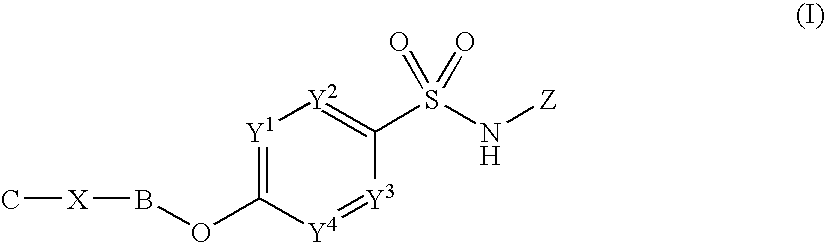
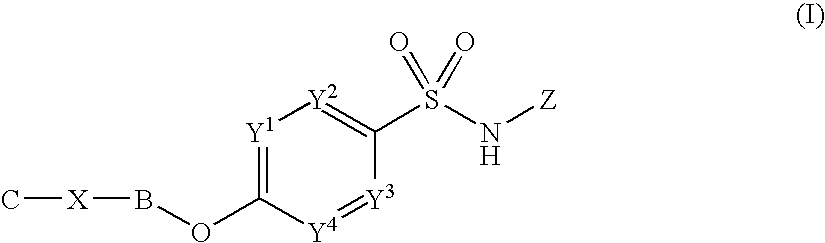
[0456]The following experimental details illustrate specifically how certain compounds of formula (I) may be prepared. All examples, unless indicated as a reference example, are compounds of formula (I). Preparations are intermediates useful in the synthesis of compounds of formula (I).
[0457]1H Nuclear magnetic resonance (NMR) spectra were in all cases consistent with the proposed structures. Characteristic chemical shifts (δ) are given in parts-per-million downfield from tetramethylsilane using conventional abbreviations for designation of major peaks: e.g. s, singlet; d, doublet; t, triplet; q, quartet; m, multiplet; br, broad.
[0458]The mass spectra (m / z) were recorded using either electrospray ionisation (ESI) or atmospheric pressure chemical ionisation (APCI). When relevant, and unless stated otherwise, the m / z data provided are for isotopes 19F, 35Cl and 79Br.
[0459]The following abbreviations have been used for common solvents: CDCl3, deuterochloroform; d5-DMSO, deu...
example 1
3-cyano-4-(4-fluoro-2-(1-methyl-1H-pyrazol-5-yl)phenoxy)-N-(1,2,4-thiadiazol-5-yl)benzenesulfonamide
[0533]
Method A
[0534]To a suspension of sodium hydride (60% dispersion in oil, 0.062 g) in N,N-dimethylformamide (5 mL) was added 4-fluoro-2-(1-methyl-1H-pyrazol-5-yl)phenol (Preparation 88A, 0.072 g, 0.00037 mol). This was stirred at room temperature for 10 minutes. To this mixture was added 3-cyano-4-fluoro-N-(1,2,4-thiadiazol-5-yl)benzenesulfonamide (Preparation 65, 0.103 g, 0.000362 mol) and the resulting mixture was stirred for 3 hours. The reaction was quenched with 1N HCl (aq) and extracted twice with ethyl acetate. The combined organic layers were dried over sodium sulfate, filtered, and concentrated in vacuo. The resulting residue was purified by flash column chromatography using a gradient of 0-10% methanol in CH2Cl2 to give the title compound as a white solid. LCMS Rt=1.50 minutes MS m / z 457.0 [MH]+
example 2
2-fluoro-4-(2-(2-methylthiazol-4-yl)phenoxy)-N-(thiazol-2-yl)benzenesulfonamide)
[0535]
Method B
[0536]To a suspension of sodium hydride (60% dispersion in oil, 0.0260 g) in N,N-dimethylformamide (5 mL) was added 2-(2-methylthiazol-4-yl)phenol (0.0830 g, 0.000434 mol). This was stirred at 20° C. for 10 minutes and then cooled to 5° C. in an ice water bath. To this mixture was added N-tert-butyl-2,4-difluoro-N-(thiazol-2-yl)benzenesulfonamide (Preparation 62, 0.151 g, 0.000454 mol) and the reaction was allowed to slowly warm to room temperature. After stirring for 16 hours, the reaction was quenched with water and extracted twice with ethyl acetate. The combined organic layers were dried over sodium sulphate, filtered, and concentrated in vacuo. The resulting residue was purified by flash column chromatography. The purified product was dissolved in methylene chloride (15 mL) and treated with trifluoroacetic acid (5 mL, 0.06 mol). After stirring for 30 minutes, the reaction was concentra...
PUM
| Property | Measurement | Unit |
|---|---|---|
| pharmaceutical composition | aaaaa | aaaaa |
Abstract
Description
Claims
Application Information
 Login to View More