
Low friction seed meter
a seed meter and low friction technology, applied in the field of low friction seed meter, can solve the problems of reducing crop production, affecting the growth of crops, and affecting the development of crops, so as to reduce the amount of energy required, accurate and accurate seed placement, and reduce the effect of energy consumption
- Summary
- Abstract
- Description
- Claims
- Application Information
AI Technical Summary
Benefits of technology
Problems solved by technology
Method used
Image

Examples
Embodiment Construction
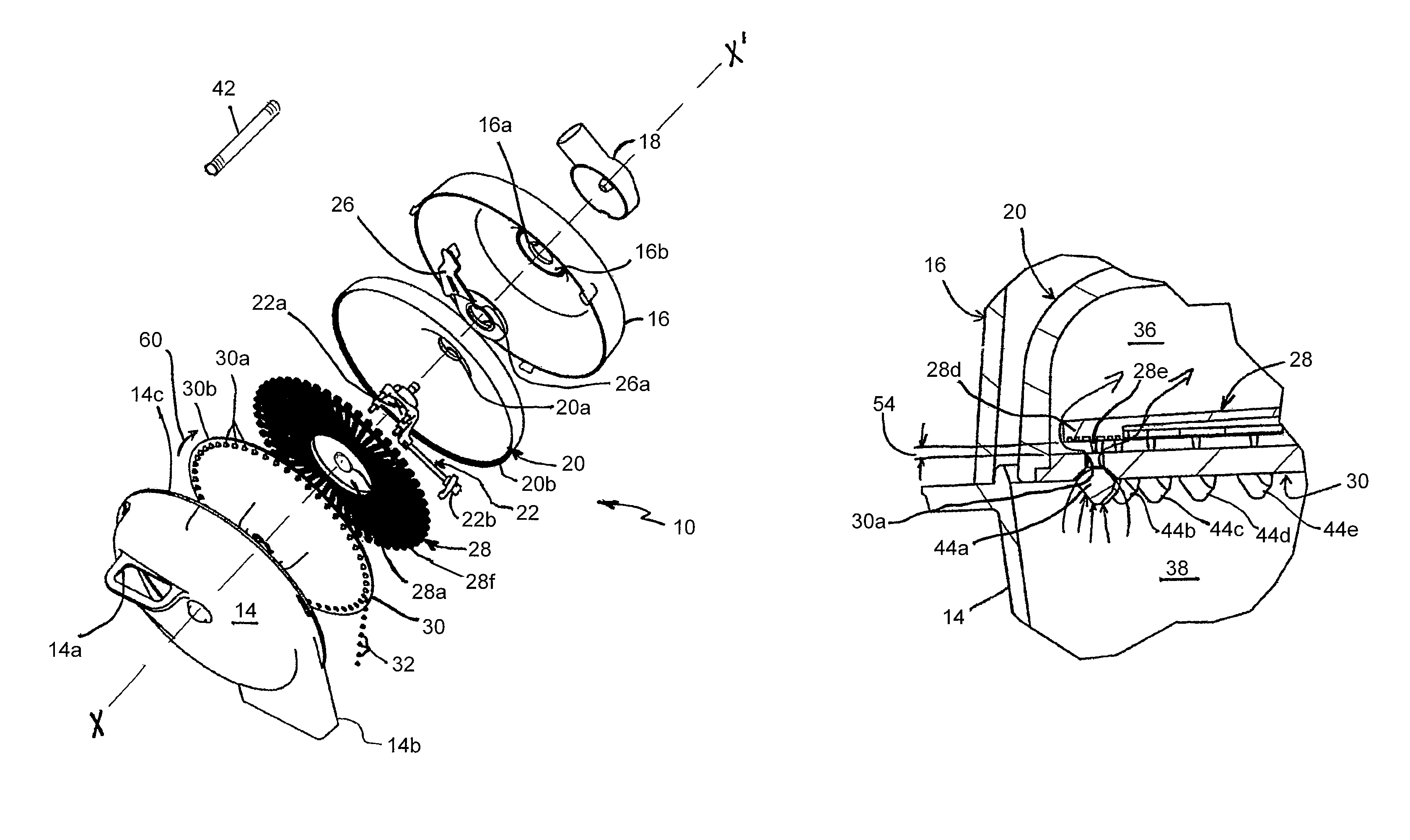
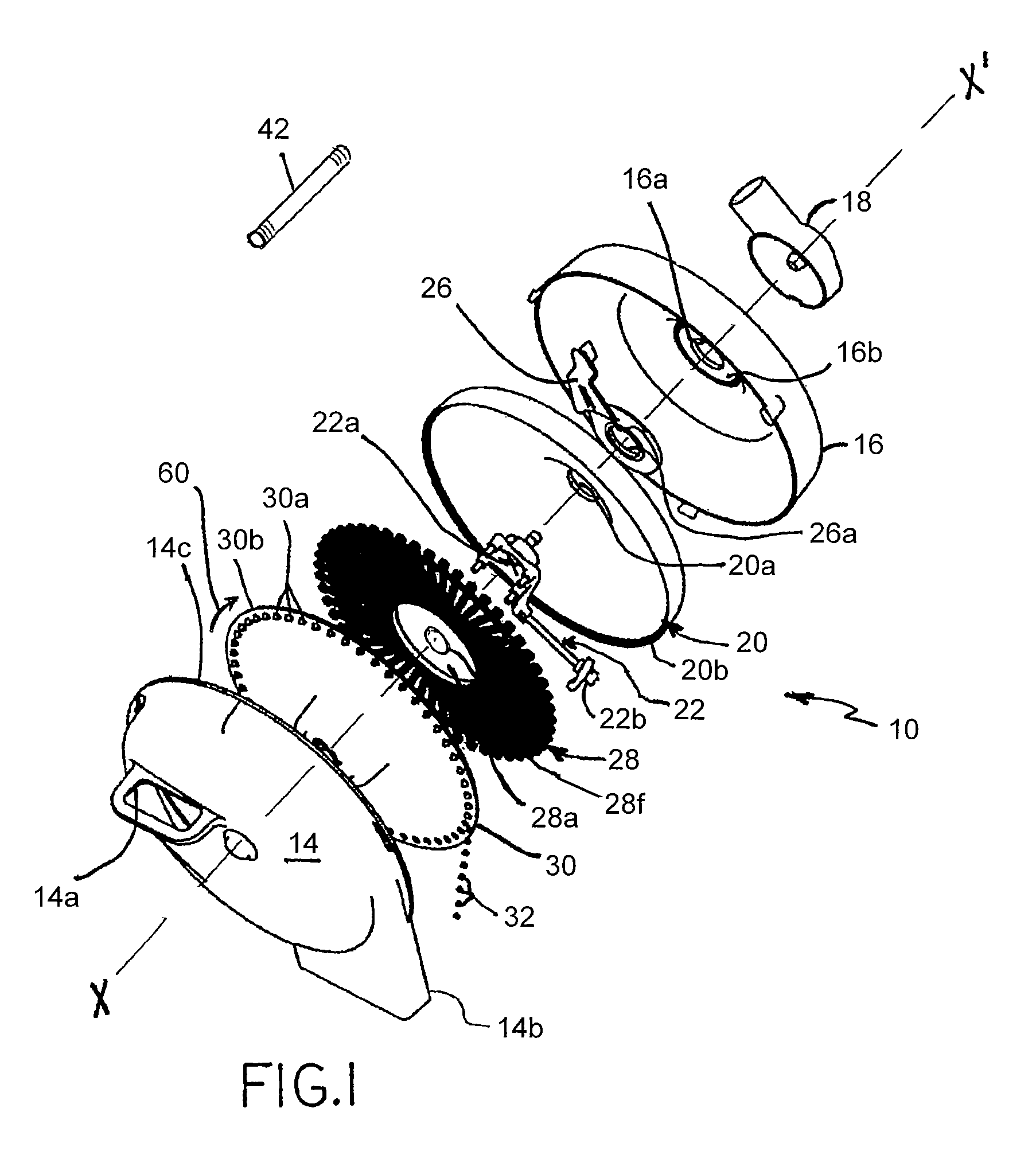
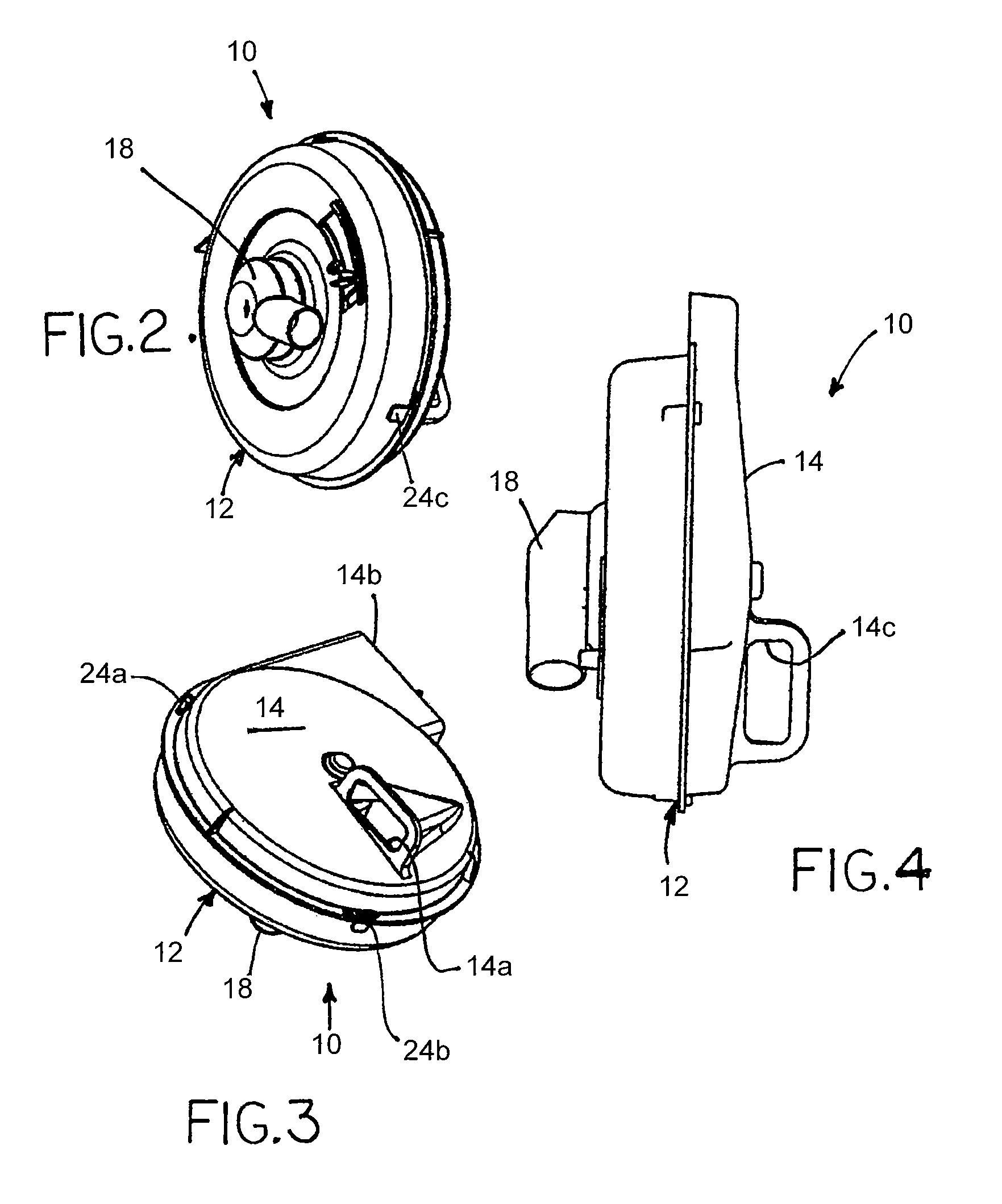
[0019]Referring to FIG. 1, there is shown an exploded perspective view of a low friction seed meter 10 in accordance with the principles of the present invention. Low friction seed meter 10 includes an outer, closed housing 12 comprised of a seed hopper 14 and an outer cover 16. First and second perspective views of the closed housing 12 are shown in FIGS. 2 and 3, while a side elevation view of the closed housing is shown in FIG. 4.
[0020]Seed hopper 14 and outer cover 16 are securely coupled together by means of plural connecting clips, three of which are shown as elements 24a, 24b and 24c in FIGS. 2 and 3. A closed end of the outer cover 16 includes a center aperture 16a. The outer surface of outer cover 16 is adapted for attachment to a vacuum inlet 18 by means of a rotary seal 16b disposed about the aperture 16a in the outer cover. Rotary seal 16b provides a vacuum-tight seal between outer cover 16 and vacuum inlet 18, which is connected to a conventional vacuum source (which is...
PUM
 Login to View More
 Abstract
Description
Claims
Application Information
 Login to View More