Customized grouping of participants in real-time conference set-up
Active Publication Date: 2012-07-31
SPRINT SPECTRUM LLC
View PDF8 Cites 29 Cited by
Summary
Abstract
Description
Claims
Application Information
AI Technical Summary
This helps you quickly interpret patents by identifying the three key elements:
Problems solved by technology
Method used
Benefits of technology
Benefits of technology
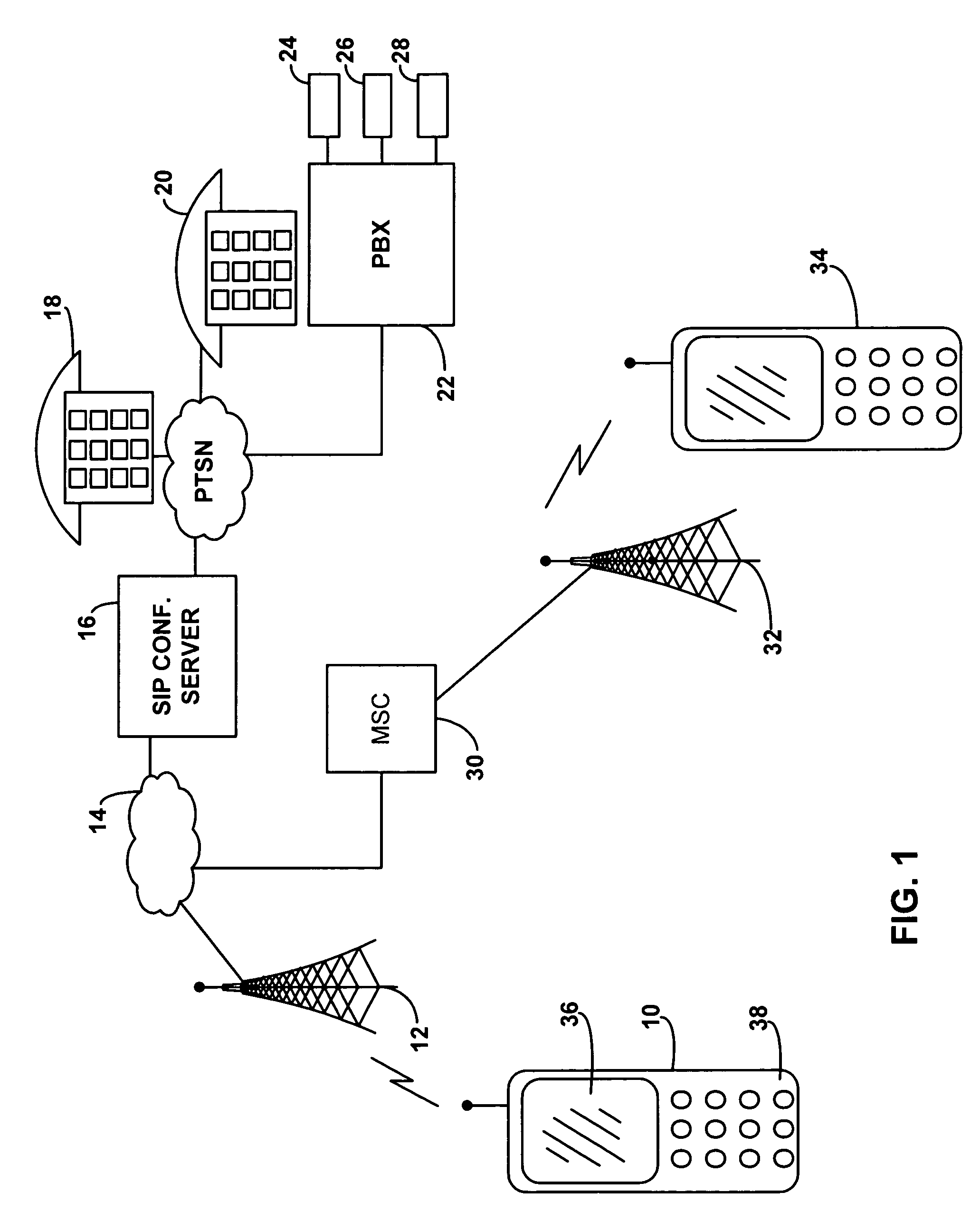
[0005]The present invention is related to methods and apparatus for initiating a real-time conference between a telephone device operated by conference initiator and one or more remotely-located participants. As noted earlier, the present invention provides more convenient methods for gro
Problems solved by technology
In current practice, there is no way to de-select a few (e.g., one or two) members from the conference group list for a particular session, without permanently deleting them from the group.
This process becomes quite cumbersome if the group is a large one.
The art has lacked a more flexible method for customized grouping of conference participants.
Method used
the structure of the environmentally friendly knitted fabric provided by the present invention; figure 2 Flow chart of the yarn wrapping machine for environmentally friendly knitted fabrics and storage devices; image 3 Is the parameter map of the yarn covering machine
View more
Image
Smart Image Click on the blue labels to locate them in the text.
Viewing Examples
Smart Image
Click on the blue label to locate the original text in one second.
Reading with bidirectional positioning of images and text.
Smart Image
Examples
Experimental program
Comparison scheme
Effect test
first embodiment
Exclusion Lists (FIGS. 2-4)
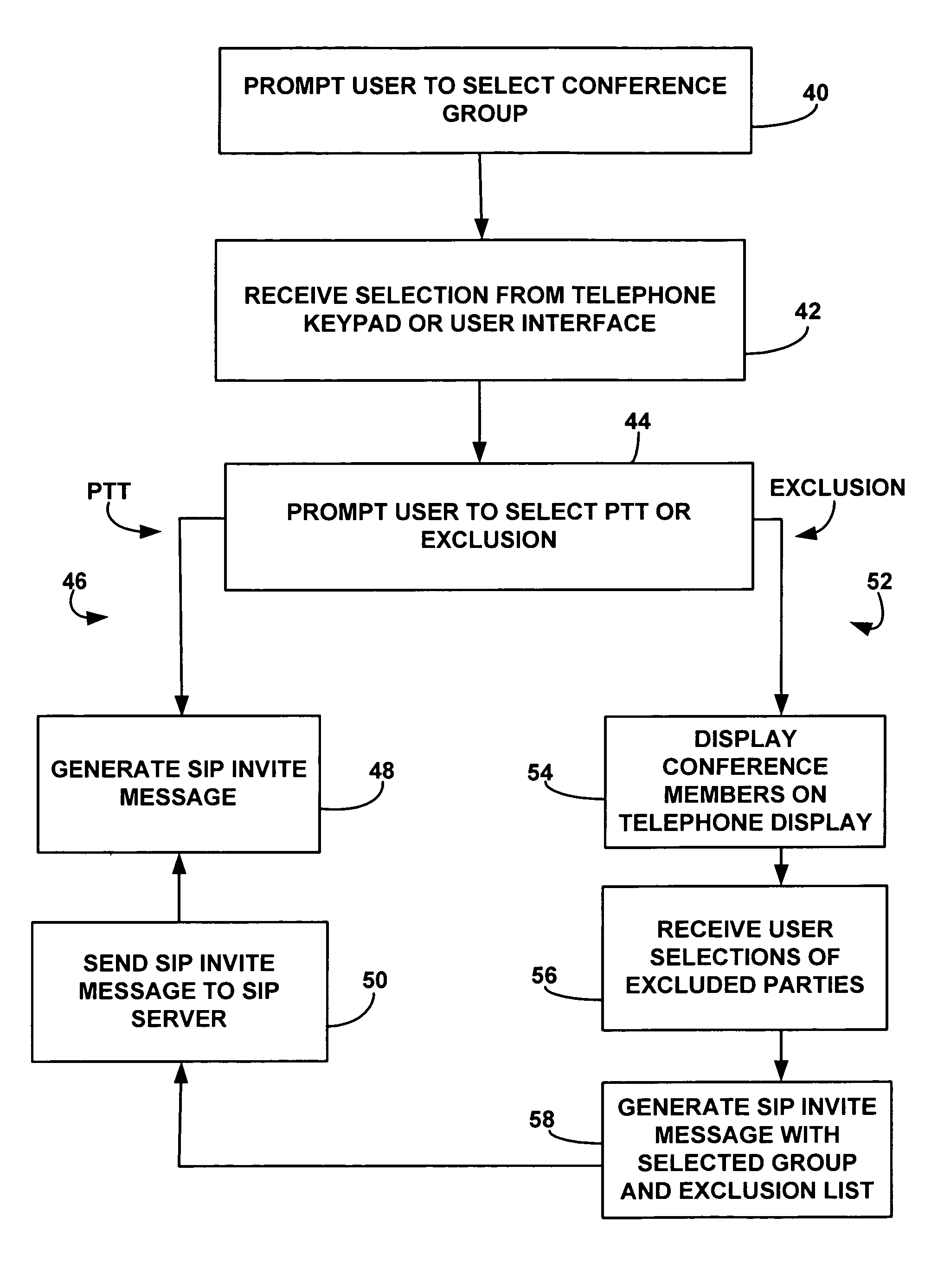
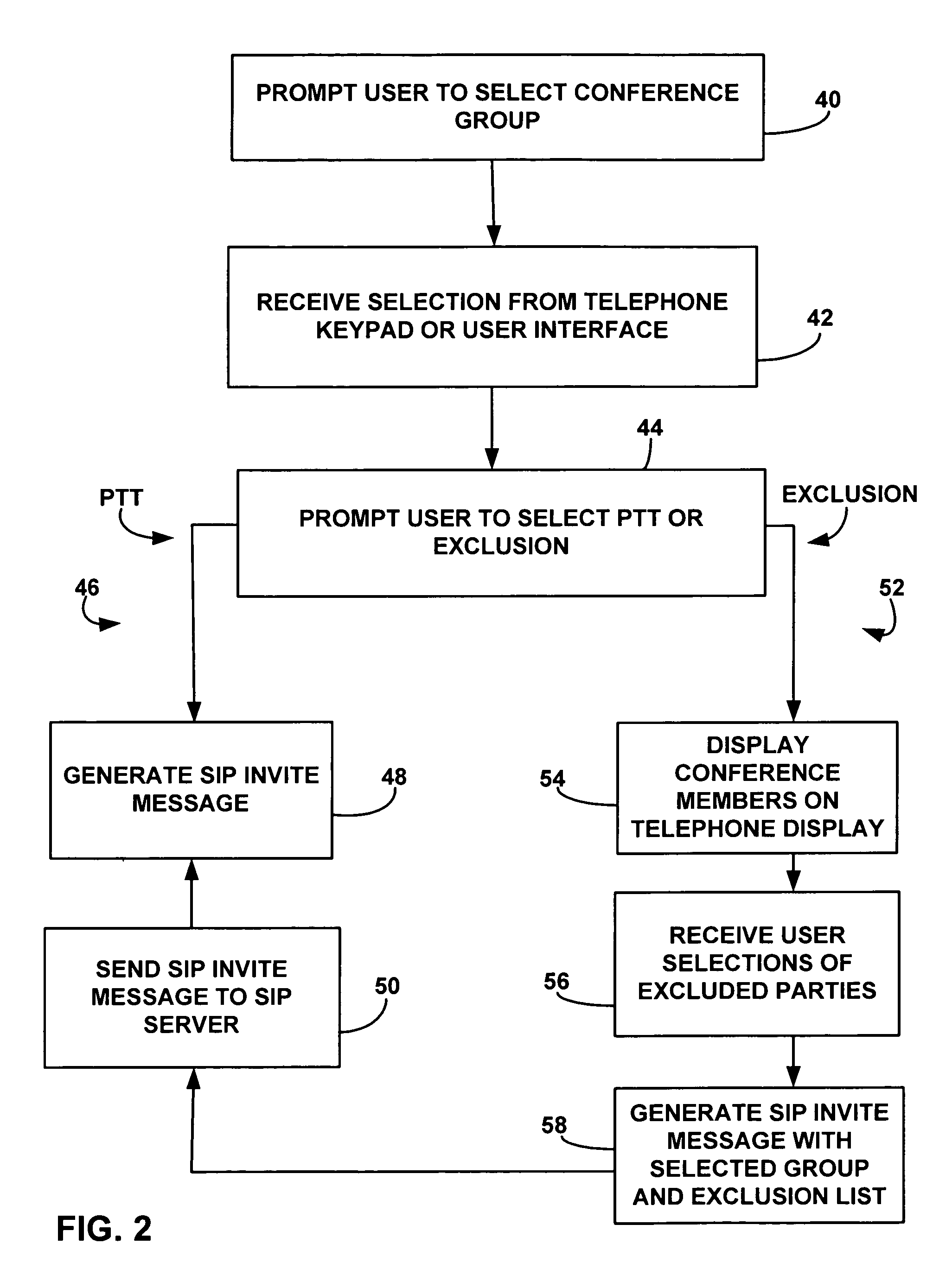
[0024]In a first embodiment, a user (conference initiator) is provided with the option to select a conference group on the telephone 10 and then select one or more members of the group to be members of an exclusion list, so that the members selected in the exclusion list will be excluded from the conference. In other words, an exclusion list comprising an identification of one or more parties (or, more specifically SIP addresses) to exclude from the conference group is sent to the conference server. The exclusion list is applied to the instant conference only; that is, it does not affect the conference group in subsequent conferences. The invention can be implemented in standard SIP signaling, such as in the SIP INVITE message, by defining a new field “exclusion list” or “exclude”, and listing the SIP addresses of the excluded parties in the field.
[0025]In a representative embodiment, when the user accesses their SIP application, a screen appears on the di...
second embodiment
Logical Operators to Combine Conference Groups (FIGS. 5-8)
[0035]As Stated Previously, Multiple Discrete, Conference Groups are Previously Defined and stored locally on the telephone 10. The conference groups could be personal groups or corporate groups. The user may wish to initiate a conference with a limited set of the members of one or more groups, or otherwise combine, exclude or group the conference groups in a new, more flexible way to achieve a new conference member list. In this second embodiment, we provide for combining conference (or PTT) groups with logical operators such as ‘AND’, ‘OR’, ‘NOT’, ‘XOR’ etc. The operation of the logical operator on the groups selected by the user results in a new grouping of conference group members; this new grouping is then used for the call.
[0036]Consider for example the following predefined conference groups:
Group 1={user1, user2, user3, user20}
Group 2={user3, user5, user7}
Group 3={user1, user2, user3}
Group 4={user18, user19, user20}
The...
the structure of the environmentally friendly knitted fabric provided by the present invention; figure 2 Flow chart of the yarn wrapping machine for environmentally friendly knitted fabrics and storage devices; image 3 Is the parameter map of the yarn covering machine
Login to View More
PUM
Login to View More
Abstract
A customized list of real-time conference participants are obtained by selecting a conference group and then selecting members of the group to be excluded using an exclusion list feature. In alternative embodiments, one or more logical operators such as AND or OR are selected and applied to conference groups the user has selected. The logical operators and selected conference groups are sent to a conference server, which applies the operator to the selected groups to arrive at a shortlist of conference participants. The invention is particularly useful for cellular telephones initiating a real-time conference using the Session Initiation Protocol (SIP) and a SIP server resident on a network.
Description
BACKGROUND[0001]This invention relates generally to real time telephone conferencing with a group of participants, and more particularly to new and convenient methods of selecting a specific, customized group of participants for a particular conference from a set of one or more previously defined and existing groups. The pre-defined groups could be personally defined groups (e.g., a group of business associates or relatives of the user); alternatively the groups could be defined by some other entity, such as the user's employer.[0002]In current practice, a user of a clientstation, e.g., a mobile phone or other station, can initiate a real-time media session with a group of one or more parties with the aid of a conference server. A widely known and used protocol enabling this communication is the Session Initiation Protocol (SIP), reflected in Internet EngineeringTask Force RFC 3261, the contents of which are incorporated by reference herein. Other protocols could be used, includin...
Claims
the structure of the environmentally friendly knitted fabric provided by the present invention; figure 2 Flow chart of the yarn wrapping machine for environmentally friendly knitted fabrics and storage devices; image 3 Is the parameter map of the yarn covering machine
Login to View More
Application Information
Patent Timeline
Application Date:The date an application was filed.
Publication Date:The date a patent or application was officially published.
First Publication Date:The earliest publication date of a patent with the same application number.
Issue Date:Publication date of the patent grant document.
PCT Entry Date:The Entry date of PCT National Phase.
Estimated Expiry Date:The statutory expiry date of a patent right according to the Patent Law, and it is the longest term of protection that the patent right can achieve without the termination of the patent right due to other reasons(Term extension factor has been taken into account ).
Invalid Date:Actual expiry date is based on effective date or publication date of legal transaction data of invalid patent.



 Login to View More
  Login to View More