Method for increasing measurement precision of two-dimensional protein
a two-dimensional protein and electrophoresis technology, applied in the direction of fluid pressure measurement, liquid/fluent solid measurement, peptide measurement, etc., can solve the problems of difficult to measure the content of salts in a protein sample, no methods have been proposed to measure the efficiency of isoelectric focusing, etc., to achieve enhanced precision of two-dimensional protein electrophoresis
- Summary
- Abstract
- Description
- Claims
- Application Information
AI Technical Summary
Benefits of technology
Problems solved by technology
Method used
Image

Examples
Embodiment Construction
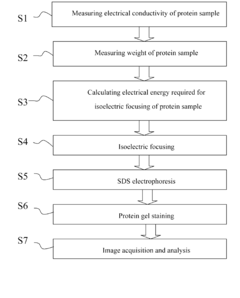
[0014]Please refer to FIG. 1 for the flowchart of a method for increasing the precision of two-dimensional protein electrophoresis according to an embodiment of the present invention. More particularly, the method involves measuring the electrical conductivity of a protein sample and calculating the electrical energy required for focusing protein as well as salts in the protein sample. As shown in FIG. 1, the method includes the following steps:
[0015](1) Measurement of the Electrical Conductivity SExp a Protein Sample
[0016]A handheld electrical conductivity meter, such as OAKTON ECTestr 11+ (Oakton Instruments, Vernon Hills, Ill., USA) is used to take a protein sample of 250 μL at 4° C. The protein sample is placed at the reading end of the electrical conductivity meter so as to measure the electrical conductivity of the sample (in the unit of μS / cm, S: siemens). The final result is the average of three measurements.
[0017](2) Measurement of the Weight MExp of the Protein Sample
[0018...
PUM
| Property | Measurement | Unit |
|---|---|---|
| length | aaaaa | aaaaa |
| weight | aaaaa | aaaaa |
| length | aaaaa | aaaaa |
Abstract
Description
Claims
Application Information
 Login to View More
PatSnap Eureka turns technology decisions into work you can execute. Powered by our Innovation Knowledge Graph, it runs expert workflows across engineering, life sciences, materials and intellectual property. Get your review-ready output in minutes.


