
Filter assembly for computed tomography systems
a computed tomography and filter technology, applied in the field of computed tomography, can solve the problems of difficult movement of the attenuation filter relative to a stationary workpiece in the collimator, severe image artefacts, and brittleness, and achieve the effect of improving performan
- Summary
- Abstract
- Description
- Claims
- Application Information
AI Technical Summary
Benefits of technology
Problems solved by technology
Method used
Image

Examples
Embodiment Construction
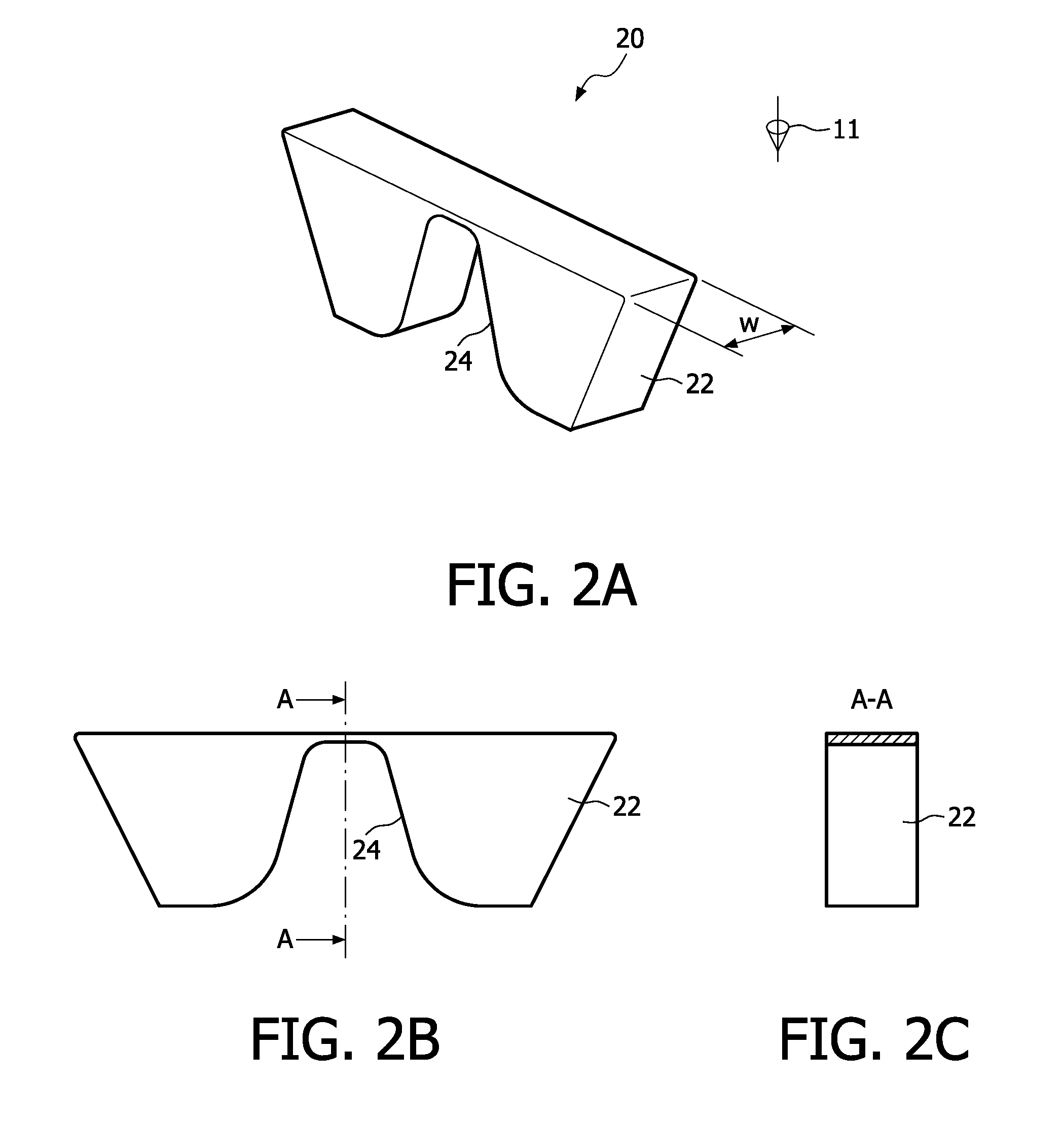
[0029]FIG. 2A is a diagram of an embodiment of an attenuation filter 20 according to the invention; FIGS. 2B and 2C are a corresponding schematic front view and a cross-sectional view, respectively, taken on the A-A axis. The attenuation filter 20 comprises a filter block 22, made of, for example, Teflon. It will be evident to those skilled in the art that other similar materials may be used for the attenuation filter 20. Furthermore, the filter block 22 may have any other shape instead of a rectangular shape, for example, the saddle shape as shown in FIG. 2A.
[0030]The filter block 22 has a saddle-notch shape 24. Unlike the saddle notch 14 in FIG. 1A, the saddle notch 24 is shaped in the full width of the filter block 22 without leaving a supporting wall intact. This means that the saddle notch 24 may allow a workpiece to move through the saddle notch from one to the other side of the attenuation filter 20, or may allow the attenuation filter 20 to freely move relative to a stationa...
PUM
 Login to View More
 Abstract
Description
Claims
Application Information
 Login to View More