[0004]The present invention provides a valve system that may: (1) enable use of a standard single line faucet with a low pressure water treatment system; (2) protect water treatment systems and other fluid flow devices from unnecessary fluid pressure, (3) remove pressure from the water treatment system and other fluid flow devices, (4) regulate or prevent fluid flow to the dispenser or outlet in response to a particular event, such as a leak and (5) cap the general fluid flow through the system.
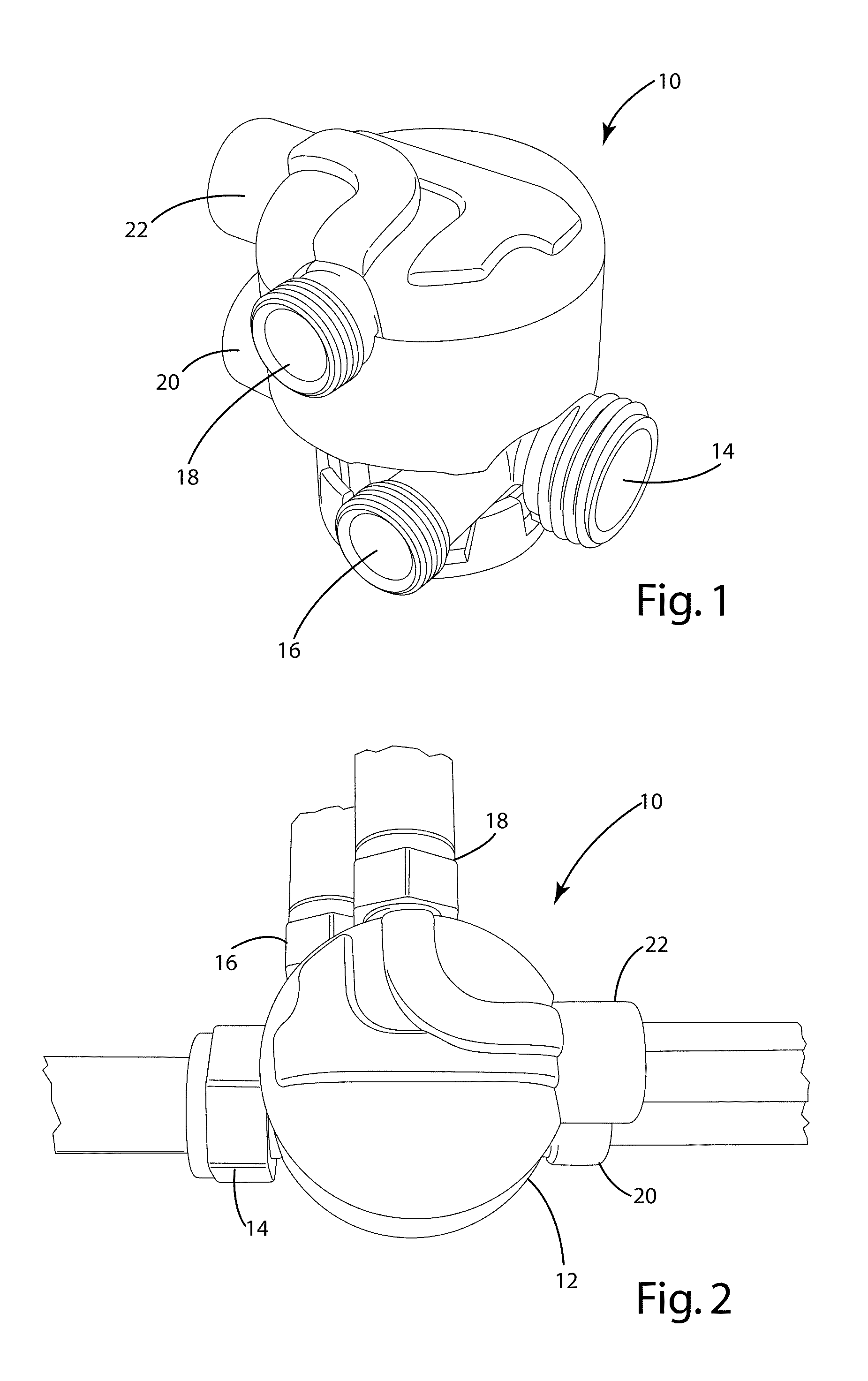
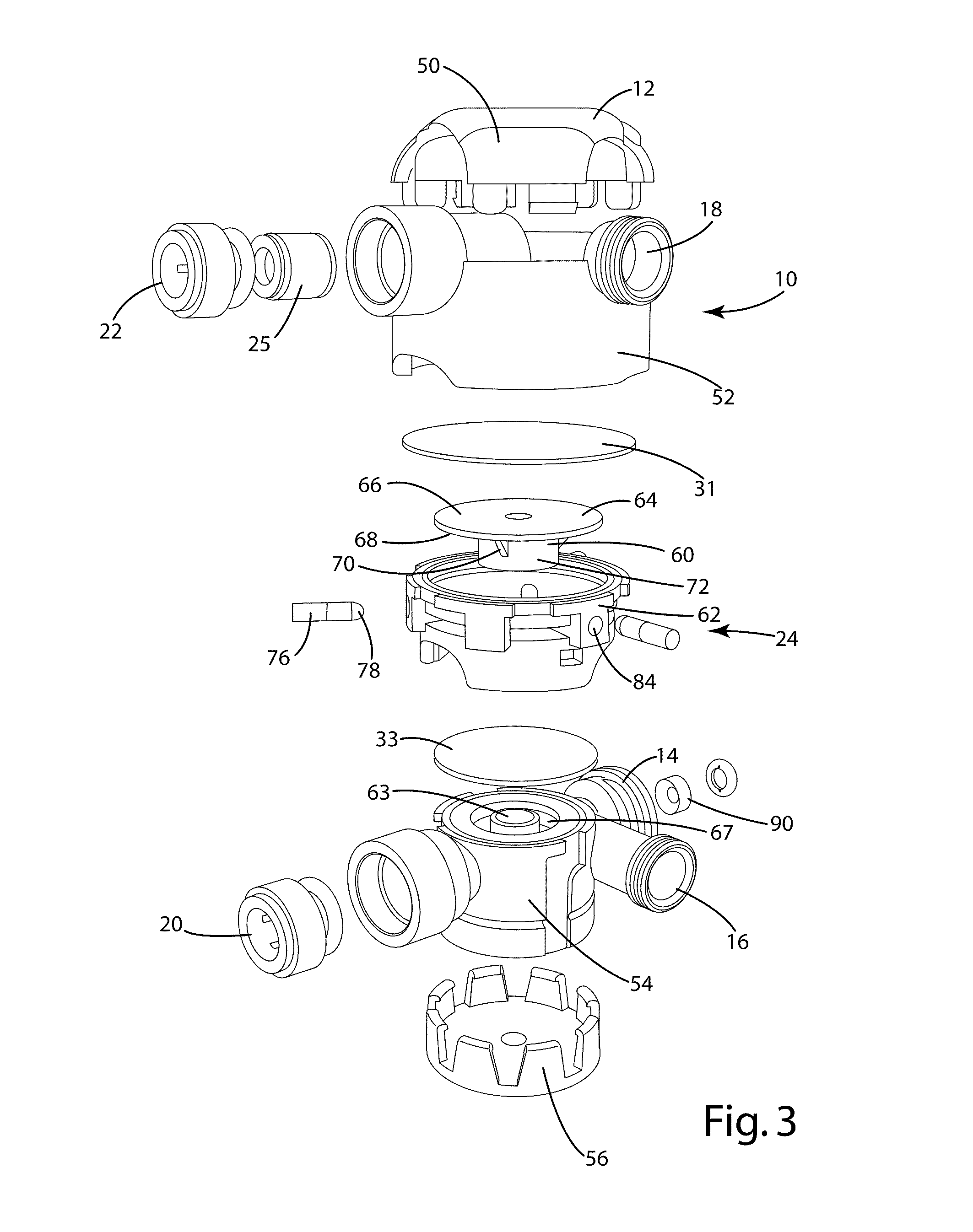
[0005]In one embodiment, the valve system includes a housing having ports for: (1) receiving a supply fluid, (2) supplying the fluid to a device, such as a water treatment system, (3) receiving the fluid from the device and (4) supplying fluid to a dispenser (i.e. a single line faucet or another type of outlet). The valve system includes an automatic shutoff device within the housing that prevents water from flowing into the housing and the water treatment system when the dispensing outlet is closed and that allows water to flow through the housing and into the water treatment system when the outlet is open. The automatic shutoff may operate on a pressure differential between the incoming supply water and the outflow of treated water. In one embodiment, the automatic shutoff includes a moveable element, such as a plunger, that moves between a first position in which the valve is open and a second position in which the valve is closed. The moveable element may be configured to move as a function of the pressure differential between the fluid flowing over an upper surface of the moveable element and the fluid flowing over the lower surface of the moveable element.
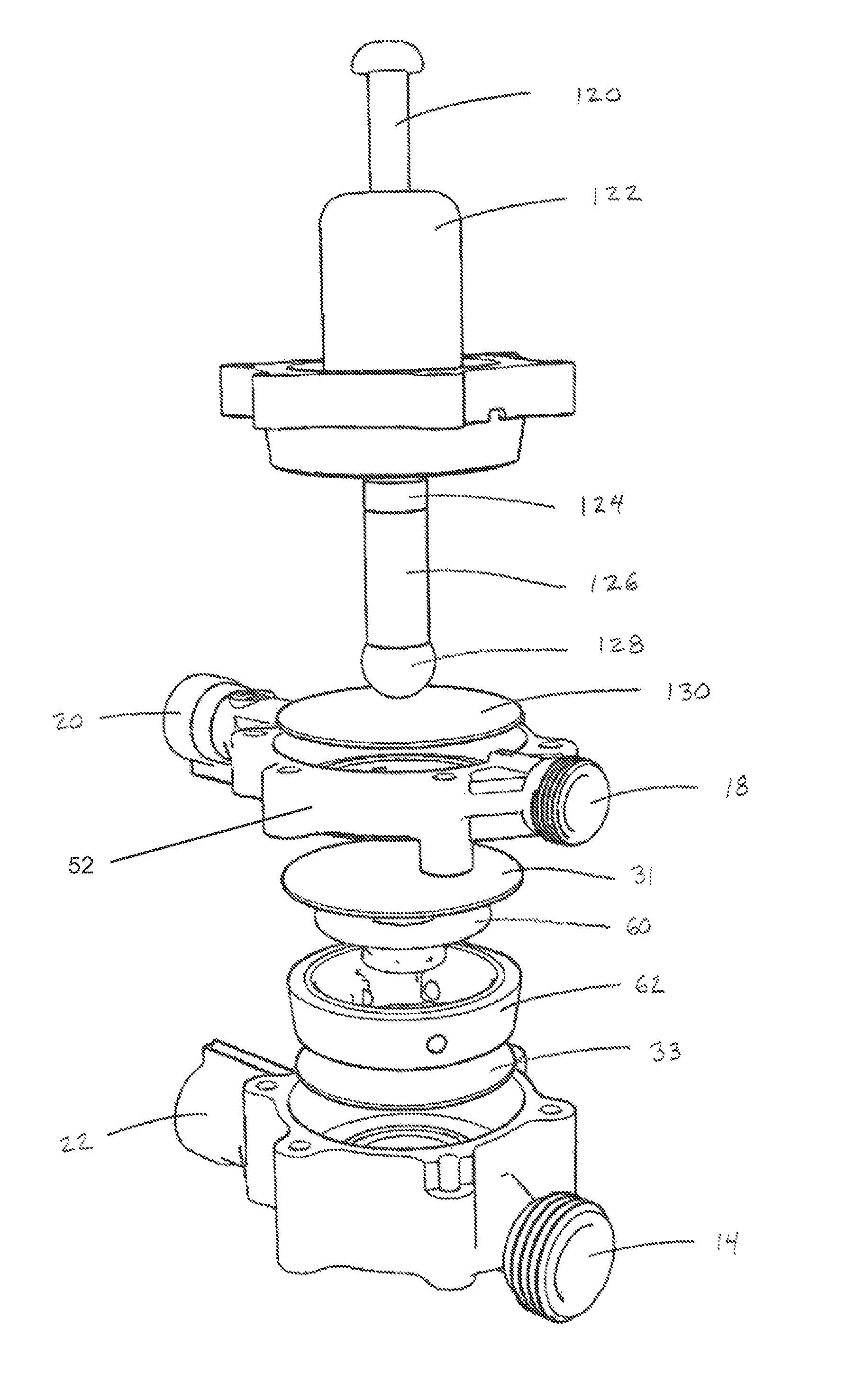
[0007]In another embodiment, the valve system includes a second actuator connected to the automatic shutoff. The second actuator is capable of moving the moveable element to the closed position regardless of the pressure differential on the automatic shutoff. In this way, the second actuator may act independently from the ordinary actuation of the automatic shutoff to force the valve system partially or completely closed. The second actuator may be manual or automatically operated, and in one embodiment the second actuator may be connected to one or more sensors that signal the second actuator to close upon the occurrence of a particular event. The second actuator may be in the form of a threaded shaft extending into the valve system housing. When the shaft is driven into the valve system, it causes the moveable element to move at least partially toward the closed position, which restricts or completely prevent flow through the valve system.
[0008]The valve system of the present invention provides a reliable device that can be inserted in-line with a water treatment system to allow use of a standard single-line outlet with the water treatment system while allowing the system to rest at low pressure. The valve system is also capable of providing pressure protection for water treatment systems and a wide variety of other fluid dispensing systems by preventing fluid flow to these devices when the dispensing outlet is closed. Such devices may include hot water heaters, beverage vending machines, drinking fountains, water softeners, refrigerator ice / water dispensers, dairy processors, food processing systems, air compressors, and hydraulic systems. The valve system enables easy maintenance of these devices by removing pressure from the device (and removing fluid flow to the device) when the dispensing outlet is turned off. Additionally, the internal components of any dispensing devices using the valve system may be lighter, smaller, and thus less expensive as they no longer have to withstand constant high pressure.
[0009]In the embodiment including a second actuator, the valve system can provide pressure protection for a variety of fluid flow devices along with additional functionality, such as system shutoff upon leak detection and flow regulation. This embodiment can be useful in many of the fluid flow applications noted above, for instance, by configuring the second actuator to shut off the fluid flow to the devices upon the detection of an undesirable event, such as a leak in the system. It can also be useful in regulating the amount of fluid that flows to a particular device, such as a gas gill, dish washer or washing machine.


 Login to View More
  Login to View More