
Feature-based registration method
a registration method and feature technology, applied in the field of feature-based registration method, can solve the problems of inconvenient or otherwise undesirable to require additional registration steps from a physician, the method of registration suffers similar setbacks, and the registration becomes less accura
- Summary
- Abstract
- Description
- Claims
- Application Information
AI Technical Summary
Benefits of technology
Problems solved by technology
Method used
Image

Examples
Embodiment Construction
[0019]Generally, the present invention includes a system and method for registering a three-dimensional model of a body volume, such as a CT volume, to a real-time image of a sensor. This registration method compares anatomical cavity features to cavity voxels, as opposed to anatomical shapes or locations to structure shapes or locations.
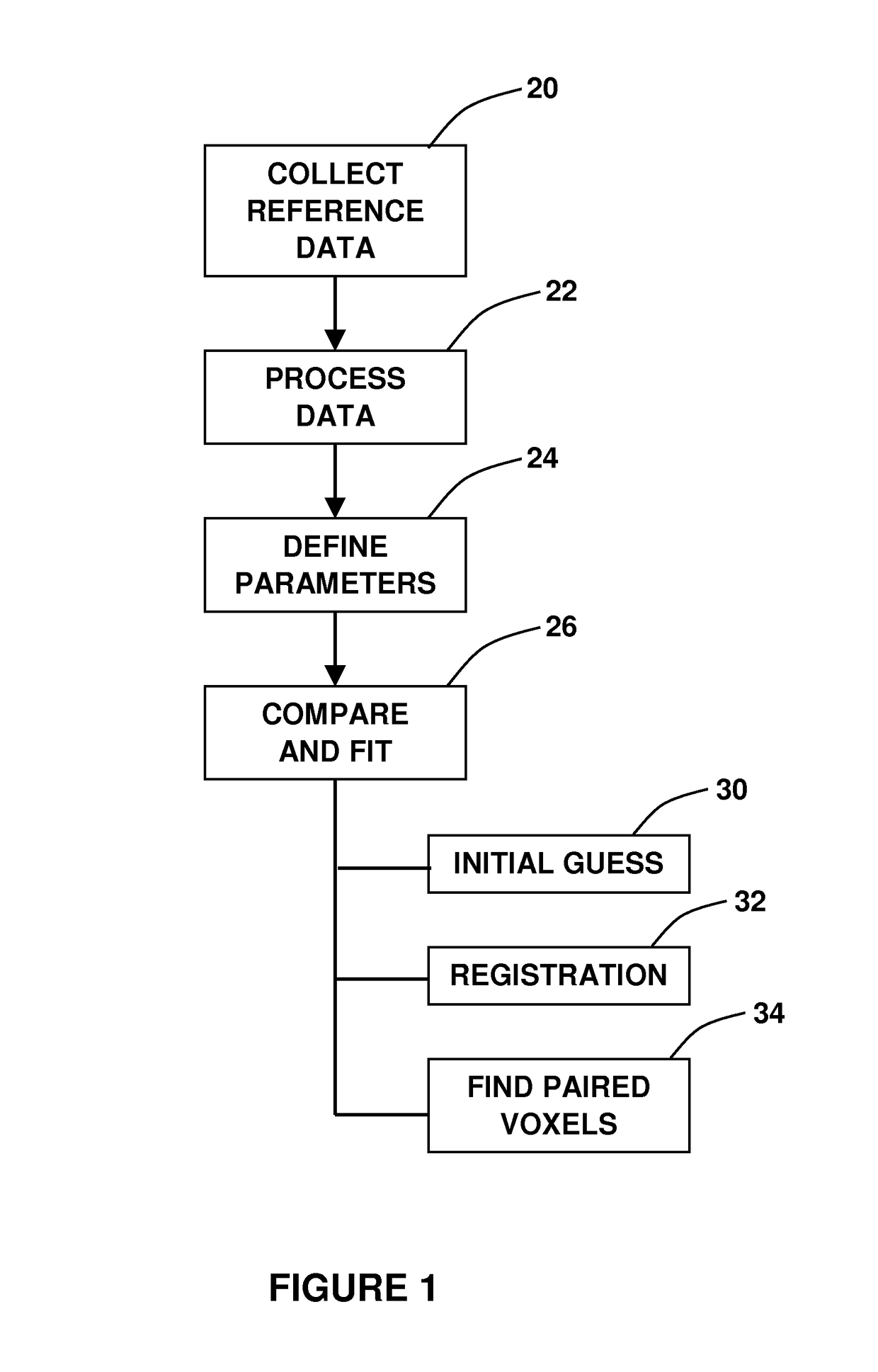
[0020]Referring now to the flowchart of FIG. 1, it is shown that the method of the present invention begins at 20 with a collection of reference data. This step involves the acquisition of a plurality of CT scans, which are then assembled into a CT volume. During the procedure, the sensor is inserted into the lungs of the patient and a data stream is established between the sensor and a system processor.
[0021]At step 22, the data acquired is processed, which involves de-cluttering and digitization. Each of the voxels is assigned a number based on the tissue density Housefield number. This density value can be associated with gray level or color usin...
PUM
 Login to View More
 Abstract
Description
Claims
Application Information
 Login to View More