Unlock instant, AI-driven research and patent intelligence for your innovation.

Method for analyzing records in a data base

Active Publication Date: 2013-10-15
HARRIS JEFFREY SAUL
View PDF91 Cites 2 Cited by
  • Summary
  • Abstract
  • Description
  • Claims
  • Application Information

AI Technical Summary

Benefits of technology

The patent describes a method for analyzing data records in a database by assigning conditions to homogeneous groups, retrieving rules, and applying them to data. The method also includes reviewing the results, and generating at least one message based on those results. The technical effect of this invention is an improved ability to analyze data records in a database efficiently and accurately.

Problems solved by technology

The present processes of medical diagnosis, treatment, and management of functional recovery are inconsistent.
Inconsistent care can be a major cause of medical errors, unnecessary lost time, and unnecessary costs.
Common problems with medical and disability data can include:Incomplete collection of information needed for decision-makingVague or incomplete descriptions of mechanisms of injury or illness, symptoms or signsConclusions or labels rather than underlying mechanisms of injury or illness, symptoms and signsIllegible recording of dataRecording in chronological order rather than by problemUse of paper records which cannot be easily sequenced, sorted, arrayed, compared, processed, or summarisedExistence of records in multiple locationsLost, misfiled, or inaccessible records
Even when electronic medical and disability management record keeping systems are used, common problems can include:Storage of data in a manner such that it cannot be easily sequenced, sorted, arrayed, compared, processed, or summarisedIncompatible record formats or information systems within institutions and among parties involved in managing health or disability to anotherDifficulty transferring information from one party involved in managing health or disability to another
Consequently, problems often observed with the process of medical care are not only due to data collection, but can also be due to lack of a systematic approach to each class of health problems.
Because comparisons to medical evidence are often not made during the process of care with respect to a class of health problems, errors in diagnosis and treatment result.
The usual clinical and medical management approach is not systematic due to failure to compare each situation with validated information about:Sensitive and specific, uniquely diagnostic symptoms, signs, manoeuvres and testsProven effective treatmentsThe effect of prior tests and treatmentsThe history and time course of a health problemThe context of the patient's health complaints
Failure to consider the context and history of a health problem also contributes to variation in care.
Problems frequently observed in the management of functional disability management include:Assumptions that inactivity will enable healing and recoveryLack of attention to the typical recovery period for a given health problemLack of attention to the essential physical and mental demands of work or schoolInattention to the social and work context of functional disabilityFailure to use limited activity at work or school to support functional recovery
Finally, most health care systems lack timely and effective methods to measure patient and provider satisfaction with care, or to measure functional outcomes of care and disability management.
There is therefore no way to correlate the process of care with its outcomes.
Practitioners often do not give patients enough understandable information to make informed decisions about their care and functional recovery.
Valid information is not easily available elsewhere.
Consequently, patients may ask for ineffective or unnecessary care, or may acquiesce to care or activity restriction that is not in their best interest based on the medical evidence.
However, the ability of case managers, utilisation review personnel, disease managers, and others acting on behalf of employees or payers to make logical, consistent decisions suffers from the same problems as those confronting health care professionals.
Their access to data and consistent processes is in fact often worse, as they are one level removed from health care transactions and are hampered by communication problems.


Method used

the structure of the environmentally friendly knitted fabric provided by the present invention; figure 2 Flow chart of the yarn wrapping machine for environmentally friendly knitted fabrics and storage devices; image 3 Is the parameter map of the yarn covering machine
View more

Image

Smart Image Click on the blue labels to locate them in the text.
Viewing Examples
Smart Image
  • Method for analyzing records in a data base
  • Method for analyzing records in a data base
  • Method for analyzing records in a data base

Examples

Experimental program
Comparison scheme
Effect test

Embodiment Construction

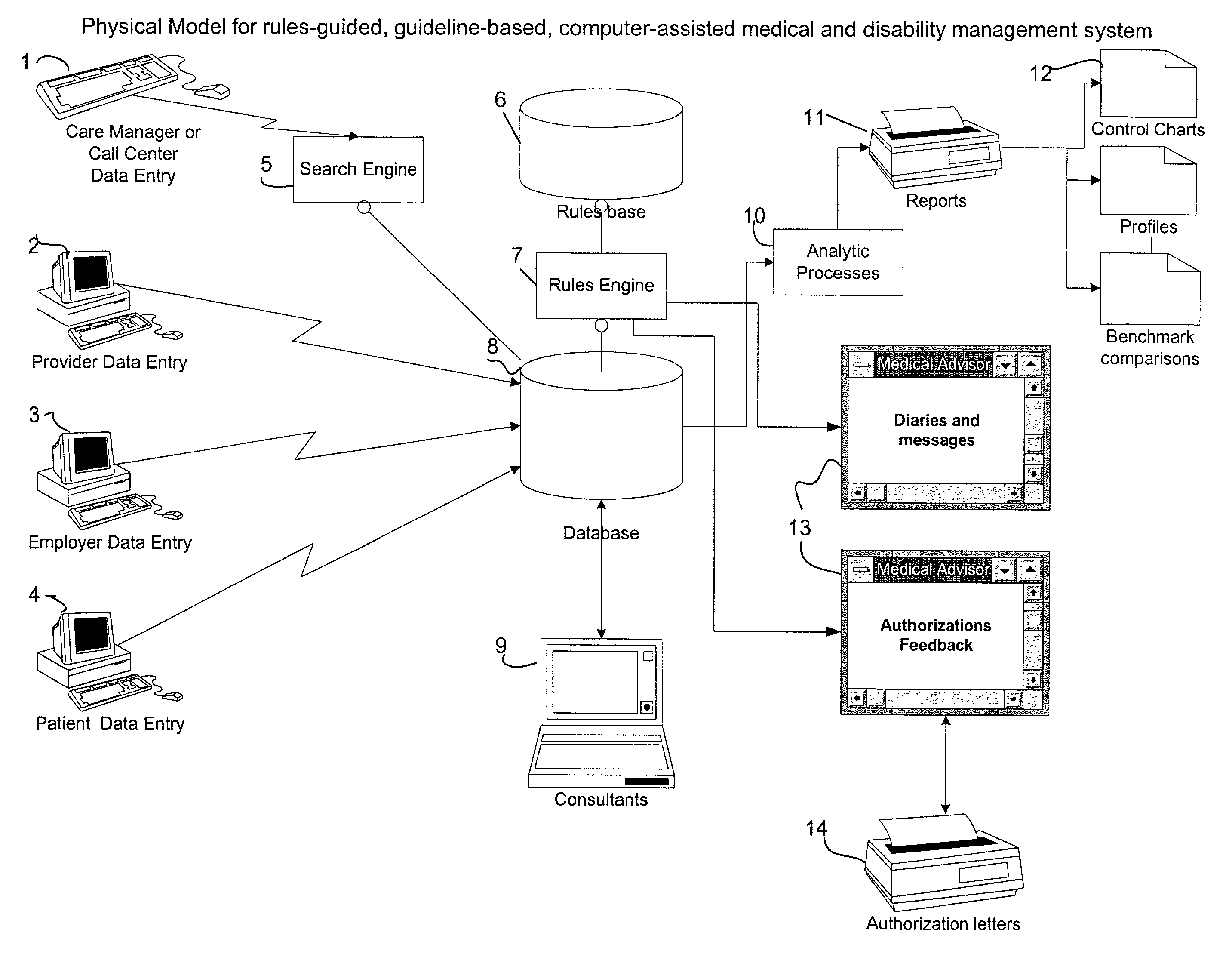
[0043]An exemplary physical embodiment of the present invention is illustrated in FIG. 1 in a physical model for a rules-guided, guideline-based, computer assisted medical and disability management system. As shown in FIG. 1, the present invention physically includes computer graphic user interfaces or other means of data entry to capture patient information. For example, the patient information can include demographics, employment information, mechanism of injury, etiologic factors of disease, medical history, physical examination data, job data, functional abilities, satisfaction, and other types of information. The patient information can be acquired by call center personnel, care managers 1, or directly from providers' computers or other data entry devices 2. In addition or in the alternative, patient information can also be acquired from employers 3 or from the patients themselves 4. A search engine 5 processes these data to determine if the entity, such as a patient, employer ...

the structure of the environmentally friendly knitted fabric provided by the present invention; figure 2 Flow chart of the yarn wrapping machine for environmentally friendly knitted fabrics and storage devices; image 3 Is the parameter map of the yarn covering machine
Login to View More

PUM

No PUM Login to View More

Abstract

A method for analyzing records in a data base which collects predetermined data and creates or appends a record, assigns individual conditions to homogeneous groups, retrieves rules, applies the rules to the data, reviews results generated from applying the rules to the data and generates at least one message.

Description

BACKGROUND[0001]This invention relates to the evaluation and management of health problems and related disabilities. More particularly, this invention relates to the use of integrated structured methods, information systems, decision rules and practice guidelines to improve outcomes.[0002]The present processes of medical diagnosis, treatment, and management of functional recovery are inconsistent. Often, the processes used for different individuals having similar health problems will vary significantly, yielding different results for each individual. Problems with the acquisition, recording, sharing, storage, comparison, and use of health and functional data underlie much of the observed inconsistency as detailed in the recent National Institute of Medicine reports on health care quality, which are hereby incorporated by reference in their entirety. Inconsistent care can be a major cause of medical errors, unnecessary lost time, and unnecessary costs. To the extent that people with ...

Claims

the structure of the environmentally friendly knitted fabric provided by the present invention; figure 2 Flow chart of the yarn wrapping machine for environmentally friendly knitted fabrics and storage devices; image 3 Is the parameter map of the yarn covering machine
Login to View More

Application Information

Patent Timeline
no application Login to View More
Patent Type & Authority Patents(United States)
IPC IPC(8): G06F15/16G06F12/00G06F17/30G06Q50/00G06F7/00G06Q50/22
CPCG06Q50/22G16H40/67
Inventor HARRIS, JEFFREY SAUL
Owner HARRIS JEFFREY SAUL