Method, apparatus and system for virtual network configuration and partition handover
a virtual network and partition technology, applied in electrical devices, digital transmission, data switching networks, etc., can solve the problems of not supporting the virtual network access of nomadic or mobile users, and the user cannot be handed over to the new service/sp network dynamically
- Summary
- Abstract
- Description
- Claims
- Application Information
AI Technical Summary
Benefits of technology
Problems solved by technology
Method used
Image



Examples
first embodiment
[0077]The application scenario of the first method of the present invention is a nomadic scenario, as shown in FIG. 3.
[0078]Each user corresponds to a port, which is either a physical port or a virtual port. The port may be sorted by: physical line such as DSL and Virtual Channel (VC), by layer-2 information (for example, VLAN ID, Ethernet priority, MAC address), or by quintuplet information (for example, source IP address, destination IP address, source port, destination port, and protocol type).
[0079]As shown in FIG. 3, a local user accesses the network through port 1, and the mapping relation between port 1 corresponding to the local user and the VLAN / VPN ID 1 is already configured on the access network. Therefore, the local user accesses the network from the corresponding port 1. The access network maps port 1 to the corresponding layer-2 VLAN or VPN channel according to the mapping relation, and port 1 is connected to the access network.
[0080]As shown in FIG. 3, the nomadic use...
second embodiment
[0090]The second embodiment of the present invention provides a service / SP handover scenario, as shown in FIG. 5.
[0091]Each user corresponds to a port, and the mapping relation between the port corresponding to the user and the VLAN / VPN ID is already configured on the access network. After the user accesses the network through port 1, the user may query the mapping relation to obtain the corresponding VLAN / VPN ID according to the information about port 1. In this way, port 1 is mapped to the layer-2 VLAN or VPN channel of the corresponding service / SP, and the user accesses the corresponding service or SP network.
[0092]When the user needs to be handed over from the same port 1 to a new service / SP network dynamically, because no mapping relation between port 1 corresponding to the user and the new VLAN / VPN ID is configured on the access network, the IP edge obtains such a mapping relation dynamically through an L2C mechanism, and delivers the obtained mapping relation to the correspon...
third embodiment
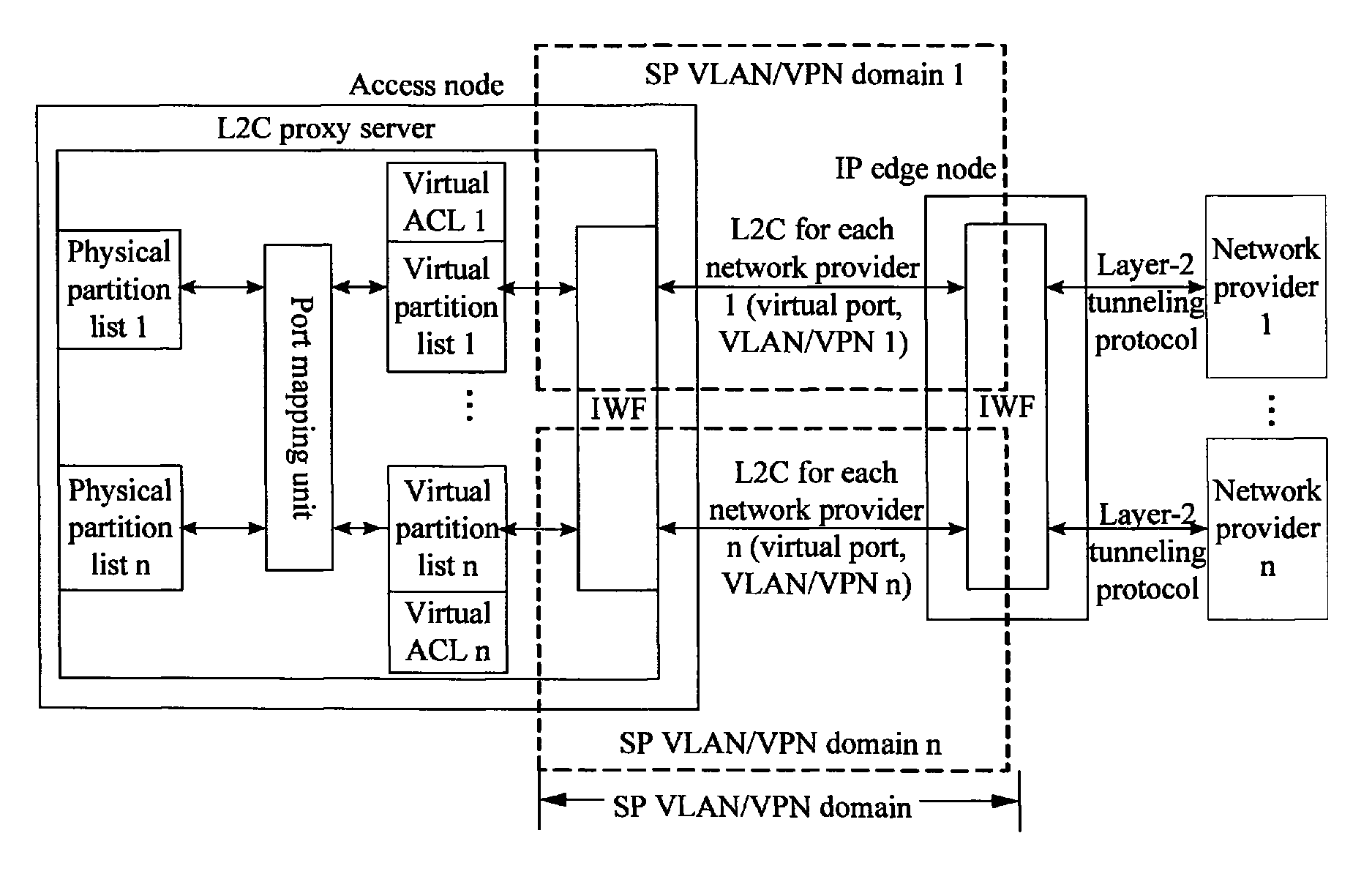
[0104]In a multicast wholesale scenario, the retailer SP configures the Access Control List (ACL) of the same DSLAM through a BNG by means of different L2C connections. The IWF is designed for the IP edge node to perform layer-2 control for the access node. As shown in Table 1, the basic structure of the ACL includes: ACI, multicast address, multicast source address (optional), and ACL attribute. The ACI is also known as an Access Loop Identifier (ALI), for example, the physical port corresponding to the DSL.
[0105]
TABLE 1Basic structure of an ACLMulticast SourceACIMulticast AddressAddressACL AttributePhysical ACI 1224.x.y.za.b.c.d>allowed224.x1.y1.z1a1.b1.c1.d1>not allowedPhysical ACI 2. . .
[0106]The third embodiment of the present invention provides a second service / SP handover scenario, as shown in FIG. 7.
[0107]The domain between the access node and the IP edge node forms the VLAN / VPN domain of the service / SP, and each different service / SP has a different VLAN / VPN. In this embodim...
PUM
 Login to View More
 Abstract
Description
Claims
Application Information
 Login to View More