
Terminal load
a terminal load and load technology, applied in the direction of waveguide type devices, coupling device connections, two-part coupling devices, etc., can solve the problems of inconvenient manufacture of conventional terminal loads, affecting the quality of products, and preventing rapid mass production of conventional terminal loads b>1/b>, etc., to achieve good conductivity of terminal loads, increase productivity, and production quick
- Summary
- Abstract
- Description
- Claims
- Application Information
AI Technical Summary
Benefits of technology
Problems solved by technology
Method used
Image

Examples
Embodiment Construction
[0024]The present invention will now be described with a preferred embodiment thereof and with reference to the accompanying drawings.
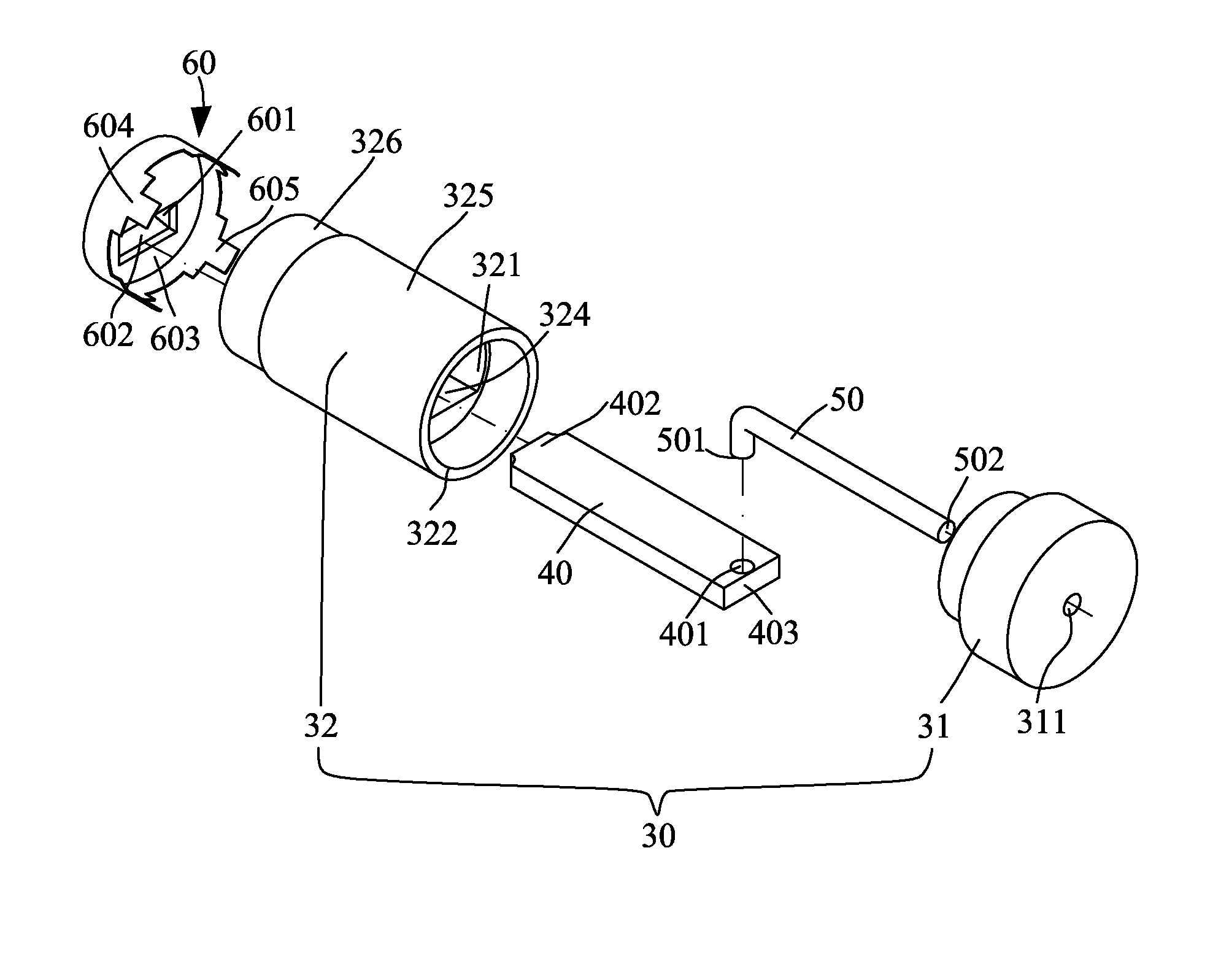
[0025]Please refer to FIG. 3. A terminal load according to a preferred embodiment of the present invention includes an insulating housing 30, a circuit board 40, a connection terminal 50 and a conductive cap 60, which are assembled together to form the terminal load.
[0026]As shown, the insulating housing 30 includes an insulating cap 31 and an insulating cylinder 32. The insulating cap 31 has a centered third hole 311. The insulating cylinder 32 internally defines a receiving space 321, a front end of which is an opening 322 and a rear end of which is formed with a notch 323. An outer circumferential surface of the insulating cylinder 32 is divided into two sections, one of which adjacent to the opening 322 has a first outer diameter 325 and another of which adjacent to the notch 323 has a second outer diameter 326, giving the insulating cylinder 32 a...
PUM
 Login to View More
 Abstract
Description
Claims
Application Information
 Login to View More