Adjustable threshold for forward collision warning system

a technology of collision warning and threshold, which is applied in the direction of vehicle position/course/altitude control, process and machine control, instruments, etc., can solve the problems of insufficient threshold for two seconds of impact under normal conditions, and inability to adjust the threshold

US8788176B1Active Publication Date: 2014-07-22FORD GLOBAL TECH LLC
14 Cites 38 Cited by

Patent Information

Authority / Receiving Office
US · United States
Current Assignee / Owner
Publication Date
2014-07-22

Smart Images

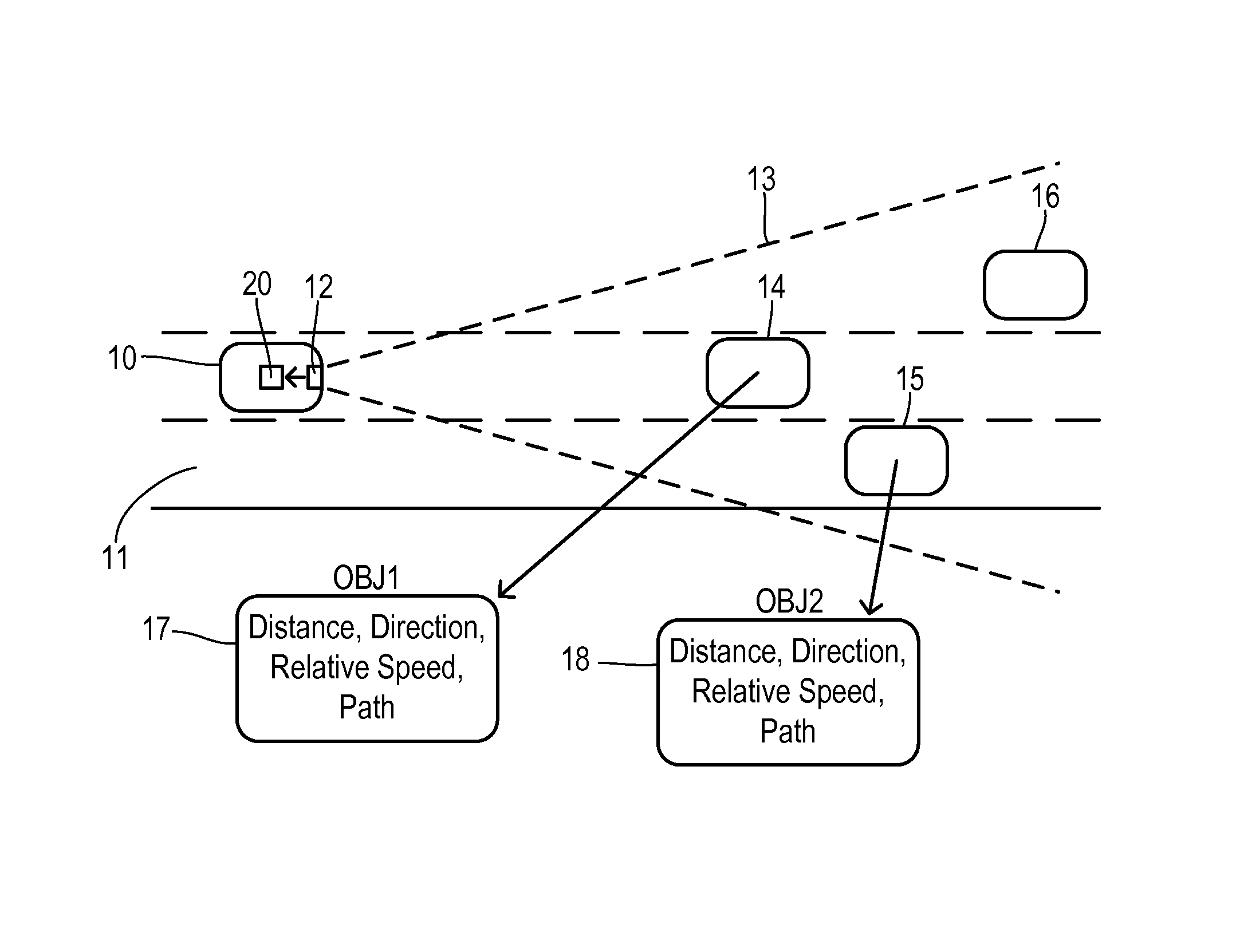
  • Figure 1
    Figure 1
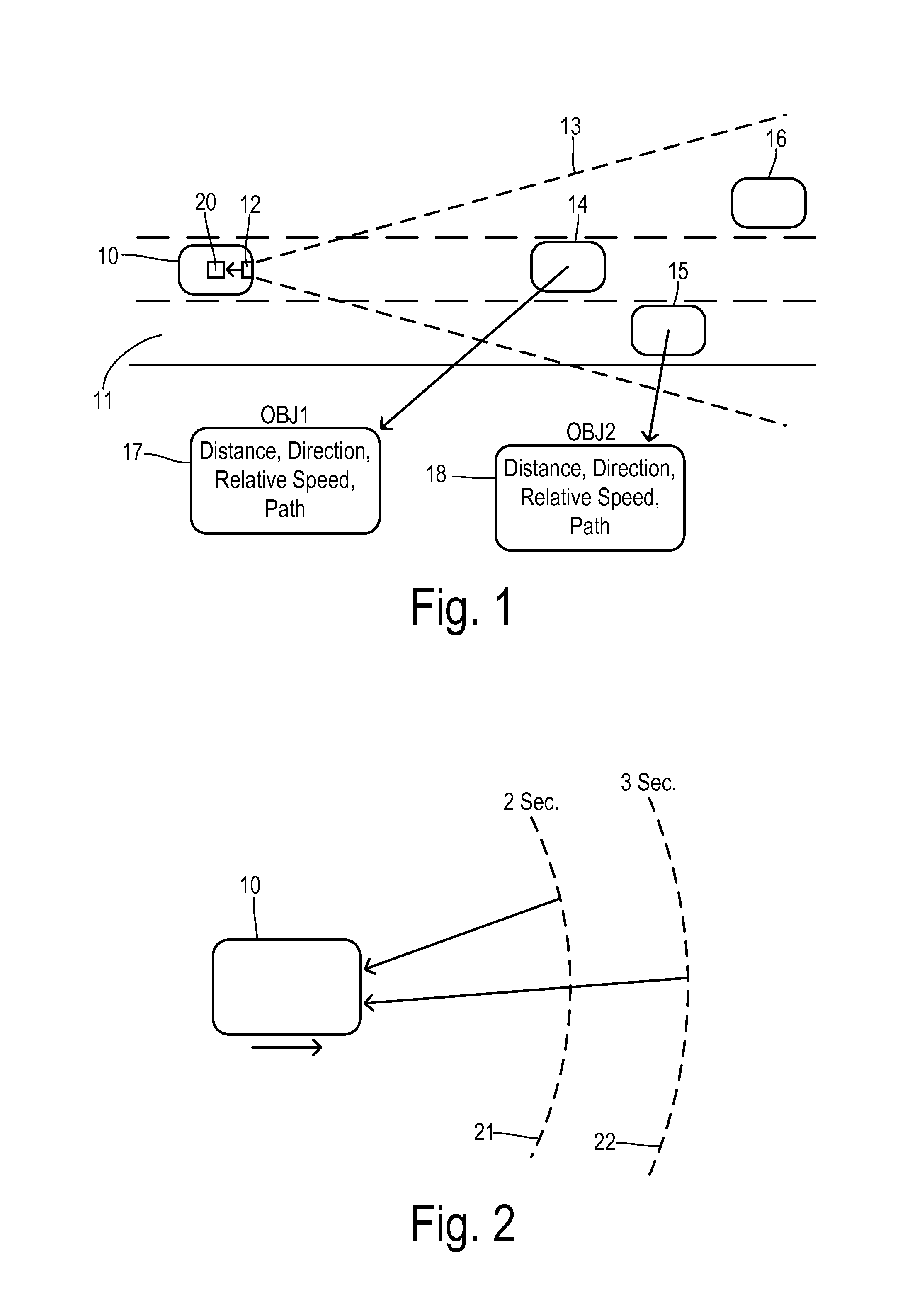
  • Figure 2
    Figure 2
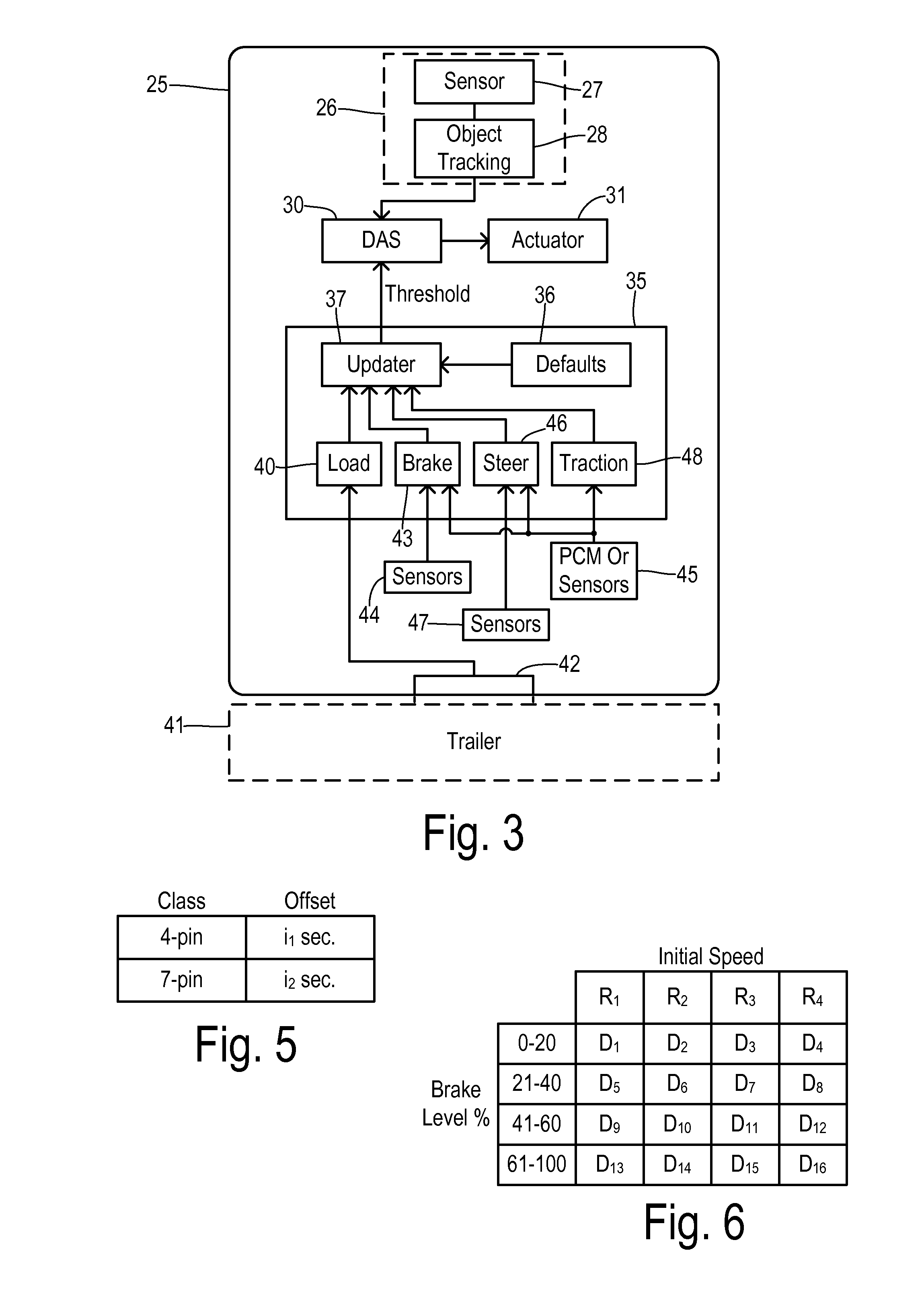
  • Figure 3
    Figure 3
Patent Text Reader

Abstract

A driver assistance system for a motor vehicle monitors approaching objects around the vehicle in order to take a driver assistance action in response to a predicted impact with an approaching object according to a time-to-impact threshold. the time-to-impact threshold includes a nominal or default value that is adjusted according to several different measures of vehicle and driving conditions. Respective offsets determined by a load monitor, a braking monitor, and a steering monitor are added to the threshold in response to measured vehicle performance parameters being different from expected values. The driver assistance action may be a perceptible warning for a forward collision warning system, a speed reduction in an adaptive cruise control system, or a braking action in a brake-steer system.
Need to check novelty before this filing date? Find Prior Art

Description

CROSS REFERENCE TO RELATED APPLICATIONS

[0001] Not Applicable.STATEMENT REGARDING FEDERALLY SPONSORED RESEARCH

[0002] Not Applicable.BACKGROUND OF THE INVENTION

[0003] The present invention relates in general to collision warning and avoidance systems for motor vehicles, and, more specifically, to an adjustable threshold for initiating driver assistance actions in response to predicted collisions.

[0004] Several different types of driver assistance systems have been developed that involve the remote sensing and tracking of other vehicles or objects that may approach or impact a host vehicle. Scanning radar systems, camera-based optical based recognition systems, or combinations of the two are typically used to find relevant objects, determine their relative speed and travel path, and predict whether and when an impact may take place if the vehicles remain on their current trajectories. The driver assistance system may simply warn a driver as in a forward collision warning (FCW) system, ther...

Examples

Embodiment Construction

[0016]The present invention estimates current driving conditions using systems and sensors typically already present in a vehicle. The examined parameters include vehicle loading (e.g., number of passengers, cargo, towing of a trailer, etc.) and vehicle-road interactions (e.g., frictional changes results from tire wear, brake wear, rough road, and surface debris). Information gathered on these parameters is used to determine whether default settings such as the time-to-impact threshold should be modified in the driver assistance system (e.g., forward collision warning system, adaptive cruise control, or brake-steer system).

[0017]Referring now to FIG. 1, a host vehicle 10 traveling on a multi-lane roadway 11 is equipped with a remote vehicle sensing and tracking system 12. Within a field of view 13, tracking system 12 is monitoring target vehicles 14, 15, and 16. For each tracked object a set of parameters characterizing the type and behavior of each object is determined and made ava...