Method and apparatus of route guidance

a route guidance and route technology, applied in the field of navigation systems, can solve the problems that the client device might not have access to the map data and routing algorithms on the navigation server, and achieve the effect of avoiding the problem of route data and routing algorithms

US9267803B2Active Publication Date: 2016-02-23GOOGLE LLC
54 Cites 4 Cited by

Patent Information

Authority / Receiving Office
US · United States
Patent Type
Patents(United States)
Current Assignee / Owner
Publication Date
2016-02-23

Smart Images

  • Figure 1
    Figure 1
  • Figure 2
    Figure 2
  • Figure 3
    Figure 3
Patent Text Reader

Abstract

Systems and methods of route guidance on a user device are provided. In one aspect, a system and method transmit partitions of map data to a client device. Each map partition may contain road geometries, road names, road network topology, or any other information needed to provide turn-by-turn navigation or driving directions within the partition. Each map partition may be encoded with enough data to allow them to be stitched together to form a larger map. Map partitions may be fetched along each route to be used in the event of a network outage or other loss of network connectivity. For example, if a user deviates from the original route and a network outage occurs, the map data may be assembled and a routing algorithm may be applied to the map data in order to direct the user back to the original route.
Need to check novelty before this filing date? Find Prior Art

Description

CROSS-REFERENCE TO RELATED APPLICATIONS

[0001] The present application claims the benefit of the filing date of U.S. Provisional Patent Application No. 61 / 420,515 filed Dec. 7, 2010, the disclosure of which is hereby incorporated herein by reference.BACKGROUND OF THE INVENTION

[0002] 1. Field of the Invention

[0003] The present application relates generally to navigation systems.

[0004] 2. Description of Related Art

[0005] With the advent of portable electronic devices, navigation systems are now more commonplace with many users worldwide. Portable electronic devices (“client devices”) such as mobile telephones, PDAs and laptop / palmtop computers may be used while in transit to a specific destination. Navigation servers typically receive requests from a client device for directions to a destination, generate routes by applying routing algorithms to map data, and subsequently provide the route to the client device. Client devices are also capable of storing map data and routing algorithms local...

Examples

Embodiment Construction

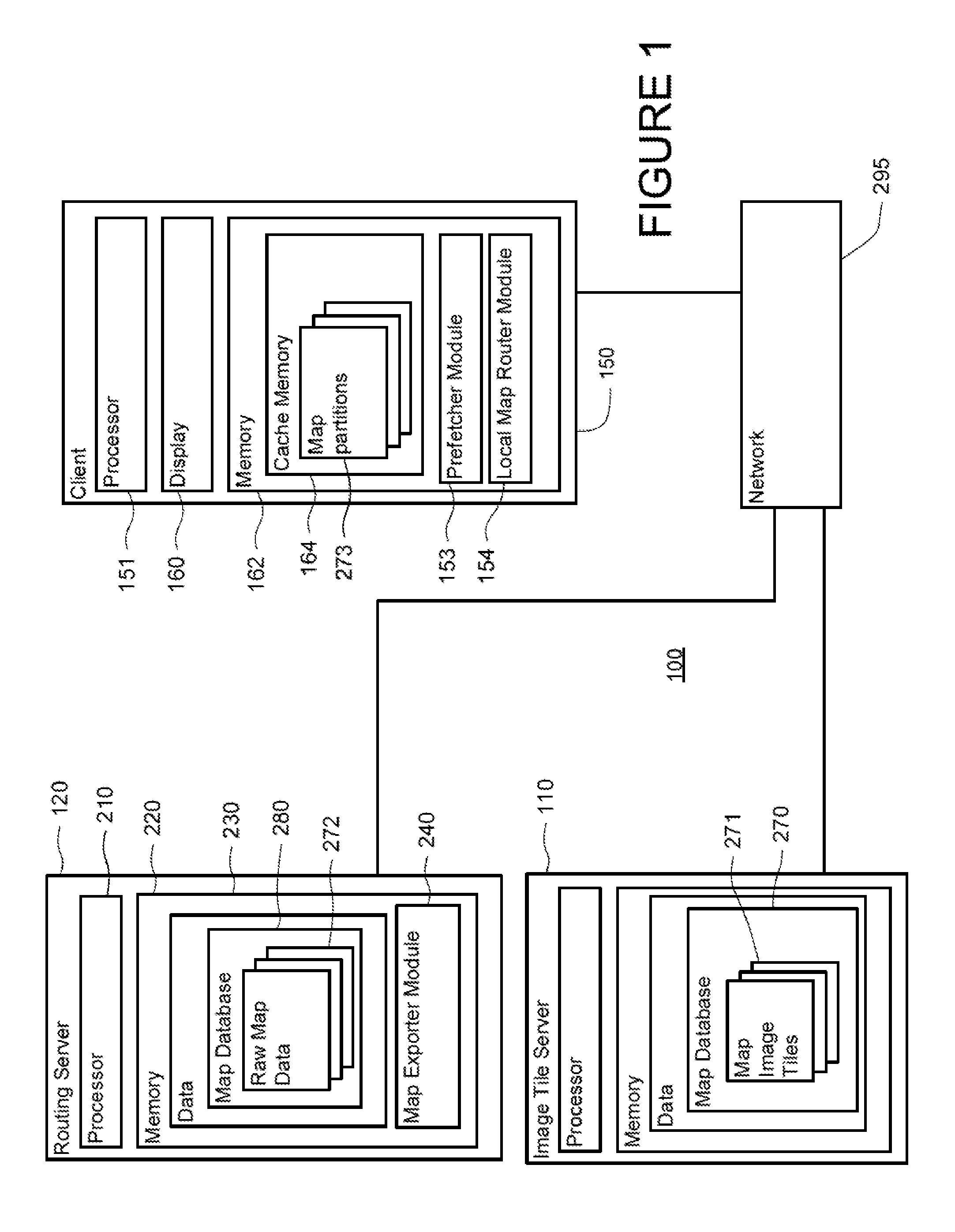
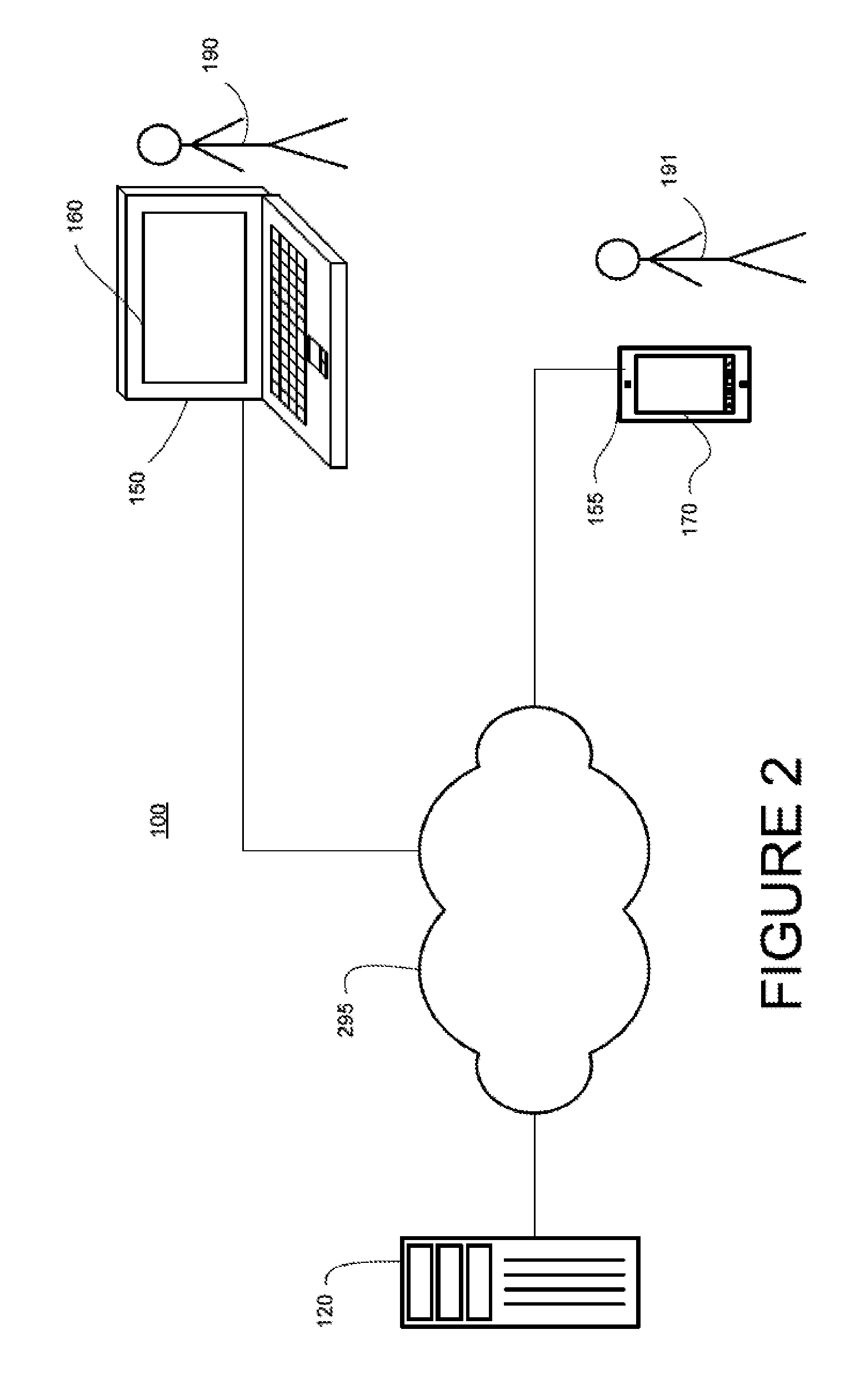
[0029]In one aspect, partitioned map data is transmitted to a client device or a user device. Each map partition may contain road data, such as road geometries, road names, road network topology, or any other information needed to provide driving directions within the partition. Each map partition may be encoded with enough data to allow the partitions to be stitched together to form a larger map. Map partitions may be fetched along each route to be used in the event that the navigation server is not accessible. For example, if a user deviates from the original route and a network outage occurs, the map data may be assembled and a routing algorithm may be applied to the map data in order to direct the user back to the original route.

[0030]As shown in FIGS. 1-2, a system 100 includes an image tile server 110 and a routing server 120 each containing a processor 210, memory 220 and other components typically present in general purpose computers. FIG. 1 also shows a client device or use...