
Glycosyltransferase mutants
A technology of glycosyltransferases and mutants, applied in the direction of transferases, enzymes, genetic engineering, etc., can solve problems such as low yield, harsh growth environment requirements, and inability to meet social needs, and achieve improved catalytic activity and enzyme-catalyzed reaction conditions mild effect
Patent Information
- Authority / Receiving Office
- CN · China
- Patent Type
- Applications(China)
- Current Assignee / Owner
- Publication Date
- 2019-02-01
Smart Images
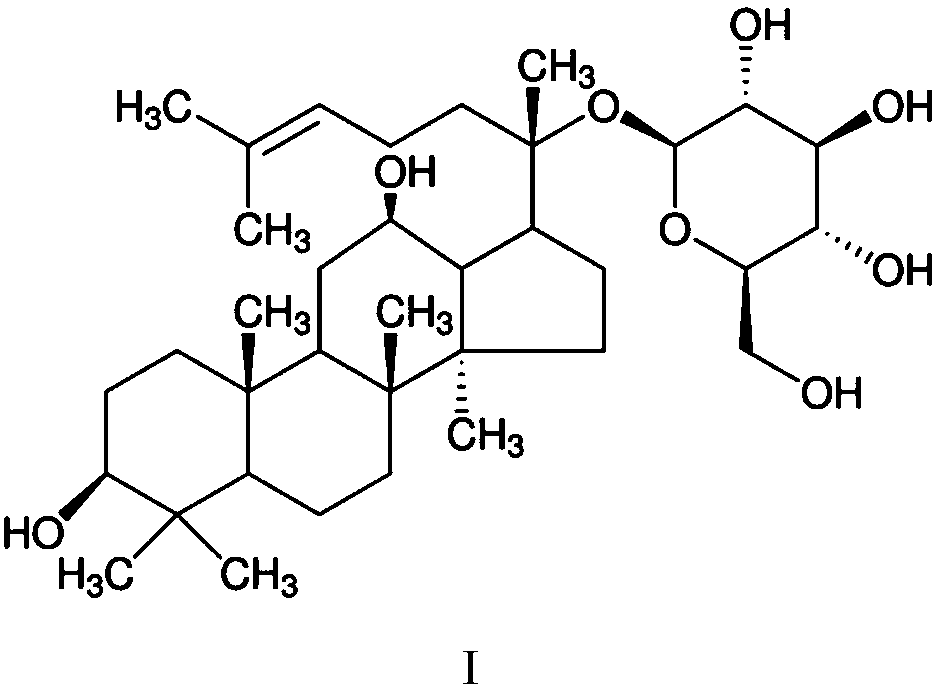
Figure 1
Abstract
Description
technical field
[0001] The invention belongs to the field of biocatalysis, and in particular relates to a glycosyltransferase mutant and its application in synthesizing ginsenoside CK. Background technique
[0002] Ginsenoside is a general term for the saponins isolated from ginseng and its congeners (such as Panax notoginseng, American ginseng, etc.), belonging to triterpenoid saponins, and is the main active ingredient in ginseng. At present, at least 60 saponins have been isolated from ginseng, some of which have been proven to have a wide range of physiological functions and medicinal value: including anti-tumor, immune regulation, anti-fatigue, heart protection, liver protection and other functions. According to the form of aglycone, ginsenosides are generally classified into three types, oleanane type, protopanaxadiol type (PPD type) and protopanaxatriol type (PPT type). Among them, ginsenoside compound K (CK) shown in the following formula I is the most biologically ...
Examples
Embodiment 1
[0064] Embodiment 1 Construction of wild-type UGT1 expression strain
[0065] Synthesize the gene sequence encoding UGT1 as SEQ ID NO: 2, design restriction sites NdeI and BamHI at both ends, clone it into the corresponding site on the pSH plasmid, obtain the recombinant plasmid pSH-UGT1, and then transform it into E. coli expression host by electroporation For BL21(DE3) competent cells, coat the LB medium plate containing kanamycin, cultivate overnight at 37°C, pick a single colony, inoculate it into a test tube containing LB medium, cultivate overnight, collect the bacteria by centrifugation, and extract The plasmid was confirmed to be correct by gene sequencing, and a recombinant genetically engineered strain BL21(DE3) / pSH-UGT1 expressing wild-type UGT1 was obtained.
[0066] The amino acid sequence was determined to be UGT1.
[0067] Select a single clone from a plate containing UGT1 engineered strains, inoculate into 5mL LB medium, and culture at 37°C; inoculate 1% v / v i...
Embodiment 2
[0068] Example 2 Error-prone PCR method constructs UGT1 random mutation point library
[0069] Using pSH-UGT1 as a template, an error-prone PCR technique was used to construct a random mutant library.
[0070] Forward primer UGT1-Nde-F: 5'-CAT ATGAAATCTGAATTAATCTTTT-3',
[0071] Reverse primer UGT1-Bam-R: 5'-GGATCC CTACATAATTTCTTCGAATAAT-3'.
[0072] 50μL error-prone PCR reaction system includes: 50ng plasmid template pSH-UGT1, 30pmol a pair of primers UGT1-Nde-F and UGT1-Bam-R, 1X Taq buffer, 0.2mM dGTP, 0.2mM dATP, 1mM dCTP, 1mM dTTP, 7mM MgCl 2 , (0mM, 0.05mM, 0.1mM, 0.15mM, 0.2mM) MnCl 2 , 2.5 units of Taq enzyme (fermentas). The PCR reaction conditions were: 95°C for 5 minutes; 94°C for 30s, 55°C for 30s, 72°C for 2min / kbp; 30 cycles; 72°C for 10min. The 2.0kb random mutation fragment was recovered from the gel as a large primer, and MegaPrimer PCR was performed with KOD-plus DNA polymerase: 94°C for 5min; 98°C for 10s, 60°C for 30s, 68°C for 2min / kbp, 25 cycles; 68°...
Embodiment 3
[0073] High-throughput screening of embodiment 3 UGT1 mutant library
[0074] 3.1 Select the transformant from the UGT1 mutant library and inoculate it into a 96-well deep-well culture plate containing 700 μL of LB medium containing 100 μg / mL kanamycin. After culturing at 37°C for 6 hours, add a final concentration of 0.1 mM IPTG Afterwards, the temperature was lowered to 25°C and cultured overnight. Centrifuge at 5000rpm for 10min, discard the supernatant, freeze at -70°C for 1h, and thaw at room temperature for 30min. Add 200 μL of lysate (components are 20mM Tris-HCl, pH8.0, 2mM 1,4-dithiothreitol, 4000U lysozyme), resuspend the bacteria, incubate at 37°C for 1 hour, and centrifuge thoroughly to obtain supernatant enzyme liquid.
[0075] Use the enzyme solution obtained above to transfer to a 96-well plate for enzyme reaction, and perform screening according to the method of "High-throughput screening reaction of glycosyltransferase mutants" described above, using wild-ty...