
Turbine cooling cascade with vortex structure
A turbine cooling and trapped vortex technology, applied in the combustion method, combustion chamber, combustion equipment, etc., can solve the problems of easy burnout of the leading edge end wall of the blade, affecting the performance of the blade cascade, and significant heat transfer characteristics, reducing cold air. The effect of utilization, reduction of mixing loss, and improvement of air-conditioning utilization rate
Patent Information
- Authority / Receiving Office
- CN · China
- Patent Type
- Applications(China)
- Current Assignee / Owner
- Publication Date
- 2009-10-07
- Estimated Expiration
- Not applicable · inactive patent
Smart Images
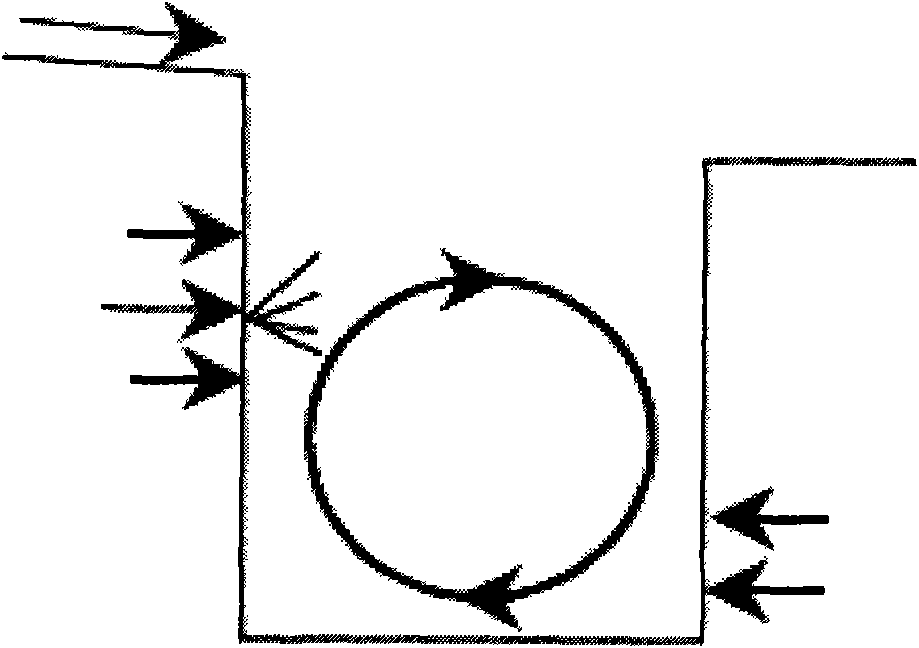
Figure 1 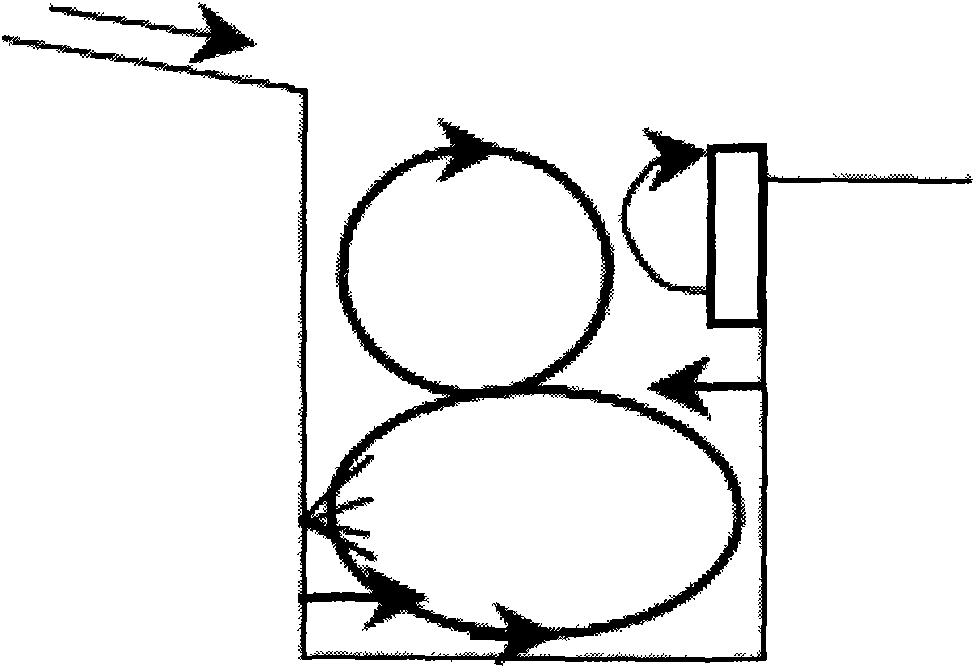
Figure 2 
Figure 3
Abstract
Description
technical field
[0001] The invention relates to a turbine cooling blade cascade. Background technique
[0002] Natural standing vortices can be seen on the sheltered sides of exposed ridges in nature, and similar standing vortices can be seen near sand dunes. When the fluid flows through a cavity, a trapped vortex will also be generated in the cavity due to the viscous effect. For different air blowing positions before and after the cavity, two different structures of double vortex and single vortex can be formed (such as figure 1 and figure 2 shown), the large vortex at the bottom of the double vortex structure is also called the primary vortex, and the small vortex above is also called the secondary vortex. The characteristic of the double vortex structure is that the large vortex at the bottom of the cavity is very stable, and the secondary vortex at the upper part of the cavity can make the gas in the trapped vortex mix with the mainstream air better and faster. [...
Examples
specific Embodiment approach 1
[0009] Embodiment 1: Combining Figure 4 ~ Figure 7 Describing this embodiment, the turbine cooling cascade with trapped vortex structure of this embodiment includes a wall 1 and a blade 2, the blade 2 is arranged on the wall 1, and the blade 2 is close to the pressure surface of the blade leading edge 2-1 2-2, the suction surface 2-3 of the blade 2 close to the leading edge of the blade 2-1, and the end wall 1-1 of the blade leading edge of the wall 1 are provided with a plurality of long grooves 3 arranged in rows, and the blade 2 Each long groove 3 on the pressure surface 2-2 close to the blade leading edge 2-1 and each long groove 3 on the suction surface 2-3 of the blade 2 close to the blade leading edge 2-1 are along the height direction of the blade 2 Open, each long groove 3 on the blade leading edge end wall 1-1 of the wall 1 is opened along the width direction of the wall 1, and one side wall of each long groove 3 is opened along the length direction of the long groo...
specific Embodiment approach 2
[0010] Specific implementation mode 2: Combining Figure 4 ~ Figure 7 Illustrating this embodiment, in this embodiment, the pressure surface 2-2 of the blade 2 close to the trailing edge 2-4 of the blade and the suction surface 2-3 of the blade 2 close to the trailing edge 2-4 of the blade are both opened in rows. Each long groove 3 on the pressure surface 2-2 of the blade 2 close to the trailing edge 2-4 of the blade and each long groove 3 on the suction surface 2-3 of the blade 2 close to the trailing edge 2-4 of the blade All are opened along the height direction of the blade 2 . This arrangement effectively avoids the burnout of the pressure surface, the suction surface and the high temperature area of the trailing edge, and effectively improves the overall performance of the blade. Other components and connection relationships are the same as in the first embodiment.
specific Embodiment approach 3
[0011] Specific implementation three: combination Figure 4 ~ Figure 7 Illustrating this embodiment, the cross section of the long groove 3 in this embodiment is a square, a trapezoid or a semicircle. In this way, the blade as a whole has diversity, and the strength of the standing vortex and the covering effect of the thin-layered gas film are better. Other compositions and connection relationships are the same as in the second embodiment.