Unlock instant, AI-driven research and patent intelligence for your innovation.
Solar silicon slice cleaning agent and method for preparing same
What is Al technical title?
Al technical title is built by PatSnap Al team. It summarizes the technical point description of the patent document.
A technology for solar silicon wafers and cleaning agents, applied in detergent compounding agents, detergent compositions, chemical instruments and methods, etc., can solve the problems affecting device quality and yield, inappropriate solution concentration, black surface of silicon wafers, etc. To solve the problem, to achieve the effect of complete dissolving scale, cheap and easy-to-obtain chemicals, and strong ability to remove oil and stubborn scale
Active Publication Date: 2012-05-23
BEIJING UNIV OF TECH
View PDF0 Cites 1 Cited by
Summary
Abstract
Description
Claims
Application Information
AI Technical Summary
This helps you quickly interpret patents by identifying the three key elements:
Problems solved by technology
Method used
Benefits of technology
Problems solved by technology
[0002] In the process of industrial production, particles, metal contamination, organic contamination, natural oxide film, micro-roughness, etc. Affect the quality and yield of the device. At present, the main problems of the silicon wafer cleaning solution are the phenomena of blackening, bluishness, mottled, overoxidation, and inconsistent color on the surface of the silicon wafer after cleaning. These phenomena are mainly caused by the cleaning solution. The reagent ratio, temperature control, solution concentration and other factors caused by inappropriate
Method used
the structure of the environmentally friendly knitted fabric provided by the present invention; figure 2 Flow chart of the yarn wrapping machine for environmentally friendly knitted fabrics and storage devices; image 3 Is the parameter map of the yarn covering machine
View more
Image
Smart Image Click on the blue labels to locate them in the text.
Viewing Examples
Smart Image
Click on the blue label to locate the original text in one second.
Reading with bidirectional positioning of images and text.
Smart Image
Examples
Experimental program
Comparison scheme
Effect test
Embodiment Construction
[0015] 1. Cleaning solution preparation steps:
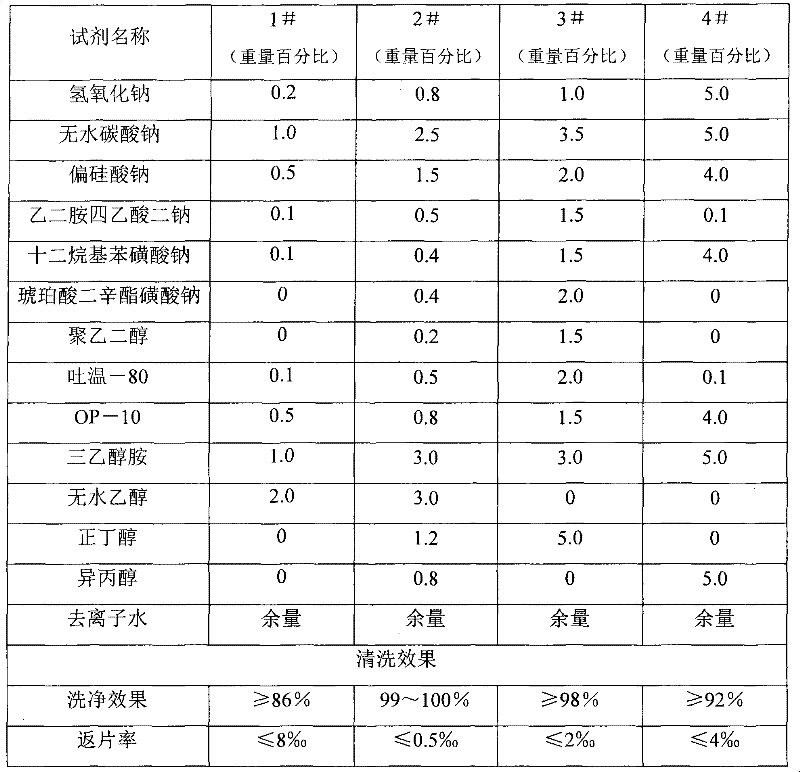
[0016] 1. Dissolve an appropriate amount of sodium hydroxide in deionized water to make an alkaline solution, then mix 1-5% sodium carbonate and 0.5-4% sodium silicate and dissolve them in the above-mentioned warm water to obtain a mixed solution.
[0017] 2. Add 0.1-1.5% chelating agent disodium ethylenediamine tetraacetate into the above mixed solution and stir evenly to prepare solution A.
[0018] 3. Add 0.1-4% of anionic surfactant sodium dodecylbenzene sulfonate, 0.4-2% dioctyl sodium sulfosuccinate, 0-1.5% of non-ionic surfactant polyethylene glycol, 0.1 ~2% of non-ionic surfactant Tween-80, 0.5-4% of non-ionic surfactant OP-10 were dissolved in deionized water and stirred evenly to prepare solution B.
[0019] 4. Mix 1-5% additive triethanolamine and 2-5% organic solvent absolute ethanol or n-butanol or isopropanol to prepare solution C.
[0020] 5. Dissolve solution B in solution C and mix well, then add the mixed sol...
the structure of the environmentally friendly knitted fabric provided by the present invention; figure 2 Flow chart of the yarn wrapping machine for environmentally friendly knitted fabrics and storage devices; image 3 Is the parameter map of the yarn covering machine
Login to View More
PUM
Login to View More
Abstract
The invention provides a solar silicon slice cleaning agent, and belongs to the field of cleaning agents for electronic industry. The cleaning agent of the invention mainly comprises sodium hydroxide, sodium carbonate, sodium silicate, disodium edentate, sodium dodecyl benzene sulfonate, sodium dioctyl sulfosuccinate, polyethylene glycol, Tween-80, OP-10, triethanolamine, anhydrous alcohol or normal butyl alcohol or isopropyl alcohol or a composition of anhydrous alcohol, normal butyl alcohol or isopropyl alcohol, and deionized water. The cleaning agent is alkaline, does not contain sulfur and phosphorus additives, and when used as alone, has the advantages of good decontamination and cleaning property, low slice-returning rate, long service cycle, no corrosion to silicon slice, low operational requirements in use, easy treatment of treated waste oil and sewage, and the suitability for manual, semi-automatic and full automatic ultrasonic cleaning production lines of various process; in addition, the cleaning rate is over 99 percent, the slice-returning rate is close to zero, and the cost of the process of the invention is one tenth to one twentieth of that of the conventional cleaning process.
Description
technical field [0001] The invention belongs to the technical field of surface cleaning for the electronic industry, and in particular relates to a cleaning agent which can be used for surface cleaning of photovoltaic solar silicon wafers and a preparation method thereof. Background technique [0002] In the process of industrial production, particles, metal contamination, organic contamination, natural oxide film, micro-roughness, etc. Affect the quality and yield of the device. At present, the main problems of the silicon wafer cleaning solution are the phenomena of blackening, bluishness, mottled, overoxidation, and inconsistent color on the surface of the silicon wafer after cleaning. These phenomena are mainly caused by the cleaning solution. The reagent ratio, temperature control, solution concentration and other factors are not suitable. Contents of the invention [0003] The object of the present invention is to provide a special water-based cleaning agent for sol...
Claims
the structure of the environmentally friendly knitted fabric provided by the present invention; figure 2 Flow chart of the yarn wrapping machine for environmentally friendly knitted fabrics and storage devices; image 3 Is the parameter map of the yarn covering machine
Login to View More
Application Information
Patent Timeline
Application Date:The date an application was filed.
Publication Date:The date a patent or application was officially published.
First Publication Date:The earliest publication date of a patent with the same application number.
Issue Date:Publication date of the patent grant document.
PCT Entry Date:The Entry date of PCT National Phase.
Estimated Expiry Date:The statutory expiry date of a patent right according to the Patent Law, and it is the longest term of protection that the patent right can achieve without the termination of the patent right due to other reasons(Term extension factor has been taken into account ).
Invalid Date:Actual expiry date is based on effective date or publication date of legal transaction data of invalid patent.

 Login to View More
  Login to View More