Method for suppressing residual multi-user interference in 2-dimensional block spread system based on 2-dimensional minimum mean square error detection algorithm
A minimum mean square error, multi-user interference technology, applied in the field of communication, can solve the problem of residual multi-user interference in two-dimensional block spread spectrum system, and achieve the effect of improving residual multi-user interference and moderate complexity
- Summary
- Abstract
- Description
- Claims
- Application Information
AI Technical Summary
Problems solved by technology
Method used
Image



Examples
specific Embodiment approach 1
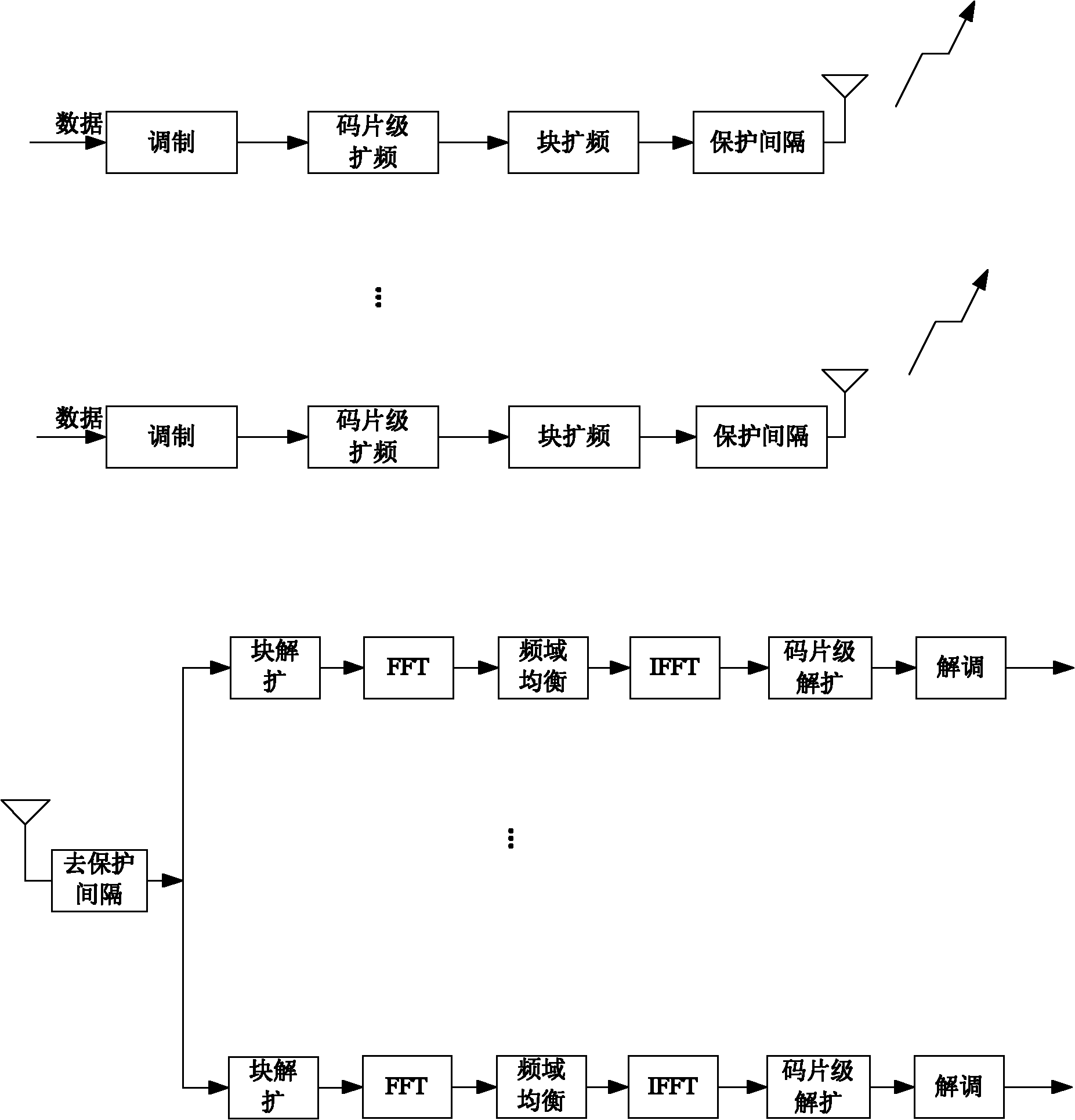
[0041] Specific implementation mode one: the following combination image 3 Describe this implementation mode, this implementation mode is based on the residual multi-user interference suppression method in the two-dimensional block spread spectrum system of the two-dimensional minimum mean square error detection algorithm, under the SC-CDMA system:
[0042] Launch process:
[0043] Step 1, respectively performing chip-level spread spectrum on the U-channel modulated signal to obtain the signal after U-channel chip-level spread spectrum;
[0044] Step 2, carry out block spread spectrum respectively to the signal after U chip-level spread spectrum obtained in step 1, obtain the signal after U block spread spectrum;
[0045] Step 3, adding the U-channel block-spread signals obtained in step 2 into guard interval processing respectively, obtaining the processed U-channel signal, and transmitting to the channel through the transmitting antenna;
[0046] Receiving process:
[00...
specific Embodiment approach 2
[0055] Specific implementation mode two: the following combination Figure 4 to Figure 6 Describe this implementation mode, this implementation mode is based on the residual multi-user interference suppression method in the two-dimensional block spread spectrum system of the two-dimensional minimum mean square error detection algorithm, under the MC-CDMA system:
[0056] Launch process:
[0057] Step 1. Carry out chip-level spreading and interleaving of U-channel modulated signals respectively, to obtain signals after U-channel chip-level spreading;
[0058]Step 2, performing inverse fast Fourier transform on the U-channel chip-level spread-spectrum signal obtained in step 1, respectively, to obtain the time-domain signal after the U-channel transform;
[0059] Step 3, performing block spread spectrum respectively on the time-domain signal after U channel transformation obtained in step 2, to obtain the signal after U channel block spread spectrum;
[0060] Step 4, add the U...
PUM
 Login to View More
 Abstract
Description
Claims
Application Information
 Login to View More