AI technical title is built by PatSnap AI team. It summarizes the technical point description of the patent document.
An electrocatalyst, electrocatalysis technology, applied in electrochemical generators, circuits, fuel cells, etc., can solve the problems of expensive, poor long-term stability, high overpotential and so on
Inactive Publication Date: 2012-02-08
MAGNETO SPECIAL ANODES
View PDF6 Cites 3 Cited by
Summary
Abstract
Description
Claims
Application Information
AI Technical Summary
This helps you quickly interpret patents by identifying the three key elements:
Problems solved by technology
Method used
Benefits of technology
Problems solved by technology
However, they require higher overpotentials than e.g. Ru-based and Ir-based catalysts
On the other hand, Ru-based and Ir-based catalysts have the disadvantages of being expensive and poor long-term stability in alkaline media
Method used
the structure of the environmentally friendly knitted fabric provided by the present invention; figure 2 Flow chart of the yarn wrapping machine for environmentally friendly knitted fabrics and storage devices; image 3 Is the parameter map of the yarn covering machine
View more
Image
Smart Image Click on the blue labels to locate them in the text.
Viewing Examples
Smart Image
Click on the blue label to locate the original text in one second.
Reading with bidirectional positioning of images and text.
Smart Image
Examples
Experimental program
Comparison scheme
Effect test
Embodiment 1
[0047] The catalyst was prepared by the general method disclosed in US4528084 and US4797182. According to these general methods, the support for the catalyst is degreased and etched with dilute acid. Then, a coating containing the desired metal salt or oxide is applied. The carrier is dried and heated in air at about 500°C. If the desired number of paint layers can be applied, they are then dried and heated.
[0048] The PtIr (70:30) catalyst was prepared as follows. The titanium sheet (160×30×1 mm) was degreased and etched (20% HCl, 90° C.), and then cleaned with deionized water. Apply H by coating 2 PtCl 6 and IrCl 3 of aqueous solution. Coating thickness is 5g / m 2 . The titanium sheet is then dried and heated at about 500°C.
[0049] The preparation of the TaIr catalyst is as follows. The titanium sheet (160×30×1 mm) was degreased and etched (20% HCl, 90° C.), and then cleaned with deionized water. Applied by coating with Ta(V) ethoxide and H 2 IrCl 6 organic ...
Embodiment 2
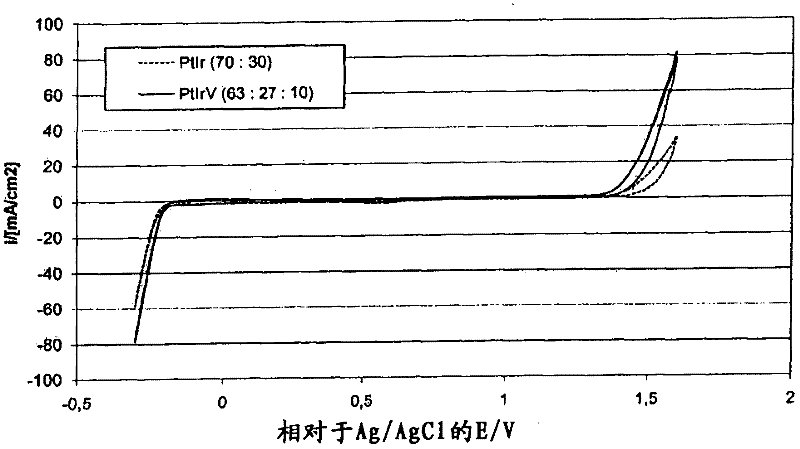
[0052] Cyclic voltammetry measurements were performed on the catalyst composition under the following conditions:
[0053] Electrolyte: H 2 SO 4 (25%w / w)
[0054] Potential: -300 / 1600mV
[0055] Scan speed: 5mV / s
[0056] Temperature: 25°C (in the oven)
[0057] Reference electrode: Ag / AgCl
[0058] Air Flow Through Electrolyte: Yes
[0059] In Table 1 the catalyst composition (on Ti support) and the results are shown.
[0060] Table 1
[0061]
Embodiment 3
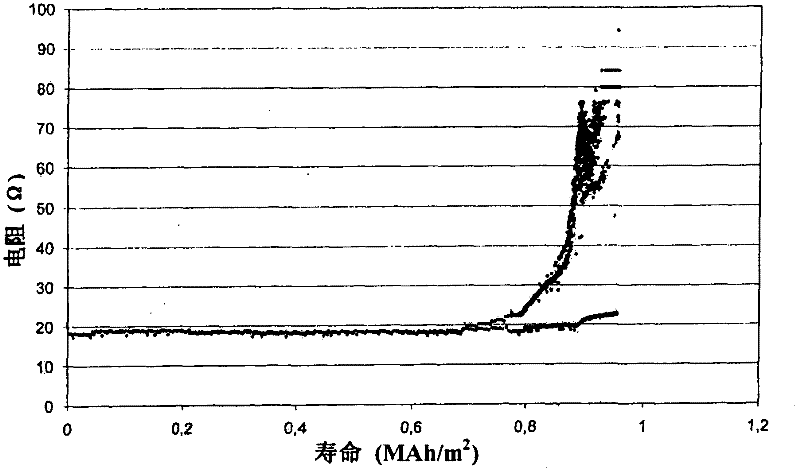
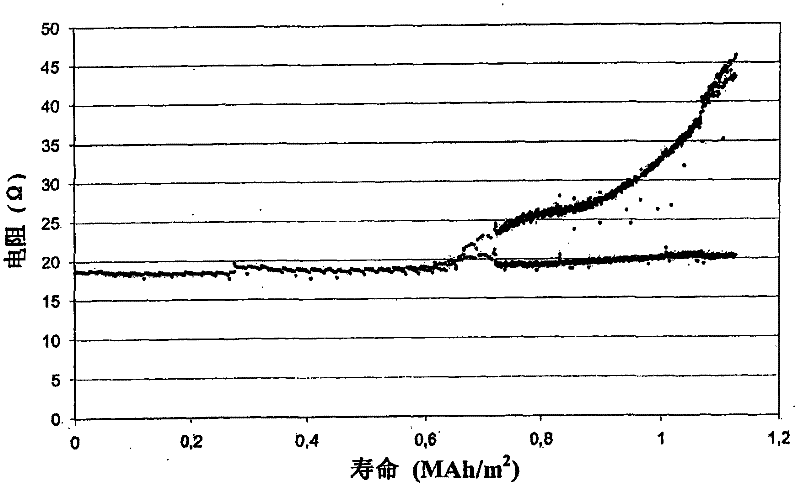
[0063] In the cycle life test, at 2500A / m alternating as anode and cathode (reversing polarity every 5 minutes) 2 The Pt-Ir catalyst (70:30 weight ratio) and the Pt-Ir-V catalyst (69:29:2 weight ratio) on the Ti support were compared at the current density. Tested at 1mol / l Na 2 SO 4 carried out at 50°C.
[0064] Compared with Pt-Ir catalyst, Pt-Ir-V catalyst has higher activity in HER, HOR, ORR, OER (the cycle life of Pt-Ir-V is 1.06MAh / m 2 =102.3kAh / g.m 2 ); the cycle life of Pt-Ir is 0.86MAh / m 2 =80.7kAh / g.m 2 ). The result is as figure 1 and 2 shown. Therefore, the cycle life of Pt-Ir-V is increased by about 27% relative to Pt-Ir (102.3 / 80.7=1.27).
the structure of the environmentally friendly knitted fabric provided by the present invention; figure 2 Flow chart of the yarn wrapping machine for environmentally friendly knitted fabrics and storage devices; image 3 Is the parameter map of the yarn covering machine
Login to View More
PUM
Login to View More
Abstract
The present invention relates to an electro-catalyst, specificially to an electro-catalyst M'aIrbMc, wherein M' is selected from the group consisting of Pt, Ta and Ru, and wherein the molar ratio a : b is within the range of 85 : 15 to 50 : 50 and the molar ratio a : c is within the range of 50 : 50 to 95 : 5, both calculated as pure metal and wherein M is selected from metals from Groups 3-15 of the Periodic System of Elements. The present invention further relates to an electrode comprising a support and the electro-catalyst. The present invention further relates to the use of the electro-catalyst and / or the electrode in electrochemical processes which comprise an oxygen reduction reaction (ORR), an oxygen evolution reaction (OER), a hydrogen evolution reaction (HER), a hydrogen oxidation reaction (HOR), a carbon monoxide oxidation reaction (COR) or a methanol oxidation reaction (MOR).
Description
Summary of the invention [0001] The present invention relates to an electrocatalyst comprising a first metal selected from Pt, Ta and Ru, a second metal being Ir, and a third metal. The invention also relates to the use of electrodes containing the catalyst and the use of said electrodes in electrocatalytic processes. In particular, the electrocatalyst can serve as a dual-functional air electrode for oxygen reduction reaction, oxygen evolution reaction, hydrogen evolution reaction, hydrogen oxidation reaction, carbon monoxide oxidation reaction, and methanol oxidation reaction. Background technique [0002] The use of metal-based catalysts in electrocatalytic processes is well known in the prior art. For example, hydrogen / air fuel cells generate electricity by converting fuel, usually hydrogen. Conventionally, such fuel cells contain membranes such as Nafion ) separated by two half-cells, where hydrogen is oxidized at the anode (usually a Pt-based anode), the correspondi...
Claims
the structure of the environmentally friendly knitted fabric provided by the present invention; figure 2 Flow chart of the yarn wrapping machine for environmentally friendly knitted fabrics and storage devices; image 3 Is the parameter map of the yarn covering machine
Login to View More
Application Information
Patent Timeline
Application Date:The date an application was filed.
Publication Date:The date a patent or application was officially published.
First Publication Date:The earliest publication date of a patent with the same application number.
Issue Date:Publication date of the patent grant document.
PCT Entry Date:The Entry date of PCT National Phase.
Estimated Expiry Date:The statutory expiry date of a patent right according to the Patent Law, and it is the longest term of protection that the patent right can achieve without the termination of the patent right due to other reasons(Term extension factor has been taken into account ).
Invalid Date:Actual expiry date is based on effective date or publication date of legal transaction data of invalid patent.



 Login to View More
  Login to View More