
FPGA (field programmable gate array) control-based all-solid-state high-voltage nanosecond pulse generator
A high-voltage nanosecond square wave and pulse generator technology, which is applied in biochemical instruments, stress-stimulated microbial growth methods, biochemical equipment and methods, etc., can solve the problem of accurate display and adjustment of pulse parameters and real-time adjustment of unfavorable pulse parameters. , low output pulse repetition frequency, etc., to achieve the effect of ensuring insulation, avoiding electromagnetic interference, and compact structure
- Summary
- Abstract
- Description
- Claims
- Application Information
AI Technical Summary
Problems solved by technology
Method used
Image

Examples
Embodiment 1
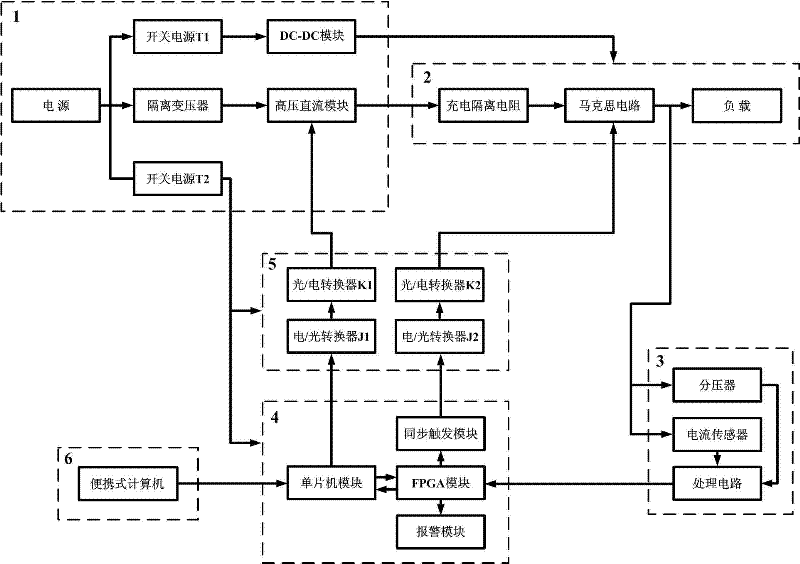
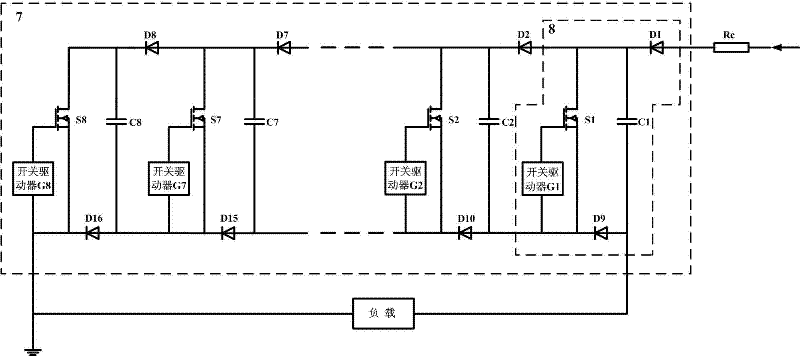
[0026] Such as Figure 1~2 As shown, an all-solid-state high-voltage nanosecond square wave pulse generator based on FPGA control mainly includes a power supply system 1, a pulse forming system 2, a pulse measurement system 3, an FPGA control system 4, a signal conversion system 5 and a portable computer 6.
[0027] The power supply system 1 includes a power supply, an isolation transformer (both voltage and frequency conversion ratios are 1:1), a high-voltage DC module, a switching power supply T1, a switching power supply T2, and a DC-DC module. The power supply is 220V mains, connected to the primary side of the isolation transformer through wires, and the secondary side of the isolation transformer is connected to the input end of the high-voltage DC module through wires to provide AC power for the high-voltage DC module. The high-voltage direct current module is a commercially available module that outputs direct current with a maximum voltage amplitude of 2000V and a m...
Embodiment 2
[0034] An all-solid-state high-voltage nanosecond square-wave pulse generator based on FPGA control is the same as in Embodiment 1, wherein the Max circuit 7 of the pulse forming system 2 is composed of 4 voltage units 8 with bypass diodes connected in series on the motherboard.
Embodiment 3
[0036] An all-solid-state high-voltage nanosecond square wave pulse generator based on FPGA control is the same as in Embodiment 1, wherein the Max circuit 7 of the pulse forming system 2 is composed of 10 voltage units 8 with bypass diodes connected in series on the motherboard.
PUM
 Login to View More
 Abstract
Description
Claims
Application Information
 Login to View More