Malus xiaojinensis Cheng et Jiang MxHA5 protein, and coding gene and application thereof
What is AI technical title?
AI technical title is built by PatSnap AI team. It summarizes the technical point description of the patent document.
A gene and coding technology is applied to the small golden begonia MxHA5 protein and its coding gene and application field to achieve the effect of increasing iron deficiency tolerance
Inactive Publication Date: 2013-11-06
CHINA AGRI UNIV
View PDF1 Cites 0 Cited by
Summary
Abstract
Description
Claims
Application Information
AI Technical Summary
This helps you quickly interpret patents by identifying the three key elements:
Problems solved by technology
Method used
Benefits of technology
Problems solved by technology
Although many studies have demonstrated that H + The -ATPase gene has a great effect on improving the tolerance of plants, but it has not been seen about the plasma membrane H in the small golden crabapple. + -Report of ATPase gene
Method used
the structure of the environmentally friendly knitted fabric provided by the present invention; figure 2 Flow chart of the yarn wrapping machine for environmentally friendly knitted fabrics and storage devices; image 3 Is the parameter map of the yarn covering machine
View more
Image
Smart Image Click on the blue labels to locate them in the text.
Viewing Examples
Smart Image
Click on the blue label to locate the original text in one second.
Reading with bidirectional positioning of images and text.
Smart Image
Examples
Experimental program
Comparison scheme
Effect test
Embodiment 1
[0053] Embodiment 1, the acquisition of MxHA5 protein and its coding gene
[0054] 1. Obtaining the full length of the MxHA5 gene
[0055] Total RNA was extracted from leaves of Begonia chinensis and reverse transcribed into cDNA. Using cDNA as a template, using a primer pair composed of F1 and R1, PCR amplification was performed using a high-fidelity HiFi mix to obtain PCR amplification products.
[0056] F1: 5'-ATGGCCGGCGATAAGG-3';
[0057] R1: 5'-AACTGTATAATGTTGTTGAATTGTATCG-3'.
[0058] PCR amplification system (20μl): ddH 2 O 7.0 μl, 2×HiF Mix (0.5 U / μl) 10 μl, F1 (10 mM) 1.0 μl, R1 (10 mM) 1.0 μl and template 1.0 μl.
[0059] PCR amplification program: 94°C pre-denaturation for 5 minutes; then denaturation at 94°C for 30 s, annealing at 50°C for 30 s, and extension at 72°C for 3 min, a total of 33 cycles; finally, extension at 72°C for 10 min.
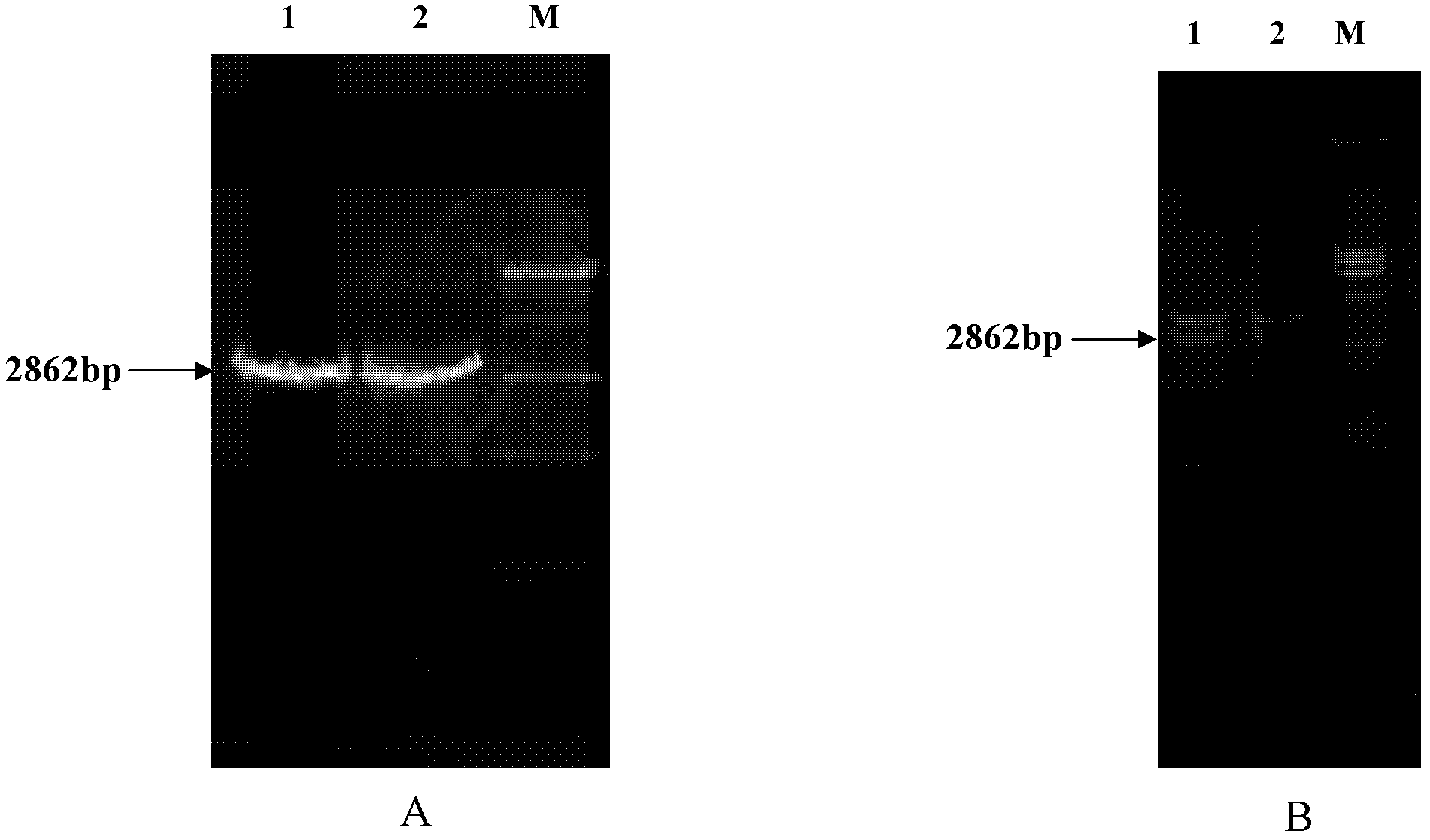
[0060] Perform 1% agarose gel electrophoresis on the PCR amplification product, see figure 1 A (Swimming lane M is a DNA ...
Embodiment 2
[0099] Example 2, the acquisition of transgenic yeast and the analysis of its resistance to heavy metal toxicity
[0100] 1. Obtaining of transgenic yeast
[0101] 1. Digest the recombinant T vector pEASY-MxHA5 constructed in Example 1 with restriction enzymes KpnI and XbaI, and recover the digested product (about 2965 bp).
[0102] 2. Digest pYES2.0 plasmid (yeast expression vector, Beijing Dingguo Changsheng Biotechnology Co., Ltd.) with restriction enzymes KpnI and XbaI, and recover the vector backbone (about 5800bp).
[0103] 3. Ligate the digested product of step 1 with the vector backbone of step 2 to obtain the recombinant expression vector pYES2.0-MxHA5.
[0104] 4. The recombinant expression vector pYES2.0-MxHA5 was introduced into the yeast strain BJ2168 using the yeast transformation kit (Beijing Pangeno Technology Co., Ltd.), and the transgenic yeast BJ2168 / pYES2.0-MxHA5 was obtained.
[0105] 5. Construction of control plasmid
[0106] (1) Digest pEASY-T1 sampl...
the structure of the environmentally friendly knitted fabric provided by the present invention; figure 2 Flow chart of the yarn wrapping machine for environmentally friendly knitted fabrics and storage devices; image 3 Is the parameter map of the yarn covering machine
Login to View More
PUM
Login to View More
Abstract
The invention discloses a malus xiaojinensis Cheng et Jiang MxHA5 protein, and a coding gene and application thereof. The protein provided by the invention is protein (a) or protein (b), wherein the protein (a) has amino acid sequences shown as a sequence 1 in a sequence table; and the protein (b) has an amino acid residue sequence which is derived from the sequence 1 by substituting and / or losing and / or adding one or more amino acid residues and is related with the P type H<+>-ATPase enzymatic activity in plant. The MxHA5 protein provided by the invention has an important effect of adjusting ion-deficient stressed plant, and the invention further provides good theoretical basis for the research on the ion-deficiency resistance of malus xiaojinensis Cheng et Jiang, and has significance to cultivation of stress-tolerant plant.
Description
technical field [0001] The invention relates to a small golden crabapple MxHA5 protein, its coding gene and application. Background technique [0002] Iron is an essential mineral element for the human body. Because plants are the main source of dietary iron for the world's population, a low iron content in plants will directly affect human health. According to the World Health Organization survey, nearly 2 billion people suffer from anemia. Premature births, congenital defects, mental retardation and decreased health indices are mainly caused by anemia. [0003] Studies have shown that plants can only absorb soluble iron-Fe(II) in the soil, but in alkaline soil (pH7.4-8.5), the concentration of soluble iron is less than 10 -10 mol·L-1, causing many plants to exhibit symptoms of iron deficiency stress. Mild iron deficiency in plants will lead to reduced chlorophyll synthesis and photosynthetic rate, severe iron deficiency will stop chlorophyll synthesis, new leaves will ...
Claims
the structure of the environmentally friendly knitted fabric provided by the present invention; figure 2 Flow chart of the yarn wrapping machine for environmentally friendly knitted fabrics and storage devices; image 3 Is the parameter map of the yarn covering machine
Login to View More
Application Information
Patent Timeline
Application Date:The date an application was filed.
Publication Date:The date a patent or application was officially published.
First Publication Date:The earliest publication date of a patent with the same application number.
Issue Date:Publication date of the patent grant document.
PCT Entry Date:The Entry date of PCT National Phase.
Estimated Expiry Date:The statutory expiry date of a patent right according to the Patent Law, and it is the longest term of protection that the patent right can achieve without the termination of the patent right due to other reasons(Term extension factor has been taken into account ).
Invalid Date:Actual expiry date is based on effective date or publication date of legal transaction data of invalid patent.



 Login to View More
  Login to View More