
Multi-element composite microorganism bacterial manure and preparation method thereof
A microbial fertilizer, multi-composite technology, applied in fertilizer mixtures, organic fertilizers, fertilization devices, etc., can solve the problems of air pollution, food safety hazards, non-renewable energy consumption, etc., to reduce the occurrence of plant diseases and improve soil. Agglomerate structure, the effect of solving soil compaction
- Summary
- Abstract
- Description
- Claims
- Application Information
AI Technical Summary
Problems solved by technology
Method used
Image

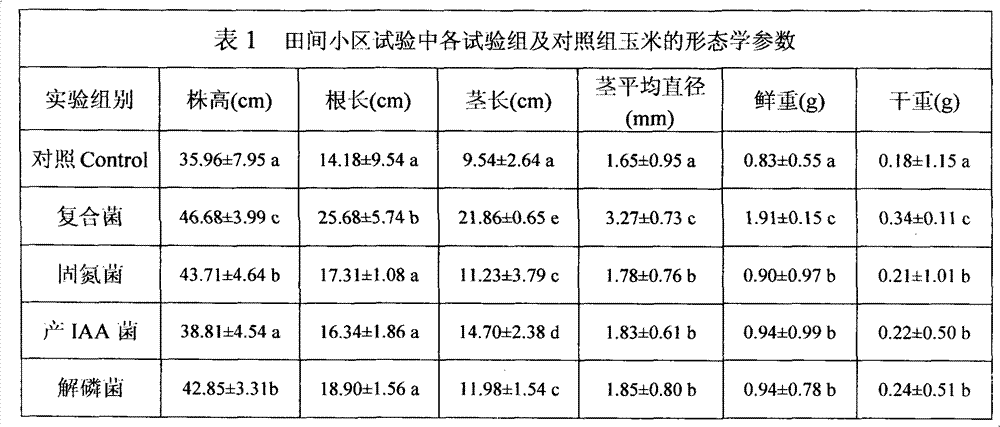

Examples
Embodiment 1
[0023] The specific preparation method of bacterial fertilizer:
[0024] The sources of 4 kinds of microbial strains involved in the present invention are as follows:
[0025] Phosphorus solubilizing bacteria: (Bacillus megaterium, CGMCC No.4296);
[0026] Azotobacter: (Azotobacter beijerinckii, DSM No.373);
[0027] IAA-producing bacteria: (Paenibacillus polymyxa, CGMCC No.3044);
[0028] Anti-bacteria: (Paracoccus sphaerophysae, ACCC 05413T);
[0029] The specific formulations of culture media for various strains are as follows:
[0030] (1) Phosphobacteria Pikovskaya's medium: glucose 10.0g, (NH 4 ) 2 SO 4 0.5g, NaCl 0.3g, MgSO 4 ·7H 2 O 0.3g, KCl 0.3g, FeSO 4 ·7H 2 O 0.03g, MnSO 4 4H 2 O 0.03g, Ca 3 (PO 4 ) 2 5.0g, dH 2 O 1000mL, pH7.0;
[0031] (2) Azotobacter Ashby medium: KH 2 PO 4 0.2g, MgSO 4 ·7H 2 O 0.2g, NaCl 0.2g, mannitol 10.0g, CaSO 4 ·7H 2 O 0.1g, dH 2 O 1000mL, pH7.0;
[0032] (3) Produce IAA culture medium: (NH 4 ) 2 SO 4 6.6g, ...
Embodiment 2
[0045] Taking tomatoes cultivated according to conventional management in the greenhouse as the test object, dilute the multivariate compound microbial fertilizer 300 times to make a compound microbial fertilizer dilution, and use the dilution as a base fertilizer for root irrigation at an amount of 25 kg of dilution per mu. Spray the leaves evenly. Spraying clear water was used as the control group, and each treatment group was repeated 4 times, and each repetition was 30m 2 , Determining the total weight of tomatoes during the test period. The test results showed that the tomato yield of the control group was 5.8kg / m 2 , the output of the test group was 7.9kg / m 2 , processing improved by 36.2%.
Embodiment 3
[0047] Select tomato seedlings at the three-leaf stage cultivated by conventional management in the greenhouse, dilute the multivariate compound microbial bacterial fertilizer by 300 times by volume to make a compound microbial bacterial fertilizer dilution, and apply 10kg of dilution per mu to the whole tomato seedling. Plants were evenly sprayed, and after the leaf surface was naturally dried for 48 hours, the spore suspension of Botrytis cinerea was sprayed and inoculated at an amount of 10kg / mu. 4 replicates per treatment, 30m per replicate 2 , and sterilized distilled water was used as the blank control (CK). After the onset of the blank control, regular observation, statistics and calculation of plant disease index and disease prevention effect. According to the percentage of lesion area to leaf area, disease grades are divided: grade 0 (no disease); grade 1 (50%); Grade 5 (leaves are completely dead).
[0048] The calculation formulas for disease index and disease pre...
PUM
 Login to View More
 Abstract
Description
Claims
Application Information
 Login to View More