Check patentability & draft patents in minutes with Patsnap Eureka AI!

Parallel self-adaption data sending method and device based on multiple IP (Internet Protocol) addresses

A data sending method and IP address technology, applied in the field of network communication, can solve the problems such as the inability of real-time dynamic adjustment of data volume and the increase of cost, and achieve the effect of realizing adaptive load balancing and improving the overall transmission speed.

Active Publication Date: 2013-01-09
BEIJING UNIV OF POSTS & TELECOMM
View PDF4 Cites 5 Cited by
  • Summary
  • Abstract
  • Description
  • Claims
  • Application Information

AI Technical Summary

Problems solved by technology

[0003] The present invention provides a parallel self-adaptive data transmission method and device based on multiple IP addresses to solve the problem of parallel data transmission through an application processor only through a wireless network card with a UART interface in the prior art, cost increase and data volume cannot be carried out The problem of real-time dynamic adjustment, for this reason the present invention adopts following technical scheme:

Method used

the structure of the environmentally friendly knitted fabric provided by the present invention; figure 2 Flow chart of the yarn wrapping machine for environmentally friendly knitted fabrics and storage devices; image 3 Is the parameter map of the yarn covering machine
View more

Image

Smart Image Click on the blue labels to locate them in the text.
Viewing Examples
Smart Image
  • Parallel self-adaption data sending method and device based on multiple IP (Internet Protocol) addresses
  • Parallel self-adaption data sending method and device based on multiple IP (Internet Protocol) addresses

Examples

Experimental program
Comparison scheme
Effect test

Embodiment Construction

[0015] The following will clearly and completely describe the technical solutions in the embodiments of the present invention with reference to the accompanying drawings in the embodiments of the present invention. Obviously, the described embodiments are only some, not all, embodiments of the present invention. Based on the embodiments of the present invention, all other embodiments obtained by persons of ordinary skill in the art without creative efforts fall within the protection scope of the present invention.

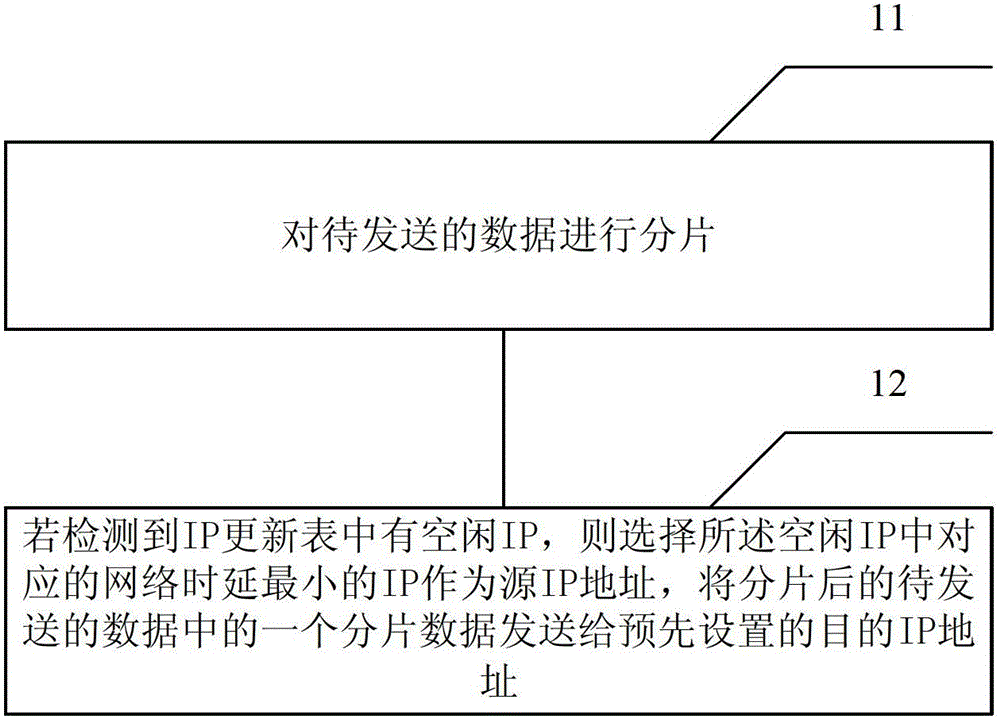
[0016] A method of parallel adaptive data transmission based on multiple IP addresses provided in the embodiment of the present invention, such as figure 1 shown, including:

[0017] 11. Fragment the data to be sent.

[0018] Specifically, the size of the data fragmentation is determined according to the user's needs. After the data to be sent is fragmented, the transmission speed of the data to be sent through multiple network cards can be increased compared with...

the structure of the environmentally friendly knitted fabric provided by the present invention; figure 2 Flow chart of the yarn wrapping machine for environmentally friendly knitted fabrics and storage devices; image 3 Is the parameter map of the yarn covering machine
Login to View More

PUM

No PUM Login to View More

Abstract

The invention provides a parallel self-adaption data sending method and device based on multiple IP (Internet Protocol) addresses, belonging to the technical field of network communication. The parallel self-adaption data sending method provided by the invention comprises the following steps of: firstly, splicing data to be sent; secondly, if detecting that spare IPs exist in an IP updating list, selecting a corresponding IP with the minimum network time delay in the spare IPs as a source IP address; and finally, sending one piece of spliced data in the spliced data to be sent to a pre-set destination IP address. With the adoption of the embodiment provided by the invention, the IP corresponding to the minimum network time delay in the spare IPs of the IP updating list can be selected as the source IP address, and the destination IP address is sent to the spliced data to be sent, so that the self-adaption load balance can be realized. Furthermore, the type and the number of network cards are unnecessary to distinguish, so that the parallel transmission of the multiple IP addresses of the data can be realized, and the entire transmission speed of the data can be fastened.

Description

technical field [0001] The invention relates to a parallel self-adaptive data sending method and device based on multiple IP addresses, belonging to the technical field of network communication. Background technique [0002] With the increasing ubiquity of the Internet, the coverage of different types of networks overlaps, which makes it possible for a PC to obtain multiple IP addresses from several Internet service providers through multiple network cards. But even so, due to the existence of the default gateway in the local routing table, the PC can only send and receive data through the IP of the default gateway. The current method for data transmission based on multiple IP addresses includes: controlling the initialization and network registration of multiple wireless network cards through an application processor, and the application processor implements a handshake with the peer network element through any one of the multiple wireless network cards After that, assign ...

Claims

the structure of the environmentally friendly knitted fabric provided by the present invention; figure 2 Flow chart of the yarn wrapping machine for environmentally friendly knitted fabrics and storage devices; image 3 Is the parameter map of the yarn covering machine
Login to View More

Application Information

Patent Timeline
no application Login to View More
Patent Type & Authority Applications(China)
IPC IPC(8): H04L12/803H04L29/06
Inventor 康桂霞曾怿竞韩速王明敏杨婷
Owner BEIJING UNIV OF POSTS & TELECOMM
Features
  • R&D
  • Intellectual Property
  • Life Sciences
  • Materials
  • Tech Scout
Why Patsnap Eureka
  • Unparalleled Data Quality
  • Higher Quality Content
  • 60% Fewer Hallucinations
Social media
Patsnap Eureka Blog
Learn More