Method and apparatus for controlling oil flow in an internal combustion engine
A technology for internal combustion engines and engines, which is applied in the direction of engine lubrication, engine components, machines/engines, etc. It can solve problems such as increasing the friction of cylinder liners and piston rings, affecting fuel consumption and starting performance, and increasing exhaust emissions.
- Summary
- Abstract
- Description
- Claims
- Application Information
AI Technical Summary
Problems solved by technology
Method used
Image

Examples
Embodiment Construction
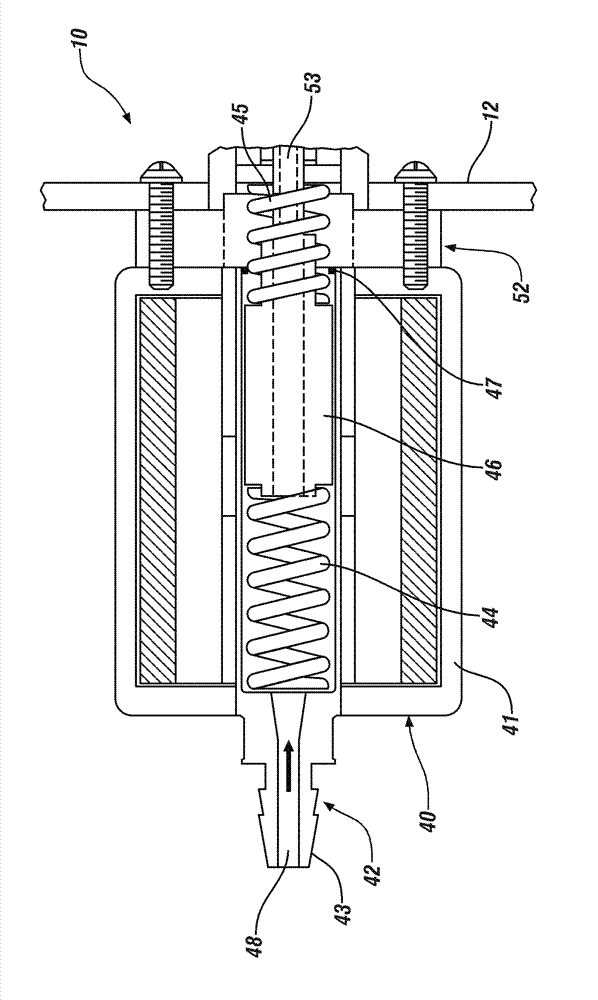
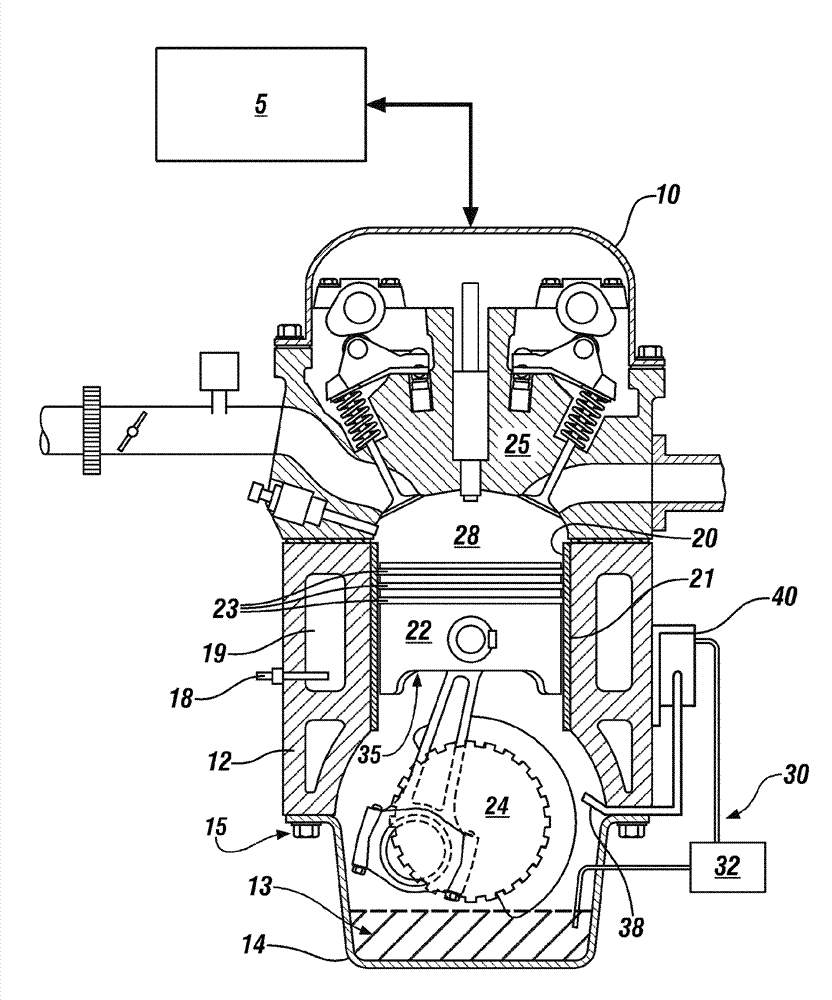
[0034] Referring now to the accompanying drawings, in which the illustrated content is merely to represent some exemplary embodiments and not to limit, figure 1 is a schematic illustration of an internal combustion engine 10 according to the present disclosure. Exemplary engine 10 may be any suitable multi-cylinder internal combustion engine. Engine 10 includes an engine block 12 and a cylinder head 25 . The engine block 12 includes a plurality of cylinders 20 formed therein and a plurality of internally porous coolant passages 19 . The wall portion 21 of each cylinder 20 may comprise a cylinder liner. Each cylinder 20 houses a reciprocating piston 22 connected to a crankshaft 24 . Crankshaft 24 is mechanically coupled to the motor vehicle transmission and driveline to deliver tractive torque thereto in response to an operator torque request. Crankshaft 24 is rotatably connected to lower portion 15 of engine block 12 with main bearings. The oil pan 14 is connected to the ...
PUM
 Login to View More
 Abstract
Description
Claims
Application Information
 Login to View More