Unlock instant, AI-driven research and patent intelligence for your innovation.

Mapping request response, information acquiring method and relevant devices based on locator identifier split protocol (LISP)

A technology for mapping information and mapping requests, applied in the field of mobile communication

Active Publication Date: 2013-04-10
昆山创智汇知识产权运营有限公司
View PDF3 Cites 14 Cited by
  • Summary
  • Abstract
  • Description
  • Claims
  • Application Information

AI Technical Summary

Problems solved by technology

[0008] In the process of implementing the present invention, the inventor found that the prior art has at least the following problems: when the MN obtains the SEID at a new location, the ITR router needs to complete two mapping information searches before it can obtain all the mappings required for establishing communication with the MN information

Method used

the structure of the environmentally friendly knitted fabric provided by the present invention; figure 2 Flow chart of the yarn wrapping machine for environmentally friendly knitted fabrics and storage devices; image 3 Is the parameter map of the yarn covering machine
View more

Image

Smart Image Click on the blue labels to locate them in the text.
Viewing Examples
Smart Image
  • Mapping request response, information acquiring method and relevant devices based on locator identifier split protocol (LISP)
  • Mapping request response, information acquiring method and relevant devices based on locator identifier split protocol (LISP)
  • Mapping request response, information acquiring method and relevant devices based on locator identifier split protocol (LISP)

Examples

Experimental program
Comparison scheme
Effect test

Embodiment 1

[0074] This embodiment relates to the processing flow of the MS responding to the mapping request and the flow of the ITR acquiring the mapping information.

[0075] Such as Figure 2a As shown, the response processing flow of MS to the mapping request includes:

[0076] Step 201, the MS receives the first mapping request message carrying the MEID sent by the ITR, and searches the local database for the first mapping information from the MEID to the location identifier and the corresponding first P bit value;

[0077] Step 202, if found, the MS judges whether the found location identifier is the SEID maintained by the MS, and if so, searches the local database for the second mapping information from the SEID to the ERLOC and the corresponding second P bit value;

[0078] In step 203, the MS continues the mapping response processing flow of the two mapping information according to the search results of the first mapping information and the first P bit value and the second mapp...

Embodiment 2

[0101] This embodiment relates to the acquisition of mapping information in proxy mode. The process of obtaining mapping information is as follows: image 3 As shown, the information acquisition steps are as follows:

[0102] 301: The ETR registers the mapping information with the MS, the mapping information includes the mapping from SEID to ERLOC, and the P bit in the registration message is set to 1, indicating that the MS can respond to the mapping request on behalf of the ETR; the MS saves the mapping information from the SEID to the ERLOC and the corresponding P bit value;

[0103] 302: The MN registers with the MS the newly obtained mapping relationship between SEID and MEID, and the P bit in the registration message is set to 1, indicating that the MS can respond to the mapping request on behalf of the MN; the MS saves the mapping information of the SEID to MEID and the corresponding P bit value ;

[0104] 303: The ITR sends a mapping request message to the mapping s...

Embodiment 3

[0111] This embodiment relates to the acquisition of mapping information in a semi-proxy mode. The semi-proxy mode includes two situations: the first one: the P bit in the registration message sent by ETR is set to 0, and the P bit in the registration message sent by the MN is set to 1; the second one, the P bit in the registration message sent by ETR is set to 1. bit is set to 1, and the P bit in the registration message sent by the MN is set to 0. The mapping information acquisition process of the two cases corresponds to Figure 4 and Figure 5 .

[0112] In the first case, the ETR does not allow the MS agent to map the response, and the MN allows the MS agent to map the response, such as Figure 4 As shown, the process of obtaining mapping information includes:

[0113] 401: The ETR registers the mapping information with the MS. The mapping information includes the mapping from SEID to ERLOC, and the P bit in the registration message is set to 0, indicating that the MS...

the structure of the environmentally friendly knitted fabric provided by the present invention; figure 2 Flow chart of the yarn wrapping machine for environmentally friendly knitted fabrics and storage devices; image 3 Is the parameter map of the yarn covering machine
Login to View More

PUM

No PUM Login to View More

Abstract

Disclosed is a mapping request response, a information acquiring method and relevant devices based on a locator identifier split protocol (LISP). Map server (MS) receives a first mapping request message which is sent by an ingress tunnel router (ITR) and carries a mobile node endpoint identifier (MEID), and the MS searches a first mapping information from the MEID to a station location marker and a first P bit value in the local database. If the MS finds, the station location marker is judged to see whether the station location maker is a station endpoint identifier (SEID) maintained by the MS. If the station location maker is the SEID maintained by the MS, the MS searches a second mapping information from the SEID to an egress tunnel router routing locator (ERLOC) and a second P bit value in the local database. The MS continues a mapping response treatment process of the two mapping information according to searched results. Correspondingly, after the ITR sends a mapping request message which carries the MEID to a mapping system, and the mapping request message corresponding to a first mapping response message is received. If 2, as a number maker which does not indicated the number of response messages, can not exist in the first mapping response message, the ITR receives all the mapping information, and the process is finished. The mapping request response, the information acquiring method and the relevant devices based on the LISP reduces sending of messages, and saves network resources.

Description

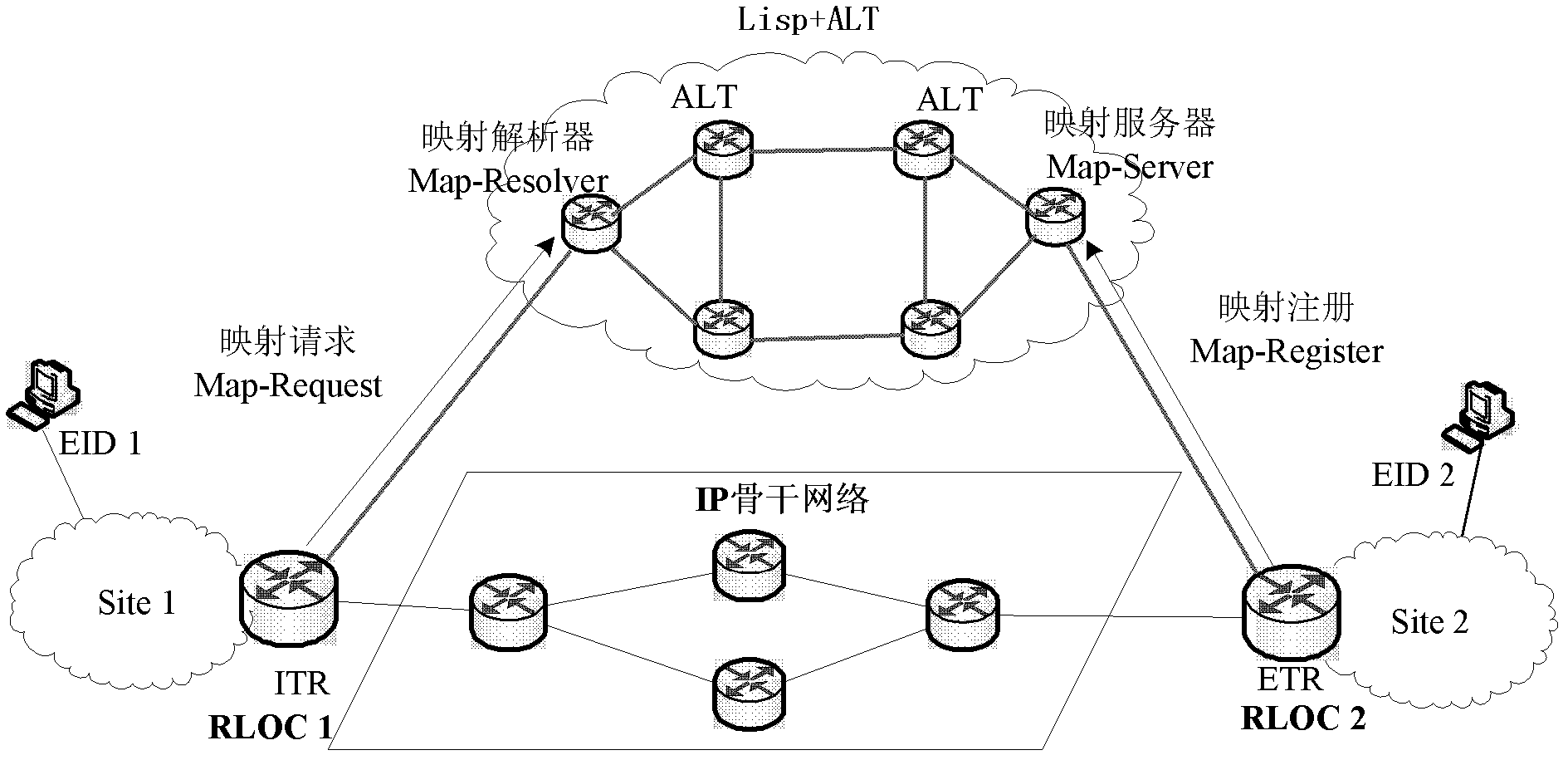
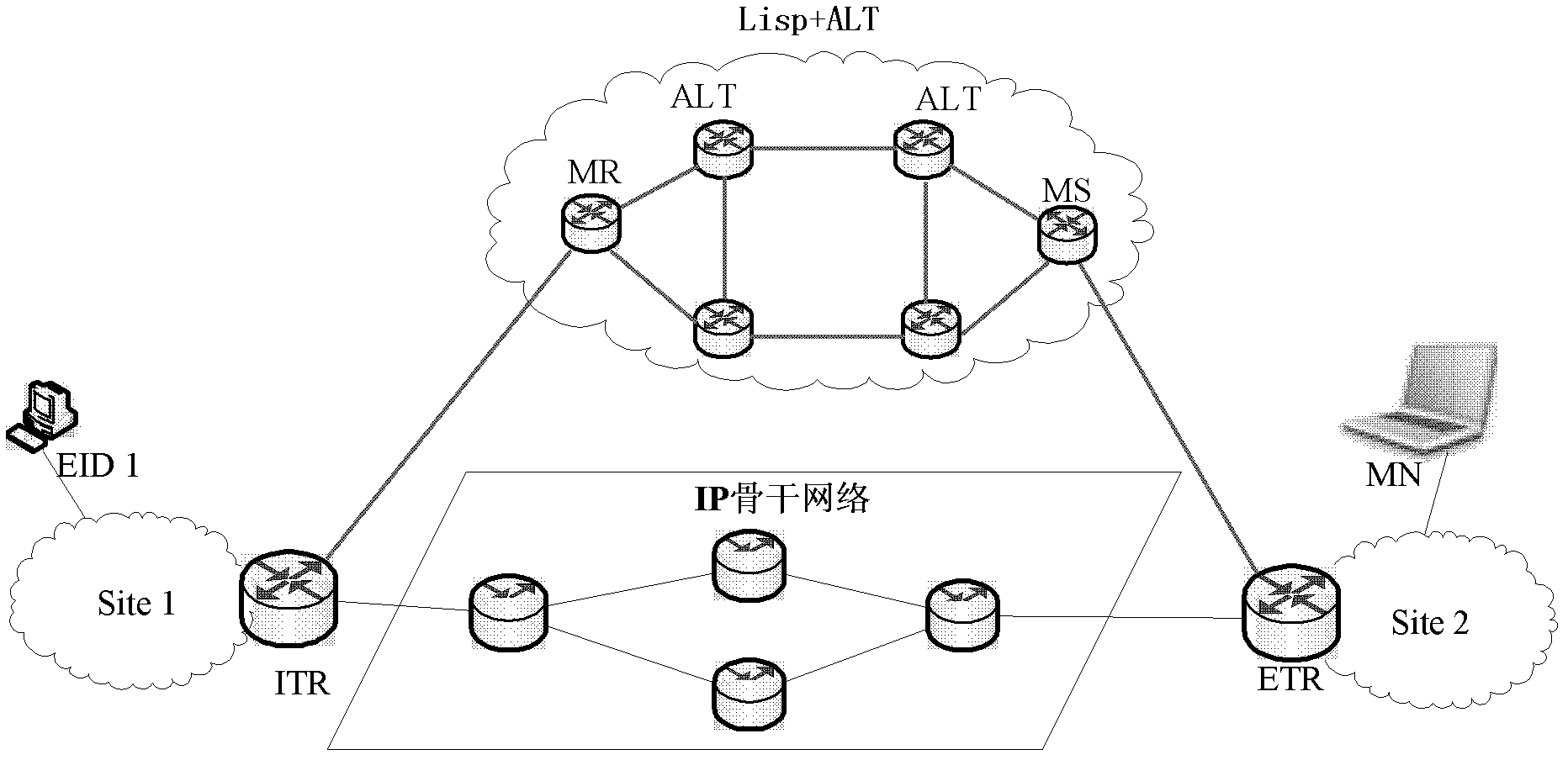
technical field [0001] The invention relates to the field of mobile communication and the Internet, more specifically, to a mapping request response, information acquisition method and corresponding equipment in a location-identity separation network. Background technique [0002] LISP (Locator Identifier Split Protocol, Location and Identity Separation Protocol) technology is a solution based on the separation of host identification and host location identification, such as Figure 1a As shown, its implementation is as follows: [0003] The site network (usually refers to the user network) is separated from the transport network (usually refers to the operator network), and the address space is divided into EID (Endpoint Identifier, endpoint identifier, indicating the address in the site network) address space and RLOC (Routing Locator, routing A location identifier that indicates reachability within a border router network) address space. The internal routing information ...

Claims

the structure of the environmentally friendly knitted fabric provided by the present invention; figure 2 Flow chart of the yarn wrapping machine for environmentally friendly knitted fabrics and storage devices; image 3 Is the parameter map of the yarn covering machine
Login to View More

Application Information

Patent Timeline
no application Login to View More
IPC IPC(8): H04W8/26H04L29/12
CPCH04L45/00H04L61/103H04L61/5084
Inventor 成黎孙默
Owner 昆山创智汇知识产权运营有限公司
Features
  • R&D
  • Intellectual Property
  • Life Sciences
  • Materials
  • Tech Scout
Why Patsnap Eureka
  • Unparalleled Data Quality
  • Higher Quality Content
  • 60% Fewer Hallucinations
Social media
Patsnap Eureka Blog
Learn More