Iron-based bulk metallic glass alloy with large supercooled liquid phase region
What is AI technical title?
AI technical title is built by Patsnap AI team. It summarizes the technical point description of the patent document.
A technology of supercooled liquid phase region and bulk metal, applied in the field of new materials, can solve problems such as the use of difficult-to-metal glass alloys and low stability of supercooled liquids, and achieve the effects of low cost, low production cost and high practical value
Active Publication Date: 2015-02-18
DALIAN UNIV OF TECH
View PDF5 Cites 0 Cited by
Summary
Abstract
Description
Claims
Application Information
AI Technical Summary
This helps you quickly interpret patents by identifying the three key elements:
Problems solved by technology
Method used
Benefits of technology
Problems solved by technology
[0008] It can be seen that although the T of the above two iron-based metallic glass alloys g low, but the stability of its supercooled liquid is very low, ΔT x are all lower than 40 ℃, it is difficult to use as a metallic glass alloy for superplastic processing
Method used
the structure of the environmentally friendly knitted fabric provided by the present invention; figure 2 Flow chart of the yarn wrapping machine for environmentally friendly knitted fabrics and storage devices; image 3 Is the parameter map of the yarn covering machine
View more
Image
Smart Image Click on the blue labels to locate them in the text.
Viewing Examples
Smart Image
Click on the blue label to locate the original text in one second.
Reading with bidirectional positioning of images and text.
Smart Image
Examples
Experimental program
Comparison scheme
Effect test
Embodiment 1
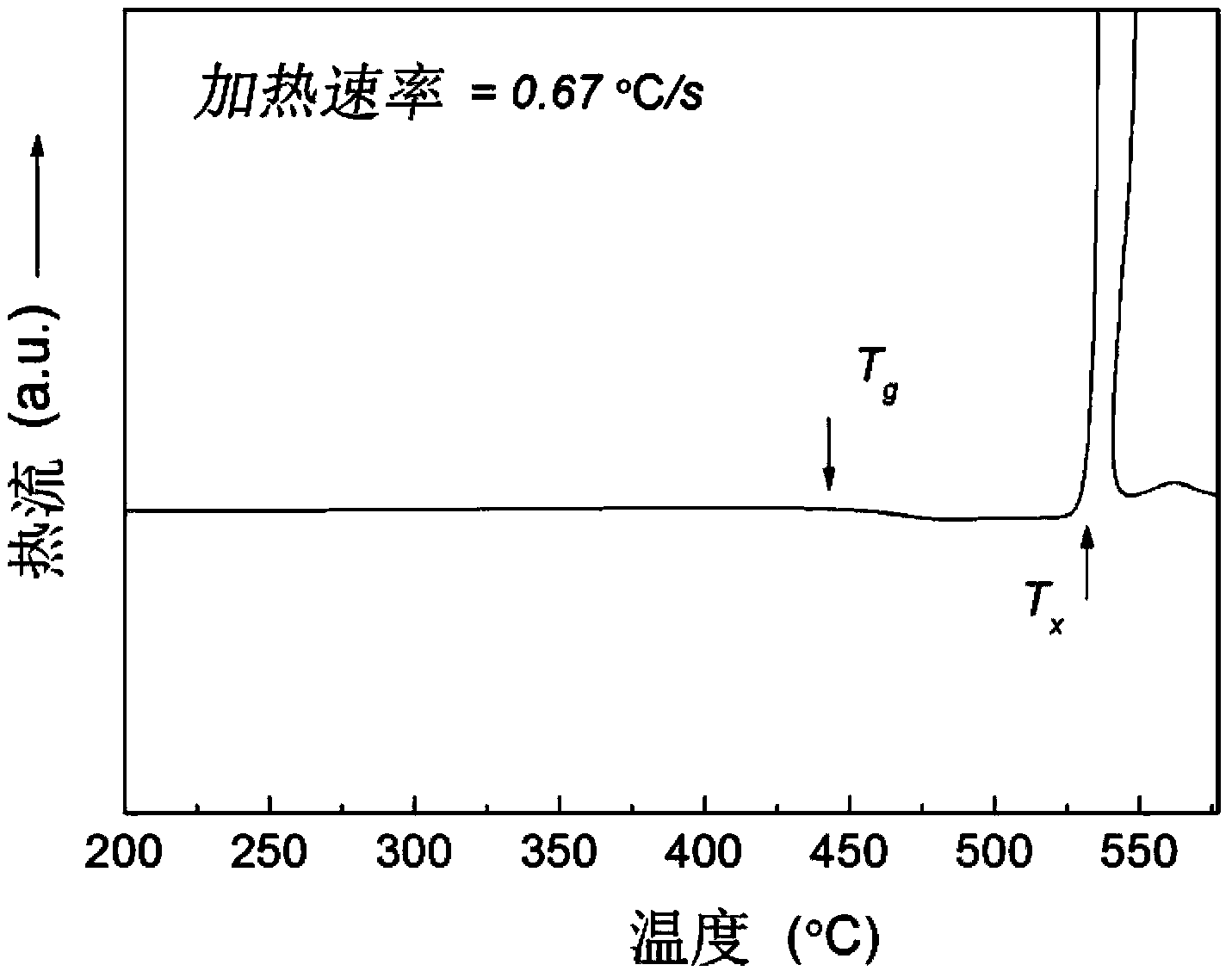
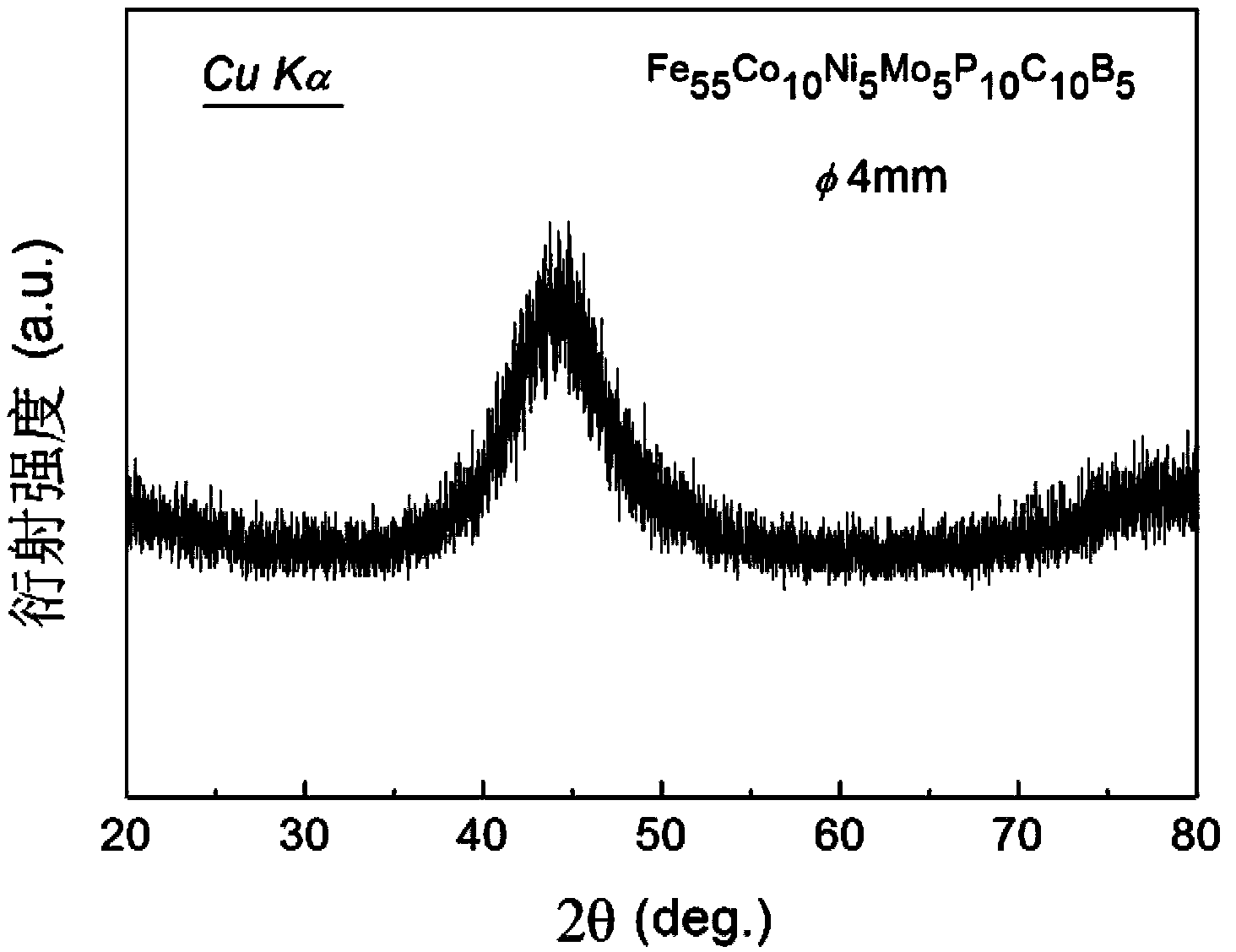
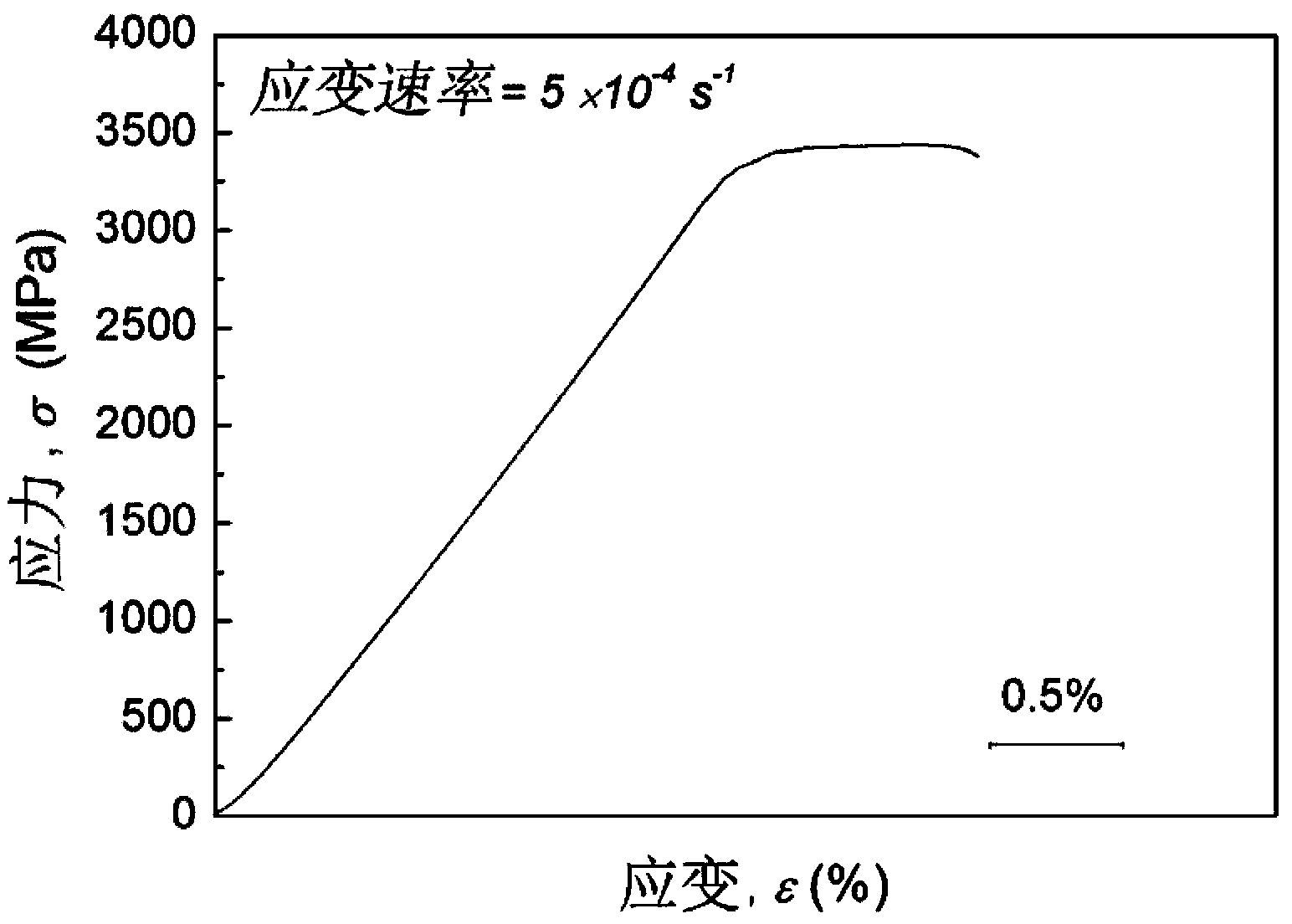
[0036] Fe 55 co 10 Ni 5 Mo 5 P 10 C 10 B 5 Preparation, testing and superplastic processing of metallic glass alloys.
[0037] (1) High-purity elements are used for compounding according to the chemical composition ratio of the alloy. Phosphorus is added through the iron-phosphorus alloy. The purity of the elements in terms of mass percentage is: iron: 99.9%, cobalt: 99.9%, nickel: 99.9%, molybdenum : 99.9%, carbon: 99.999%, boron: 99.5%, iron phosphorus: 99.9%.
[0038] (2) Put the proportioned raw materials into the crucible of the induction melting furnace, and evacuate to 2×10 -3 Pa, filled with argon, in the argon atmosphere, using high-frequency induction melting 4 times, to obtain a master alloy ingot with uniform composition.
[0039] (3) Break the master alloy ingot and put it into a quartz tube with a small hole at the bottom. After vacuuming, fill it with argon gas. In the argon atmosphere, first heat the master alloy to a molten state by high-frequency ind...
Embodiment 2
[0048] Fe 55 Ni 15 Mo 5 P 10 C 10 B 5 Preparation, testing and superplastic processing of metallic glass alloys. Step is with embodiment 1, and concrete data is listed in attached table.
Embodiment 3
[0050] Fe 65 Ni 5 Mo 5 P 10 C 10 B 5 Preparation, testing and superplastic processing of metallic glass alloys. Step is with embodiment 1, and concrete data is listed in attached table.
the structure of the environmentally friendly knitted fabric provided by the present invention; figure 2 Flow chart of the yarn wrapping machine for environmentally friendly knitted fabrics and storage devices; image 3 Is the parameter map of the yarn covering machine
Login to View More
PUM
Property
Measurement
Unit
glass transition temperature
aaaaa
aaaaa
glass transition temperature
aaaaa
aaaaa
yield strength
aaaaa
aaaaa
Login to View More
Abstract
The invention relates to an iron-based bulk metallic glass alloy with a large supercooled liquid phase region and belongs to the technical field of novel materials. The iron-based bulk metallic glass alloy with the large supercooled liquid phase region is characterized by consisting of iron, nickel, cobalt, molybdenum, chromium, tungsten, phosphorus, carbon, boron and silicon and having a composition expression of FexNiyCozMoaCrbWcPdCeBfSig, wherein x, y, z, a, b, c, d, e, f and g respectively represent atom percent content of each corresponding component; x is 50 to 70 percent; y is 0 to 20 percent; z is 0 to 15 percent; a is 2 to 6 percent; b is 0 to 4 percent; c is 0 to 3 percent; d is 8 to 15 percent; e is 10 to 12 percent; f is 2 to 6 percent; g is 0 to 2 percent; x+y+z is 50 to 75 percent; a+b+c is 4 to 10 percent; and x+y+z+a+b+c+d+e+f+g is equal to 100 percent. The alloy has the typical composition expression of Fe55Co10Ni5Mo5P10C10B5. The iron-based bulk metallic glass alloy has the effects and the benefits that the alloy simultaneously has the advantages of low glass transition temperature, large supercooled liquid phase interval, high glass-forming ability, low coercive force, excellent mechanical performance, low viscosity coefficient in a cold liquid phase interval and the like, can implement micron-grade and nano-grade superplasticity processing, and is a novel iron-based soft magnetic metallic glass alloy for superplasticity processing, with low production cost.
Description
technical field [0001] The invention belongs to the technical field of new materials, and relates to an iron-based metallic glass alloy which can be used for superplastic processing and has a large supercooled liquid phase interval, a low glass transition temperature, strong glass forming ability, excellent mechanical properties and good soft magnetic properties and its preparation method. Background technique [0002] Due to their special atomic arrangement structure, metallic glasses (amorphous alloys) have functional properties unmatched by ordinary crystalline metal materials, such as high strength, high specific strength, large elastic limit, excellent soft magnetic properties, high resistance Corrosion performance, supercooled liquid viscous flow characteristics, and precision casting formability, etc., are gradually being applied in fields such as energy, environment, electronics, and biomedicine. However, due to the influence of the glass forming ability of the allo...
Claims
the structure of the environmentally friendly knitted fabric provided by the present invention; figure 2 Flow chart of the yarn wrapping machine for environmentally friendly knitted fabrics and storage devices; image 3 Is the parameter map of the yarn covering machine
Login to View More
Application Information
Patent Timeline
Application Date:The date an application was filed.
Publication Date:The date a patent or application was officially published.
First Publication Date:The earliest publication date of a patent with the same application number.
Issue Date:Publication date of the patent grant document.
PCT Entry Date:The Entry date of PCT National Phase.
Estimated Expiry Date:The statutory expiry date of a patent right according to the Patent Law, and it is the longest term of protection that the patent right can achieve without the termination of the patent right due to other reasons(Term extension factor has been taken into account ).
Invalid Date:Actual expiry date is based on effective date or publication date of legal transaction data of invalid patent.


 Login to View More