Time sequence probability modeling method for output power of solar photovoltaic power supply
What is AI technical title?
AI technical title is built by PatSnap AI team. It summarizes the technical point description of the patent document.
A solar photovoltaic and photovoltaic power supply technology, which is applied in the fields of electrical digital data processing, instruments, and calculations, and can solve problems such as insufficient theoretical basis, errors, and uncertainty about the timing of stopping output power.
Inactive Publication Date: 2013-05-15
CHONGQING UNIV
View PDF3 Cites 16 Cited by
Summary
Abstract
Description
Claims
Application Information
AI Technical Summary
This helps you quickly interpret patents by identifying the three key elements:
Problems solved by technology
Method used
Benefits of technology
Problems solved by technology
However, the main disadvantages of this method are: 1) This method assumes that the start time and stop time of the daily power output of photovoltaic power sources are fixed, and this assumption will bring large errors, because it is affected by uncertain factors such as the rising and setting time of the sun. The influence of photovoltaic power supply, the moment of starting and stopping output power of photovoltaic power supply in a day is random and uncertain; 2) This method needs to assume parameter distribution to simulate the randomness of photovoltaic power supply output power, but the selection of parameter distribution depends on subjective experience, The theoretical basis is not sufficient, which will bring large errors, and the selected parameter distribution does not always give satisfactory results, that is, the probability that the selected parameter distribution may be applicable to the output power of photovoltaic power sources in some areas 3) This method considers that the random changes in the output power of photovoltaic power sources at each time are independent of each other, and does not take into account the correlation between the output power of photovoltaic power sources at each time, so it cannot be accurately realized Accurate simulation of the output power of photovoltaic power supply at each time and the probability distribution of daily output power
Method used
the structure of the environmentally friendly knitted fabric provided by the present invention; figure 2 Flow chart of the yarn wrapping machine for environmentally friendly knitted fabrics and storage devices; image 3 Is the parameter map of the yarn covering machine
View more
Image
Smart Image Click on the blue labels to locate them in the text.
Viewing Examples
Smart Image
Click on the blue label to locate the original text in one second.
Reading with bidirectional positioning of images and text.
Smart Image
Examples
Experimental program
Comparison scheme
Effect test
Embodiment 1
[0072] Such as figure 1 As shown, the specific steps of a time-series probabilistic modeling method for the output power of solar photovoltaic power sources in X region of my country are as follows:
[0073] (1) Input measured data
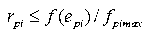
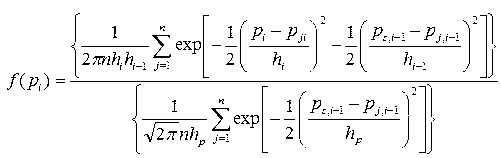
[0074] Input solar photovoltaic power supply (hereinafter referred to as photovoltaic power supply) in X region of my country at 24 hours a day for 365 days (ie n for 365, t 24) The measured data of the output power is p ki ( k =1,2,..., n , i =1,2,..., t ); n = 365 days of daily power output start time t s The measured data of T s =[ T s1 , T s2 ,..., T sn ]; n = 365 days of daily power output stop time t e The measured data of T e =[ T e1 , T e2 ,..., T en ].
[0075] Generate random samples of the start and stop times of daily power output of photovoltaic power sources
[0076] After step (1) is completed, according to the measured data input in step (1), based on non-parametric kernel density estimation theory, ...
Embodiment 2
[0135] A kind of sequential probabilistic modeling method of the output power of a kind of solar photovoltaic power supply in Y area of my country, same as embodiment 1, wherein:
[0136] In step (1), the solar photovoltaic power supply (hereinafter referred to as photovoltaic power supply) in the Y area of my country is 24 hours a day for 365 days (that is, n for 365, t 24) The measured data of the output power p ki ( k =1,2,..., n , i =1,2,..., t ); n = 365 days of daily power output start time t s measured data T s =[ T s1 , T s2 ,..., T sn ]; n = 365 days of daily power output stop time t e measured data T e =[ T e1 , T e2 ,..., T en ];
[0137] In step (2), after step (1) is completed, according to the measured data input in step (1), it is calculated according to formula (1) in the technical proposal h s =0.4312, h e =0.5603, and then estimated according to the formula (2) in the technical solution t s with t e The probability dens...
the structure of the environmentally friendly knitted fabric provided by the present invention; figure 2 Flow chart of the yarn wrapping machine for environmentally friendly knitted fabrics and storage devices; image 3 Is the parameter map of the yarn covering machine
Login to View More
PUM
Login to View More
Abstract
The invention discloses a time sequence probability modeling method for output power of solar photovoltaic power supply and belongs to the technical field of probability modeling for output power of the power supply of an electric powersystem. The time sequence probability modeling method comprises the following steps of: firstly inputting measured data of the output power of the photovoltaic power supply and daily power output begin-end time by utilizing a computer through a program; then estimating a probability density function of the daily power output begin-end time of the photovoltaic power supply based on a nonparametric kernel density estimation theory, and generating a random sample; and then sequentially estimating the probability density function of the output power of the photovoltaic power supply at each time based on nonparametric kernel density estimation and conditional probability theories, and generating a random sample. The time sequence probability modeling method provided by the invention has the advantages of simplicity, strong practicality, high estimation accuracy, strong commonality, and convenience in popularization and application. The time sequence probability modeling method can be widely used for establishing a time sequence probability model of the output power of the photovoltaic power supply in the electric powersystem.
Description
technical field [0001] The invention belongs to the technical field of probabilistic modeling of the output power of a power system power supply, in particular to a probabilistic modeling method for the output power of a solar photovoltaic power supply (photovoltaic power supply for short) in a power system. Background technique [0002] There are a large number of uncertain factors in the power system, such as the random fluctuation of power output power and load, the change of network operation mode, etc. In recent years, with the large-scale grid-connected operation of green energy sources with random fluctuations in output power, such as wind power and solar photovoltaic power (referred to as photovoltaic power), the uncertainty of the power system has further increased. Therefore, accurately simulating the probability distribution characteristics of the output power of green energy such as photovoltaic power sources is the basis for evaluating the ability of the power s...
Claims
the structure of the environmentally friendly knitted fabric provided by the present invention; figure 2 Flow chart of the yarn wrapping machine for environmentally friendly knitted fabrics and storage devices; image 3 Is the parameter map of the yarn covering machine
Login to View More
Application Information
Patent Timeline
Application Date:The date an application was filed.
Publication Date:The date a patent or application was officially published.
First Publication Date:The earliest publication date of a patent with the same application number.
Issue Date:Publication date of the patent grant document.
PCT Entry Date:The Entry date of PCT National Phase.
Estimated Expiry Date:The statutory expiry date of a patent right according to the Patent Law, and it is the longest term of protection that the patent right can achieve without the termination of the patent right due to other reasons(Term extension factor has been taken into account ).
Invalid Date:Actual expiry date is based on effective date or publication date of legal transaction data of invalid patent.




 Login to View More
  Login to View More