
Interlocking armored forming die and process
A technology of interlocking armoring and forming molds, applied in the manufacturing of electrical components, circuits, cables/conductors, etc. The effect of safety and reliability, perfect processing technology, and reduced processing difficulty
- Summary
- Abstract
- Description
- Claims
- Application Information
AI Technical Summary
Problems solved by technology
Method used
Image

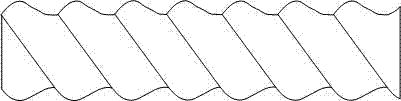
Examples
Embodiment Construction
[0026] The present invention will be further described in detail below in conjunction with the accompanying drawings and specific embodiments.
[0027] The present invention takes the interlocking armoring forming mold of the international universal metal strip with a processing width of 9.5 mm and a thickness of 0.5 mm as an example to specifically illustrate the detailed structure of the present invention.
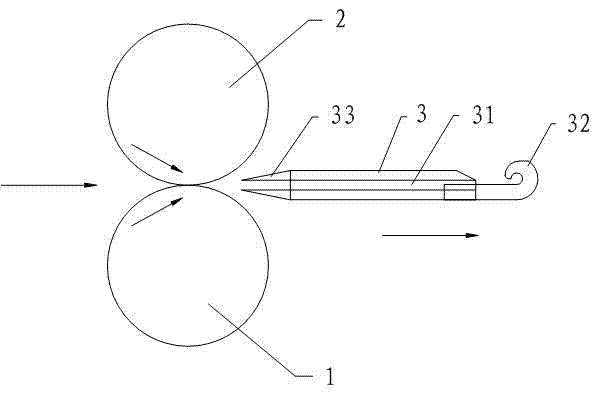
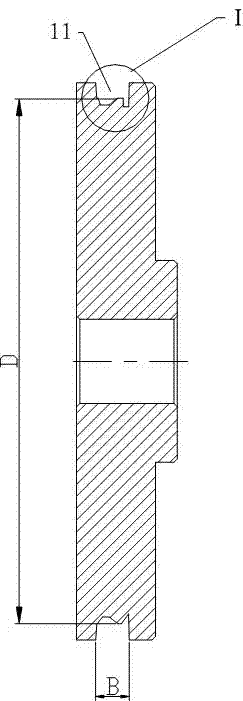
[0028] refer to figure 2 As shown, a kind of interlocking armor forming mold comprises a pair of rolls 1, 2 and a guide rail 3, the rolls are divided into a fixed roll 1 and an adjustment roll 2, and the guide rail 3 is arranged along the direction of the extension line where a pair of rolls mesh, namely After the fixed roll 1 and the adjusting roll 2 are matched, the tangential direction of the engagement between the two is the direction in which the guide rail 3 is set, and the metal strip after being pressed by the roll enters the guide rail 3, and there is a channel...
PUM
| Property | Measurement | Unit |
|---|---|---|
| height | aaaaa | aaaaa |
| depth | aaaaa | aaaaa |
Abstract
Description
Claims
Application Information
 Login to View More