
Method of producing a nano-winned titanium material by casting
A nano-twin, pure titanium technology, applied in the field of manufacturing commercial pure titanium materials containing nano-twins, can solve the problem of unknown strength of titanium
- Summary
- Abstract
- Description
- Claims
- Application Information
AI Technical Summary
Problems solved by technology
Method used
Image

Examples
Embodiment 1
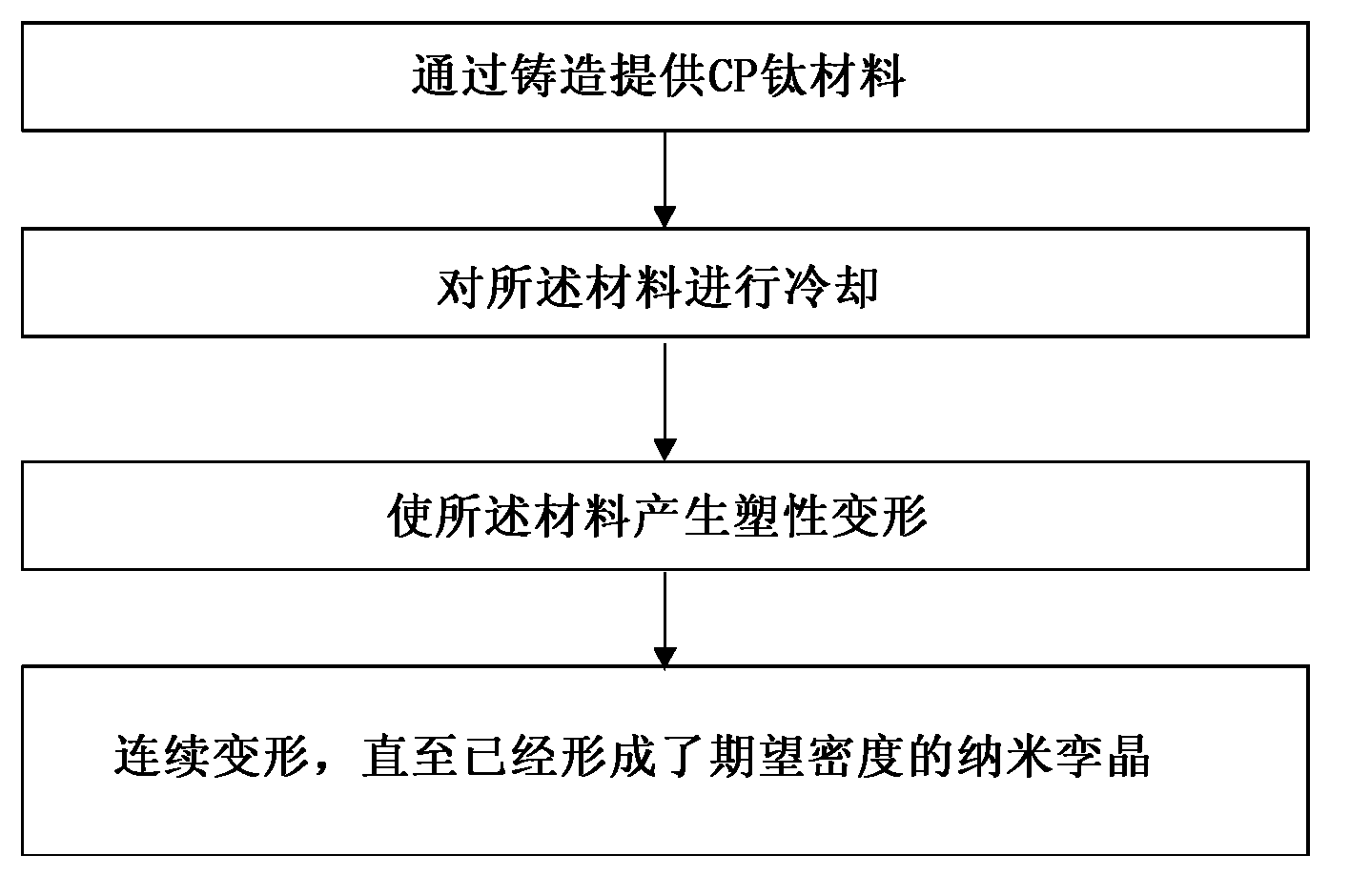
[0059] In Example 1, sample CP Ti#1 was cooled to a temperature below -100°C and then plastically deformed at that temperature.
[0060] A sample with an initial total length of 50 mm was plastically deformed by stretching at a rate of 20 mm / min (0.67% per second) until the total deformation rate was 35%. The deformation is done at 2% intervals.
Embodiment 2
[0062] In Example 2, sample CP Ti#2 was cooled to a temperature below -100°C and then plastically deformed at that temperature.
[0063] A specimen having an initial total length of 50 mm was plastically deformed by stretching at a rate of 30 mm / min (1% per second) until the total deformation rate was 35%. The deformation is done at 2% intervals.
Embodiment 3
[0065] In Example 3, sample CP Ti#3 was cooled to a temperature below -100°C and then plastically deformed at that temperature.
[0066] A sample with an initial total length of 50 mm was plastically deformed by stretching at a rate of 20 mm / min (0.67% per second) until the total deformation rate was 40%. The deformation is done at 2% intervals.
PUM
 Login to View More
 Abstract
Description
Claims
Application Information
 Login to View More