
A method for determining the limit working torque of drill tool joints under complex working conditions
A technology of ultimate working torque and drill tool joints, which is applied to drill pipes, drill pipes, drilling equipment, etc., which can solve the problem of difficult to reflect the torsional strength of downhole drilling tools, difficult to reflect the limit working torque of drill tool joints, and difficult to evaluate the force characteristics. And other issues
- Summary
- Abstract
- Description
- Claims
- Application Information
AI Technical Summary
Problems solved by technology
Method used
Image

Examples
Embodiment
[0027] Example: Determination of Limit Working Torque of Drill Tool Joint Using Three-Dimensional Finite Element Analysis Technique
[0028] Using this evaluation method to evaluate a certain drill joint, the main parameters of the drill joint are shown in Table 1.
[0029]
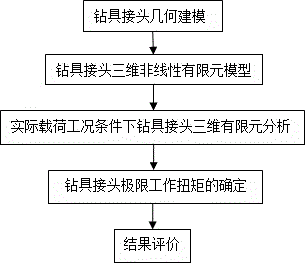
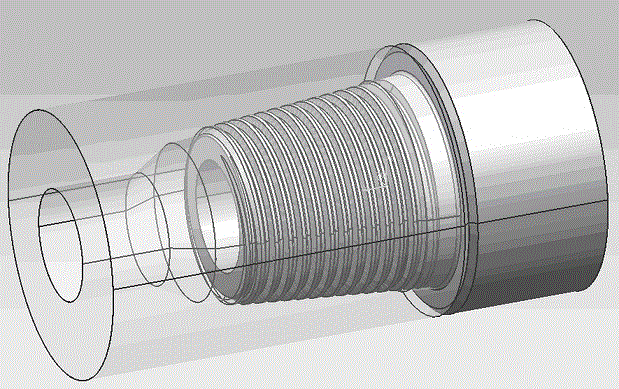
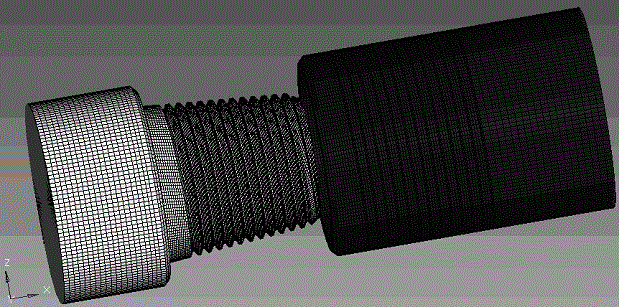
[0030] Use CAD geometric modeling software to establish a three-dimensional geometric model of the drill tool joint, such as figure 1 shown. Use the finite element pre-processing software to mesh the drill joint, and establish a three-dimensional finite element model of the threaded joint, as shown in figure 2 shown.
[0031] The material used for the tool joint is an isotropic elastic-plastic material with an elastic modulus of 2.06×10 5 MPa, Poisson's ratio is 0.29, and the true stress-plastic strain data of the material are shown in Table 2. Considering the influence of thread grease containing 40-60% by weight of zinc powder, the coefficient of friction between mating surfaces (including bet...
PUM
 Login to View More
 Abstract
Description
Claims
Application Information
 Login to View More