
Electrochemical method used for rapidly detecting imidacloprid serving as pesticide
A detection method and electrochemical technology, applied in the field of electrochemical analysis and detection, can solve the problems of complicated preparation of modified glassy carbon electrodes, and achieve the effects of low preparation cost, good stability and strong selectivity
- Summary
- Abstract
- Description
- Claims
- Application Information
AI Technical Summary
Problems solved by technology
Method used
Image

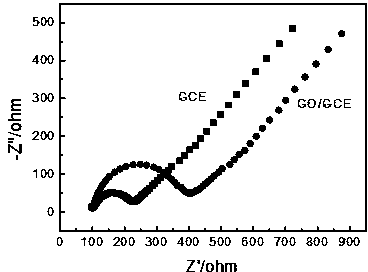
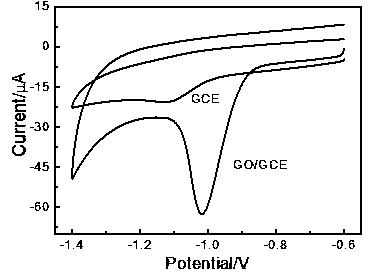
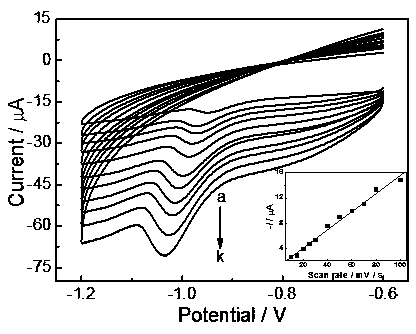
Examples
Embodiment 1
[0023] An electrochemical method for rapid detection of pesticide imidacloprid, said electrochemical method comprising the following steps:
[0024] (1) Preparation of graphene oxide modified glassy carbon electrode (GO / GCE): dilute graphene oxide with double distilled water and then ultrasonically disperse to obtain 1 mg / mL graphene oxide dispersion; then 10 μL graphene oxide The dispersion liquid is drop-coated on the surface of a clean glassy carbon electrode, and after the solvent evaporates, a graphene oxide-modified glassy carbon electrode covered with a sensitive film is obtained.
[0025] (2) Place the graphene oxide-modified glassy carbon electrode obtained in step (1) in a citric acid / disodium hydrogen phosphate buffer solution with a pH value of 7.0, pass nitrogen gas for 20 minutes, add 100 μmol / L imidacloprid, and use a cycle Voltammetry, with a scan rate of 100 mV / s, was used to detect the electrochemical response of the graphene oxide modified glassy carb...
Embodiment 2
[0032] An electrochemical method for rapid detection of pesticide imidacloprid, said electrochemical method comprising the following steps:
[0033] (1) Preparation of graphene oxide modified glassy carbon electrode (GO / GCE): dilute graphene oxide with double distilled water and then ultrasonically disperse to obtain 5 mg / mL graphene oxide dispersion; then 2 μL graphene oxide The dispersion liquid is drop-coated on the surface of a clean glassy carbon electrode, and after the solvent evaporates, a graphene oxide-modified glassy carbon electrode covered with a sensitive film is obtained.
[0034](2) Place the graphene oxide-modified glassy carbon electrode obtained in step (1) in a citric acid / disodium hydrogen phosphate buffer solution with a pH value of 7.0, pass nitrogen gas for 5 minutes, add 0.8 μmol / L imidacloprid, and use cyclic Voltammetry, with a scan rate of 100 mV / s, was used to detect the electrochemical response of the graphene oxide modified glassy carbon e...
Embodiment 3
[0036] An electrochemical method for rapid detection of pesticide imidacloprid, said electrochemical method comprising the following steps:
[0037] (1) Preparation of graphene oxide-modified glassy carbon electrode (GO / GCE): dilute graphene oxide with twice distilled water and then ultrasonically disperse to obtain a 0.1 mg / mL graphene oxide dispersion; then 10 μL graphene oxide The dispersion liquid is drop-coated on the surface of a clean glassy carbon electrode, and after the solvent evaporates, a graphene oxide-modified glassy carbon electrode covered with a sensitive film is obtained.
[0038] (2) Place the graphene oxide-modified glassy carbon electrode obtained in step (1) in a citric acid / disodium hydrogen phosphate buffer solution with a pH value of 7.5, pass nitrogen gas for 20 minutes, add 50 μmol / L imidacloprid, and use a cycle Voltammetry, with a scan rate of 10 mV / s, was used to detect the electrochemical response of the graphene oxide modified glassy car...
PUM
| Property | Measurement | Unit |
|---|---|---|
| concentration | aaaaa | aaaaa |
Abstract
Description
Claims
Application Information
 Login to View More