
Cross-modal search method capable of directly measuring similarity of different modal data
A cross-modal, similarity technology, applied in the direction of electrical digital data processing, special data processing applications, instruments, etc., can solve problems such as unsatisfactory query results, inability to learn, and high dimensionality
- Summary
- Abstract
- Description
- Claims
- Application Information
AI Technical Summary
Problems solved by technology
Method used
Image


Examples
Embodiment
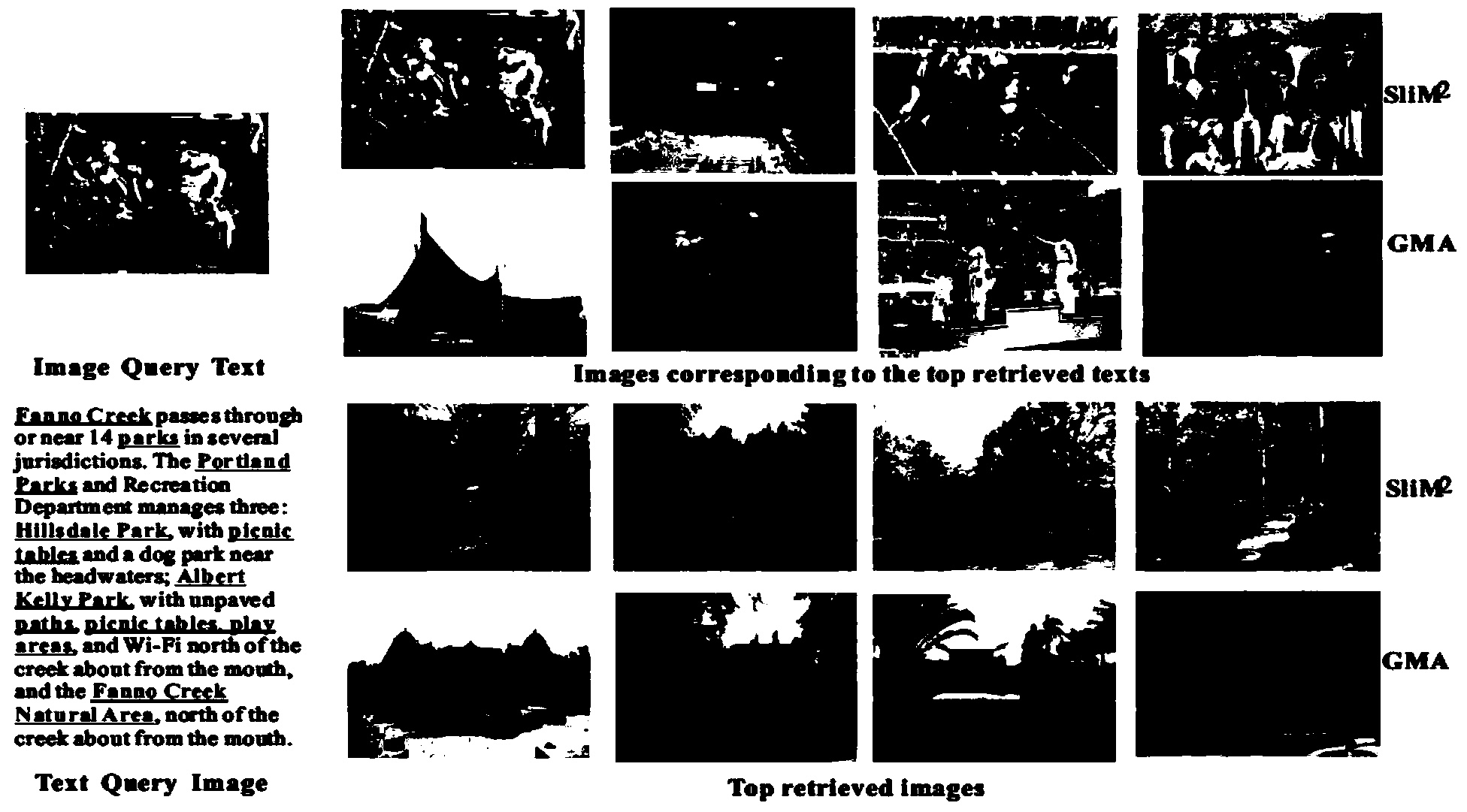
[0092] Suppose we have 2173 pairs of text and image data with known correspondence, and 693 pairs of text data and image data with unknown correspondence. Examples of pictures and text are as follows figure 2 . First, SIFT features are extracted for all image modality data in the database, and the k-means method is used to cluster to form visual words, and then the features are normalized so that the feature vector representing each image is a unit vector. At the same time, perform part-of-speech tagging on all text modal data in the database, remove non-noun words, retain nouns in the text, use all words that have appeared in the database to form a thesaurus, and count the occurrence of words in the thesaurus separately for each text The number of times, using single-text vocabulary frequency for vectorization, and then normalizing the feature vector, so that the feature vector representing each text is a unit vector.
[0093] Express the paired 2173 pairs of data (features...
PUM
 Login to View More
 Abstract
Description
Claims
Application Information
 Login to View More