Marker gene for yellowing and greening in rice and its application
What is AI technical title?
AI technical title is built by PatSnap AI team. It summarizes the technical point description of the patent document.
A yellow-to-green, rice technology, applied in application, genetic engineering, plant genetic improvement, etc., can solve problems such as fertility fluctuation, seed production and field production loss
Inactive Publication Date: 2015-08-19
SICHUAN AGRI UNIV
View PDF0 Cites 0 Cited by
Summary
Abstract
Description
Claims
Application Information
AI Technical Summary
This helps you quickly interpret patents by identifying the three key elements:
Problems solved by technology
Method used
Benefits of technology
Problems solved by technology
However, the fertility expression of photothermosensitive GMS lines is affected by environmental conditions, especially temperature. In some years, due to unpredictable abnormal weather conditions, fertility fluctuations lead to hybrid seeds produced in seed production fields containing more CMS self-bred seeds (ie "false hybrids"), causing significant losses in seed production and field production
Method used
the structure of the environmentally friendly knitted fabric provided by the present invention; figure 2 Flow chart of the yarn wrapping machine for environmentally friendly knitted fabrics and storage devices; image 3 Is the parameter map of the yarn covering machine
View more
Image
Smart Image Click on the blue labels to locate them in the text.
Viewing Examples
Smart Image
Click on the blue label to locate the original text in one second.
Reading with bidirectional positioning of images and text.
Smart Image
Examples
Experimental program
Comparison scheme
Effect test
Embodiment 1
[0059] Example 1. Discovery and application of rice yellowing-turning-greening mutant gene mGRY79
[0060] 1. Obtaining the yellow-to-green mutant gry79
[0061] The japonica rice line lvp1 (hereinafter also referred to as wild-type japonica rice) was treated with EMS mutagenesis, and a yellow-to-green mutant gry79 (green-revertible yellow79) that could be stably inherited was obtained in its offspring.
[0062] The leaves of the mutant were yellow-green at the 1st-3rd leaf stage, the chlorophyll content decreased, and the plant grew slowly. It gradually turned green from the 4th leaf stage, and the leaves were all green at the 6th leaf stage to the heading and fruiting stage.
[0063] From the above, it can be seen that the mutant has the trait of turning from yellow to green.
[0064] The yellow-to-green mutant gry79 (Oryza.sativa L.) was deposited in the General Microorganism Center of China Committee for Microorganism Culture Collection (CGMCC for short) on January 14, 20...
Embodiment 2
[0079] Example 2. Acquisition and functional verification of the rice gene GRY79
[0080] 1. Cloning of rice gene GRY79
[0081] Synthesize the following primer pairs:
[0082] P1: 5′ CCG TCTAGA ATGGTGGCGCTCGCCTCC3' (XbaⅠ restriction site is underlined)
[0083] P2: 5′GCC GTC GAC TCATTGGGTTGCCATTTC3′ (the underline is the SalⅠ restriction site)
[0084] RNA was extracted from the leaves of the normal green japonica rice line lvp1, transcribed into cDNA by a reverse transcription kit, and amplified by RT-PCR with primers P1 and P2 to obtain a fragment of about 2500bp, which was ligated into the pMD-19-T vector, The obtained ligation product was transformed into Escherichia coli JM109 strain, and positive clones were screened to extract plasmids and sent for sequencing.
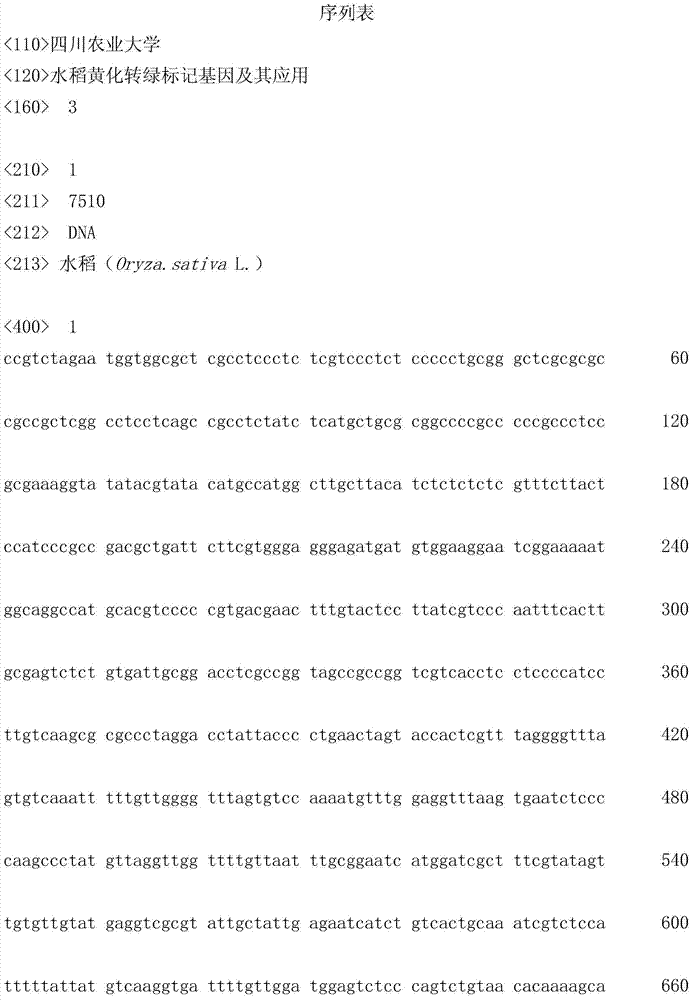
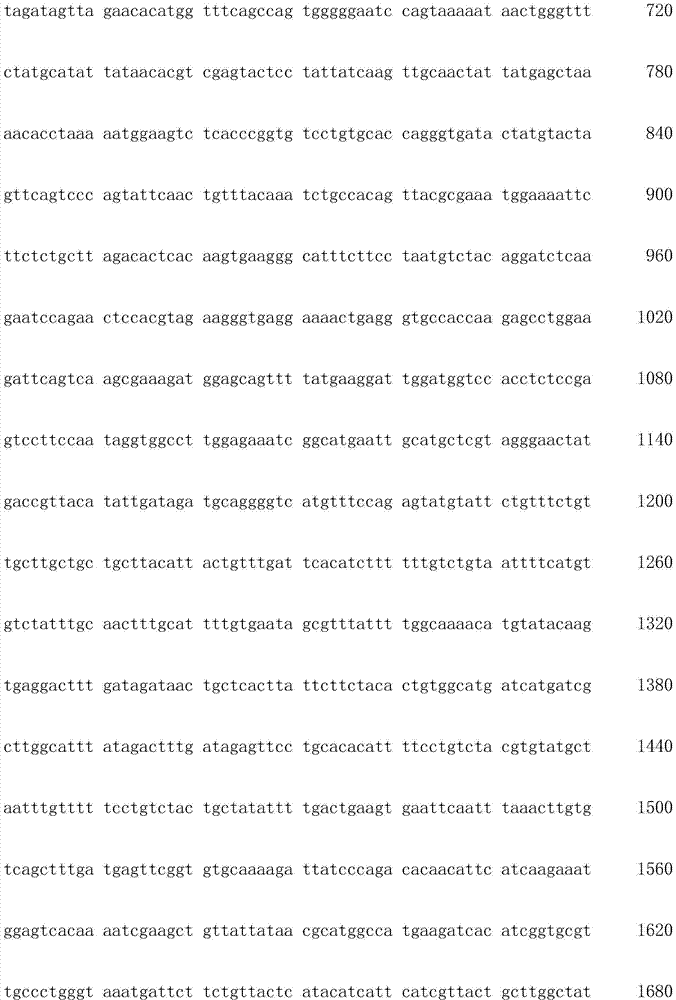
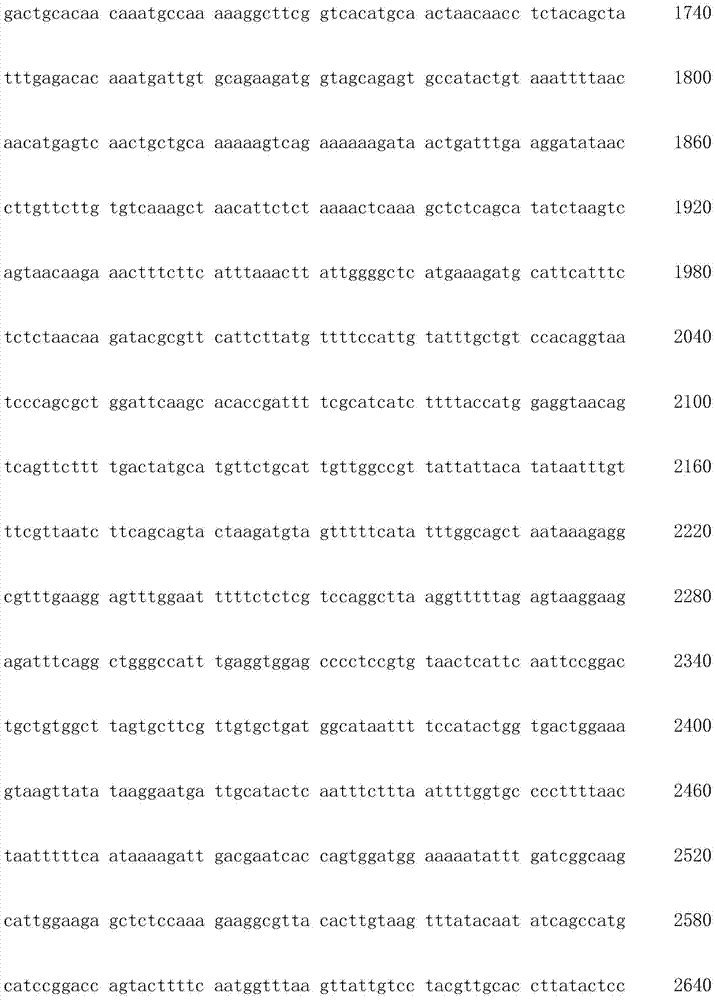
[0085] Sequencing results show that: the amplified fragment has the sequence shown in the 10-2625th nucleotide from the 5' end of the sequence 2 in the sequence listing, and the amplified fragment is the ...
the structure of the environmentally friendly knitted fabric provided by the present invention; figure 2 Flow chart of the yarn wrapping machine for environmentally friendly knitted fabrics and storage devices; image 3 Is the parameter map of the yarn covering machine
Login to View More
PUM
Login to View More
Abstract
The invention discloses a rice yellowing-to-greening marker gene and application thereof. The invention provides a rice yellowing-to-greening mutant gry79, with a collection number of CGMCC (China General Microbiological Culture Collection Center) NO.8769. The invention provides a mutant gene mGRY79 in the rice yellowing-to-greening mutant gry79. The invention provides application of the rice yellowing-to-greening mutant gry79 or the mutant gene mGRY79 to cultivation of a rice male sterile line with a yellowing-to-greening character. Experiments prove that the yellowing-to-greening mutant gry79 can be obtained by using chemical mutagenesis. A mild type rice and the mutant are compared, and a new gene GRY79 is found in the wild type rice, the mutant gene corresponding to the gene is found in the mutant, and the mutant gene can be used as a leaf color marker gene, and is used for effectively identifying and efficiently removing false hybrids in early stage of hybrid rice seedlings, thus the field purity of hybrid rice is increased.
Description
technical field [0001] The invention relates to the field of biotechnology, in particular to a rice yellowing-turning-greening marker gene and application thereof. Background technique [0002] Plant leaf color is a comprehensive expression of various pigments in chloroplasts. In normal leaves, chlorophyll is dominant, usually appearing as green. Leaf color mutation is a relatively common mutation type in rice, which is generally controlled by recessive nuclear genes. Dozens of rice leaf color mutants have been reported, which can be roughly divided into several categories such as yellowing, albinism, stripes, and spots. The distribution of leaf color mutation genes has been found on each chromosome of rice. The molecular mechanism of leaf color mutation is relatively complex. Mutant genes can cause leaf color variation through a variety of pathways, such as chlorophyll biosynthesis-related gene mutation, chloroplast differentiation and development blockage, cytoplasmic-nuc...
Claims
the structure of the environmentally friendly knitted fabric provided by the present invention; figure 2 Flow chart of the yarn wrapping machine for environmentally friendly knitted fabrics and storage devices; image 3 Is the parameter map of the yarn covering machine
Login to View More
Application Information
Patent Timeline
Application Date:The date an application was filed.
Publication Date:The date a patent or application was officially published.
First Publication Date:The earliest publication date of a patent with the same application number.
Issue Date:Publication date of the patent grant document.
PCT Entry Date:The Entry date of PCT National Phase.
Estimated Expiry Date:The statutory expiry date of a patent right according to the Patent Law, and it is the longest term of protection that the patent right can achieve without the termination of the patent right due to other reasons(Term extension factor has been taken into account ).
Invalid Date:Actual expiry date is based on effective date or publication date of legal transaction data of invalid patent.



 Login to View More
  Login to View More