
Device for hydrodynamically strengthening nonwovens, wovens or knitted fabrics
A kind of non-woven fabric, knitted fabric technology
- Summary
- Abstract
- Description
- Claims
- Application Information
AI Technical Summary
Problems solved by technology
Method used
Image

Examples
Embodiment Construction
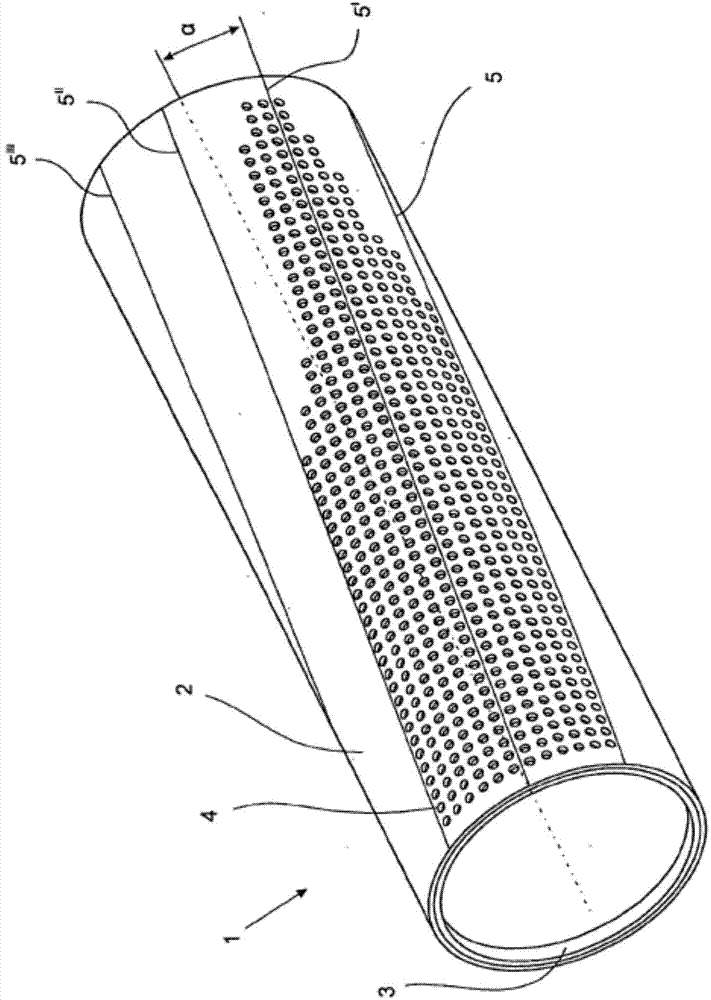
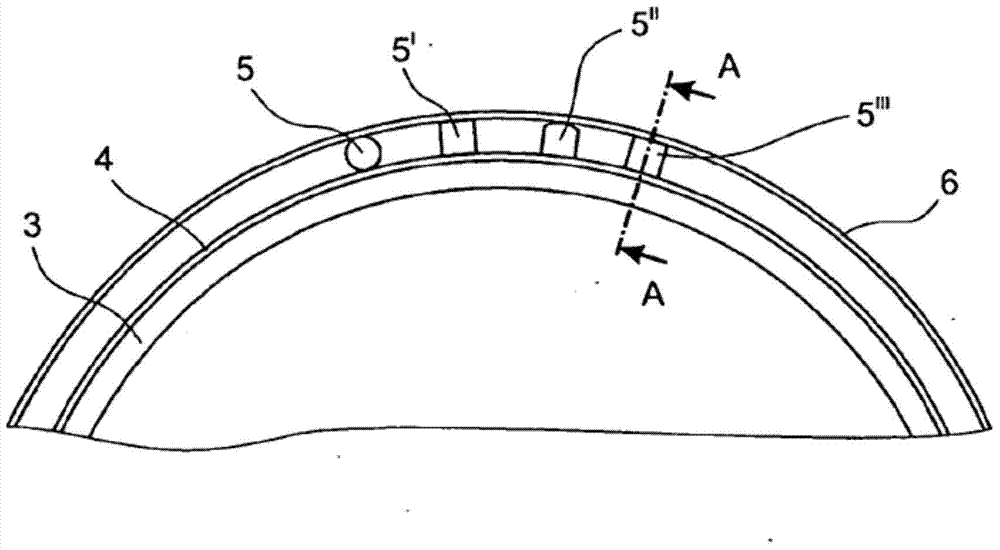
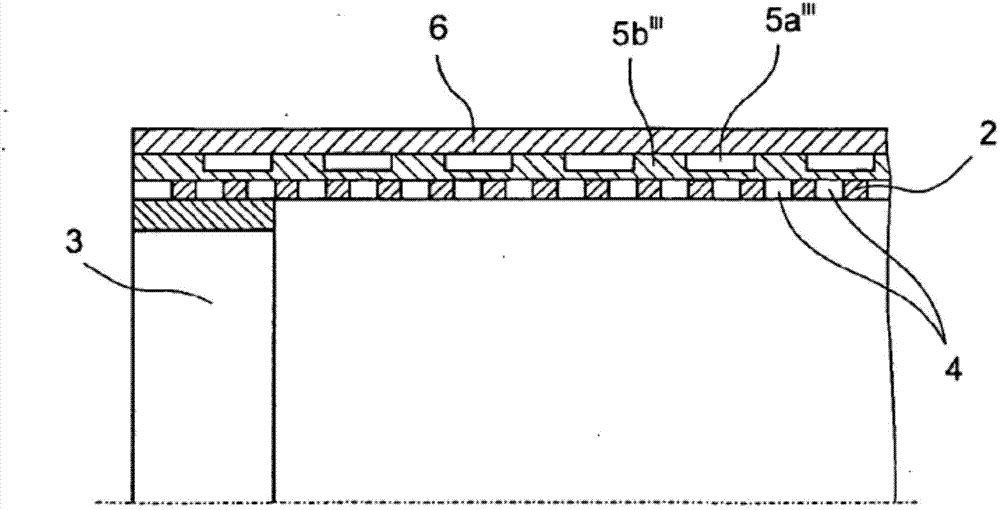
[0032] exist figure 1 A base cylinder 1 is shown in , which has a plurality of holes 4 on its surface. The basic drum 1 can be designed as a solid cylindrical component or as a component with a plurality of cylindrical supports 3 on which a sheet metal 2 or a fabric with a plurality of holes 4 is stretched. In this exemplary embodiment, the sheet metal 2 is stretched on two cylindrical supports 3 , of which only the supports 3 are shown. The support 3 is arranged in the region of the end faces of the base drum 1 and is designed to receive bearing parts (not shown) on both sides. The wall thickness of the solid base cylinder 1 can be between 2 mm and 10 mm. In the case of thin plates 2, the wall thickness can be between 1 mm and 6 mm.
[0033]The bore 4 is generally cylindrical and can have a diameter of 2 mm to 10 mm, preferably 3.5 mm to 5 mm. The contour of the hole 4 can have an oval, square or other shape. Furthermore, the cross-section of the holes 4 can vary over th...
PUM
| Property | Measurement | Unit |
|---|---|---|
| diameter | aaaaa | aaaaa |
| height | aaaaa | aaaaa |
| diameter | aaaaa | aaaaa |
Abstract
Description
Claims
Application Information
 Login to View More