Check patentability & draft patents in minutes with Patsnap Eureka AI!

(2T1R)& 1R four-DOF (degree-of-freedom) decoupling series-parallel connection mechanism

A hybrid mechanism and degree of freedom technology, applied in the field of robotics, can solve the problems of poor decoupling of hybrid mechanisms and sparse hybrid mechanisms, achieving good mobility and stability, large operating space, and reduced load. Effect

Inactive Publication Date: 2015-06-10
JIANGNAN UNIV
View PDF9 Cites 5 Cited by
  • Summary
  • Abstract
  • Description
  • Claims
  • Application Information

AI Technical Summary

Problems solved by technology

However, there are very few hybrid mechanisms that can achieve decoupling, and the decoupling of most hybrid mechanisms has not been well resolved.

Method used

the structure of the environmentally friendly knitted fabric provided by the present invention; figure 2 Flow chart of the yarn wrapping machine for environmentally friendly knitted fabrics and storage devices; image 3 Is the parameter map of the yarn covering machine
View more

Image

Smart Image Click on the blue labels to locate them in the text.
Viewing Examples
Smart Image
  • (2T1R)& 1R four-DOF (degree-of-freedom) decoupling series-parallel connection mechanism
  • (2T1R)& 1R four-DOF (degree-of-freedom) decoupling series-parallel connection mechanism

Examples

Experimental program
Comparison scheme
Effect test

Embodiment Construction

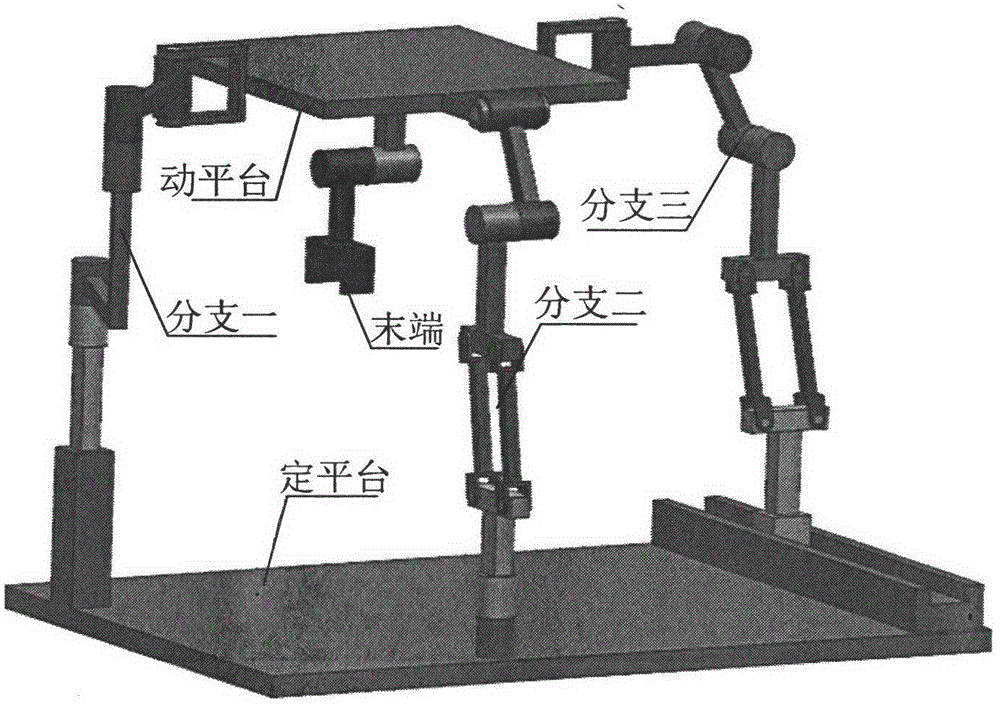
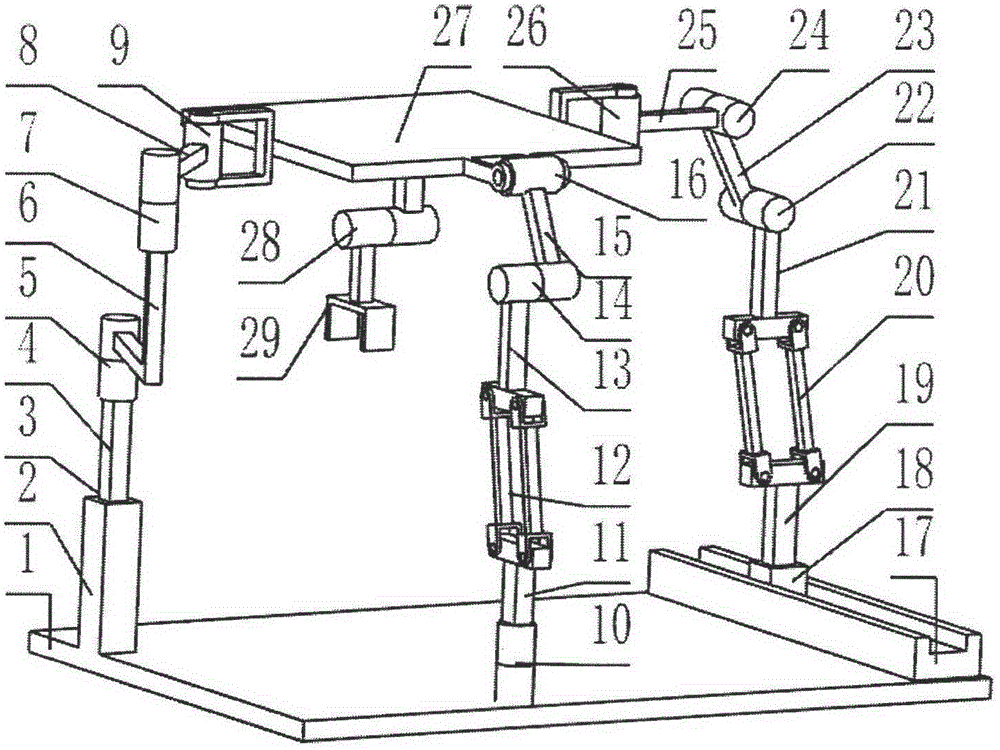
[0014] exist figure 1 , 2 In the schematic diagram of a two-moving, two-rotating, four-degree-of-freedom decoupling space hybrid mechanism shown, the fixed platform 1 and the moving platform 27 are rectangular structures, and the bottom edge of the fixed platform is equipped with a chute 17, and the center line of the chute is in line with the fixed platform. The platform 1 is parallel; one end of the first connecting rod 4 in the branch one is connected with the fixed platform 1 through the moving pair 3, the other end of the connecting rod 4 is connected with the second connecting rod 6 through the rotating pair 5, and the other end of the connecting rod 6 One end is connected to the third connecting rod 8 through the rotating pair 7, and the other end of the connecting rod 8 is connected to the moving platform 27 through the rotating pair 9; one end of the first connecting rod 11 in the second branch is connected to the fixed platform 1 through the rotating pair 10 , the o...

the structure of the environmentally friendly knitted fabric provided by the present invention; figure 2 Flow chart of the yarn wrapping machine for environmentally friendly knitted fabrics and storage devices; image 3 Is the parameter map of the yarn covering machine
Login to View More

PUM

No PUM Login to View More

Abstract

The invention belongs to the field of robots, and particularly relates to a space decoupling series-parallel connection mechanism. The series-parallel connection mechanism mainly comprises a parallel connection mechanism (2T1R) and a rotating pair 1R connected to a movable platform of the parallel connection mechanism, wherein the parallel connection mechanism comprises a fixed platform, a movable platform and three branches connecting the fixed platform and the movable platform; a branch I comprises a shifting pair, three rotating pairs with parallel axes and three connecting rods connecting the shifting pair and the rotating pair, and the axis of the rotating pair is perpendicular to the fixed platform; a branch II comprises a rotating pair with an axis perpendicular to the fixed platform, a parallelogram hinge, two rotating pairs with parallel axes and three connecting rods connecting the rotating pairs and the hinge; a branch III comprises a shifting pair, a parallelogram hinge, two rotating pairs with parallel axes, a rotating pair with an axis perpendicular to the movable platform and four connecting rods connecting the shifting pair, the hinge and the rotating pairs; the tail end of the mechanism is parallel to the rotating pair of the movable platform and is connected with the movable platform. The series-parallel connection mechanism is stable in structure, can move in the direction of a chute in the movable platform and in the direction parallel to the fixed platform, rotates around the axis of the fixed platform and the axis of the rotating pair at the tail end of the mechanism, can realize movement decoupling and is easy to control and high in bearing force.

Description

Technical field [0001] The invention belongs to the field of robots, in particular to a space decoupling hybrid mechanism. Background technique [0002] A hybrid robot refers to a complex mechanical system that includes at least one parallel mechanism and one or more serial mechanisms combined in a certain way. The hybrid mechanism is a combination of series and parallel mechanisms. It can comprehensively inherit the excellent properties of the parallel mechanism and the series mechanism, and provide a better performance balance between the two. It is more practical in modern manufacturing. It has been applied in welding, painting, handling, automobile assembly, medical treatment and other fields. [0003] The design and innovation of parallel mechanisms with few degrees of freedom is an important prerequisite for the design of hybrid mechanisms. Since hybrid robots include parallel structures, parallel mechanisms have the problem of strong kinematic coupling. Due to the c...

Claims

the structure of the environmentally friendly knitted fabric provided by the present invention; figure 2 Flow chart of the yarn wrapping machine for environmentally friendly knitted fabrics and storage devices; image 3 Is the parameter map of the yarn covering machine
Login to View More

Application Information

Patent Timeline
no application Login to View More
IPC IPC(8): B25J9/00
Inventor 曹毅秦友蕾李可陈桂兰
Owner JIANGNAN UNIV
Features
  • R&D
  • Intellectual Property
  • Life Sciences
  • Materials
  • Tech Scout
Why Patsnap Eureka
  • Unparalleled Data Quality
  • Higher Quality Content
  • 60% Fewer Hallucinations
Social media
Patsnap Eureka Blog
Learn More