
An Online Monitoring Method of CVT Capacitance Based on Zero Sequence Voltage Monitoring
A technology of zero-sequence voltage and capacitance, which is applied in the field of online monitoring of CVT capacitance based on zero-sequence voltage monitoring, can solve problems such as the inability to find capacitive voltage transformers, large test instruments, and unqualified CVT ratio errors, etc. Monitor the effect of a small number of capacitor breakdown, good anti-interference performance, and avoid electromagnetic interference
- Summary
- Abstract
- Description
- Claims
- Application Information
AI Technical Summary
Problems solved by technology
Method used
Image

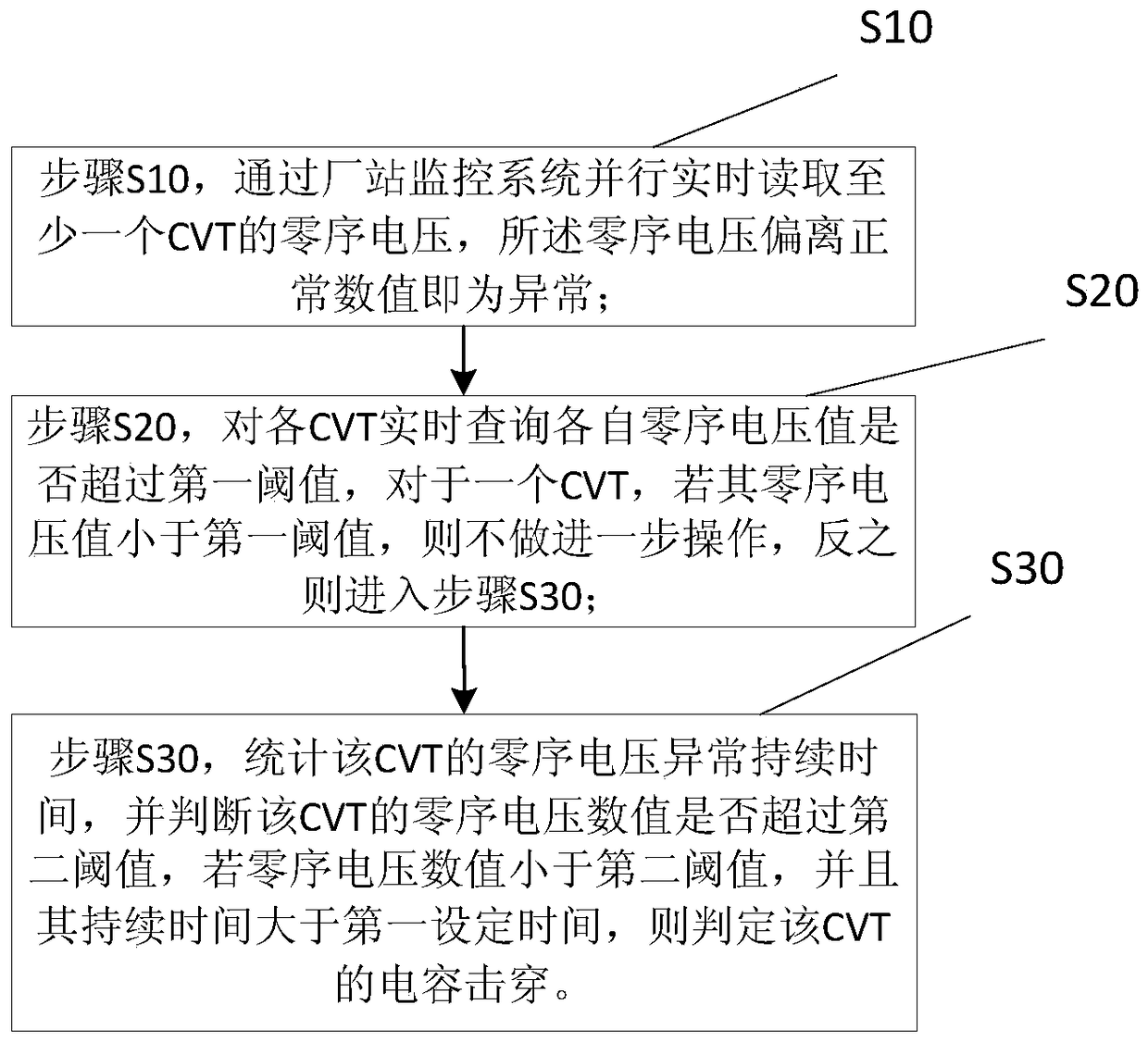

Examples
Embodiment Construction
[0026] The technical solutions in the embodiments of the present invention will be clearly and completely described below in conjunction with the drawings and embodiments. Apparently, the described embodiments are only some of the embodiments of the present invention, not all of them.
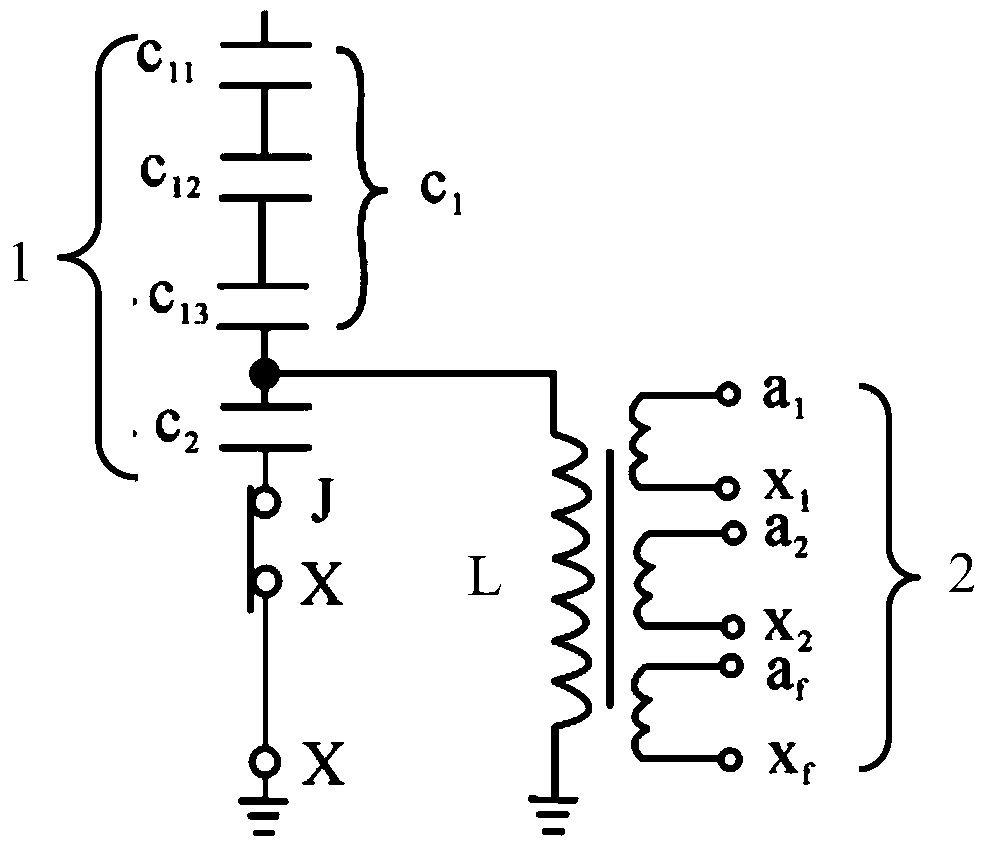
[0027] see figure 1 , is the structural principle diagram of the CVT. The CVT is mainly composed of the capacitive voltage divider 1 and the electromagnetic part 2 in structure, and the capacitive voltage divider C1 and C2 are two parts. For example, a CVT is composed of three porcelain bushings in appearance, C11 and C12 are in the upper and middle porcelain bushings respectively, and C13 and C2 are in the lower porcelain bushing and are connected together by the flange and the electromagnetic part. In this embodiment, the CVT takes the following parameters as an example: There are 154 elements in the capacitor of the ceramic sleeve, among which C13 has 130 elements, and C2 has 24 elements. No...
PUM
 Login to View More
 Abstract
Description
Claims
Application Information
 Login to View More