Anti-collision structure for road vehicle sliding-plug door system

A technology for anti-collision and vehicles, which is applied in the direction of building construction, fastening devices for wing leaves, buildings, etc., can solve problems such as unsafety, increased weight of the door system, deformation and opening, etc., and achieves the effect of simple operation and simple structure

CN105735795AInactive Publication Date: 2016-07-06NINGBO CRRC TIMES TRANSDUCER TECH CO LTD
7 Cites 8 Cited by

Patent Information

Authority / Receiving Office
CN · China
Patent Type
Applications(China)
Current Assignee / Owner
Publication Date
2016-07-06
Estimated Expiration
Not applicable · inactive patent

Smart Images

  • Figure 1
    Figure 1
  • Figure 2
    Figure 2
  • Figure 3
    Figure 3
Patent Text Reader

Abstract

The invention discloses an anti-collision structure for a road vehicle sliding-plug door system. The anti-collision structure comprises a door body with two folio door leaves which can perform translational motion mutually, and further comprises a first restraining mechanism and a second restraining mechanism, wherein the first restraining mechanism is arranged above the side, close to a vehicle door frame, of the door body; the second restraining mechanism is arranged below the door body; when the door body is closed, the first restraining mechanism connects the door body to the vehicle door frame, while when the door body is opened, the first restraining mechanism separates the door body from the vehicle door frame; and the second restraining mechanism always connects the door body to the vehicle body frame. By adoption of the anti-collision structure, not only can the door body be prevented from being opened due to a collision when being closed and can the rigidity and strength of the door body be improved, but also the door body can be guided and restrained in a multi-point manner when being opened and closed, so that smooth opening / closing action can be realized, vertical column mechanisms on the two sides of the door body are eliminated, and then the interior space of a road vehicle is larger.
Need to check novelty before this filing date? Find Prior Art

Description

technical field

[0001] The invention relates to a sliding door for a vehicle, in particular to an anti-collision structure for a sliding door for a vehicle. Background technique

[0002] Sliding doors are usually installed on large vehicles such as railway vehicles, subway vehicles and buses, especially on high-speed railway vehicles, the application of sliding doors is particularly important. The sliding door is a type of door that makes the outer surface of the sliding door coincide with the outer surface of the vehicle body when the entrance and exit are closed. According to such a sliding door, noise such as air resistance and wind noise can be reduced.

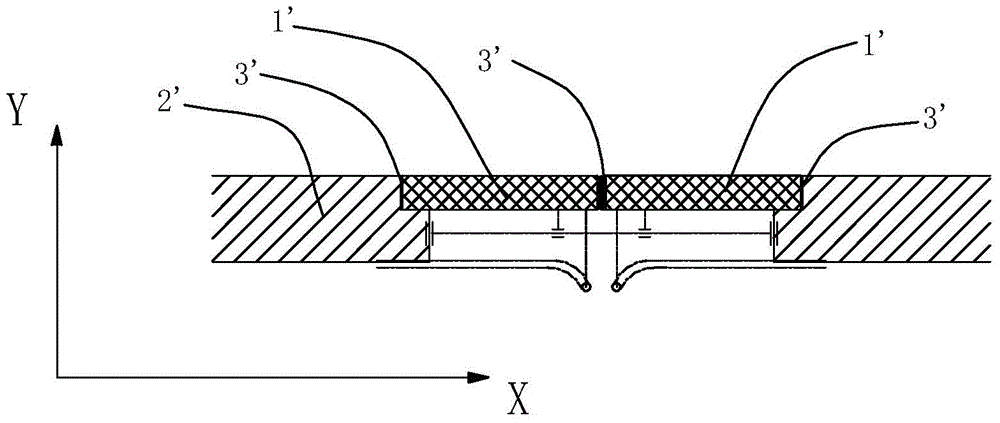
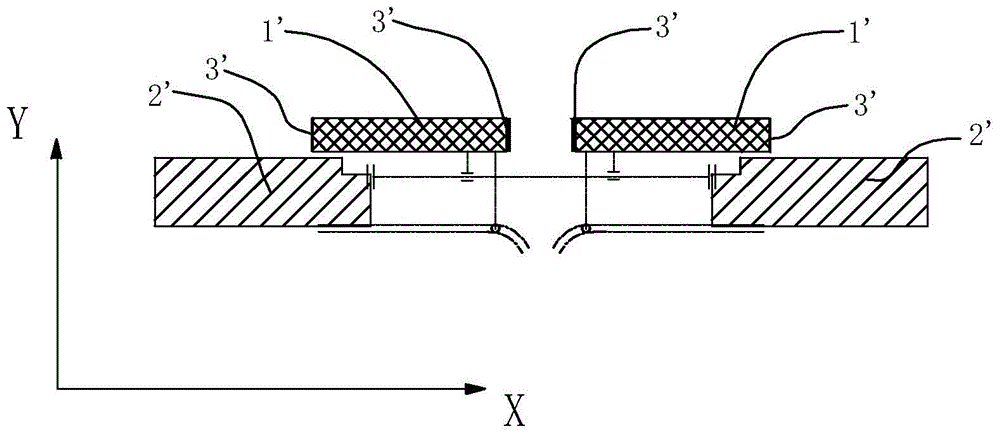
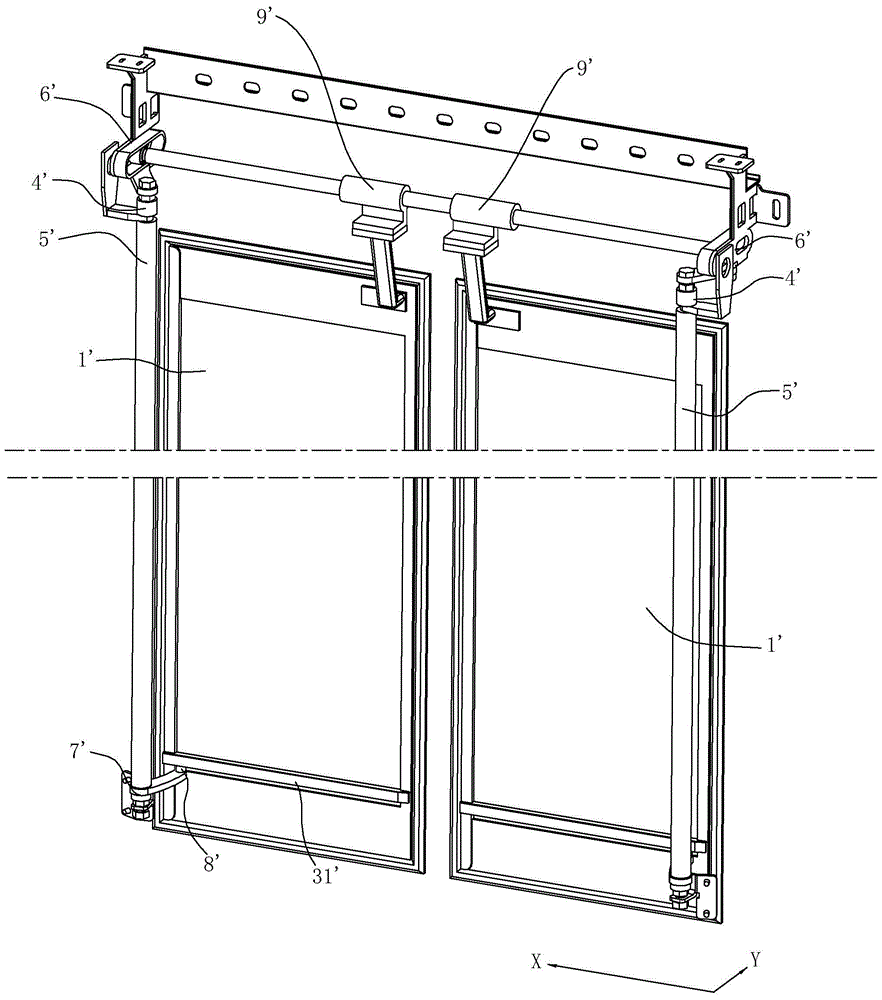
[0003] Such as figure 1 As shown in the figure, the two mutually perpendicular directions of X and Y are shown in the figure. This figure shows the closed state of the sliding door. At this time, the sliding door 1' is flush with the car body 2'. Driven by the drive system, The sliding door 1' first moves outwards al...

Examples

Embodiment Construction

[0028] The present invention will be further described in detail below in conjunction with the accompanying drawings and embodiments.

[0029] Such as Figure 4-8 As shown, it is an anti-collision structure for a road vehicle sliding door system in an embodiment of the present invention, which includes two doors 1 that are mutually translated and separated, and the top of the door 1 is connected to the On the X-guiding rail 31 extending in the same direction in the width direction of the door body 1, the two ends of the X-guiding rail 31 are respectively arranged on the Y-guiding rail 32 perpendicular to the plane where the door body 1 is located, and the Y-guiding rail 32 passes through the bracket 33 Connected to the door frame of the road vehicle, the X-guiding rail 31 is perpendicular to the Y-guiding rail 32 . The door frame 2 is connected to the driving mechanism, and drives the two door bodies 1 to move along the X guide rail 31 and the Y guide rail 32 at the same time...