Monocular SLAM (Simultaneous Localization and Mapping) method capable of creating large-scale map

A large-scale, map-based technology, applied in image analysis, image data processing, instruments, etc., can solve problems such as inability to build environmental maps, inflexibility, and inability to guarantee flexibility

CN105825520AInactive Publication Date: 2016-08-03BEIJING ROBOTLEO INTELLIGENT TECH
3 Cites 15 Cited by

Patent Information

Authority / Receiving Office
CN · China
Patent Type
Applications(China)
Current Assignee / Owner
Publication Date
2016-08-03
Estimated Expiration
Not applicable · inactive patent

Smart Images

  • Figure 1
    Figure 1
  • Figure 2
    Figure 2
  • Figure 3
    Figure 3
Patent Text Reader

Abstract

The present invention provides a monocular SLAM method that can create large-scale maps by using direct image alignment correction, explicit absorption and detection of scale drift; then adding filter-based semi-dense depth map estimation to achieve continuous With large-scale environment maps, the method not only tracks camera motion locally, but also maintains and tracks it on a global map of the environment. At the same time, the method can also run in real time on the CPU of an ordinary PC, and as a ranging method, it can even run on modern smartphones.
Need to check novelty before this filing date? Find Prior Art

Description

technical field

[0001] The invention belongs to the field of robot synchronous positioning and map creation, and relates to a monocular SLAM method capable of creating large-scale maps. Background technique

[0002] In recent years, with the further development of computer technology, digital image processing technology and image processing hardware, computer vision has begun to receive widespread attention in the field of robotics. SLAM is the abbreviation of Simultaneous Localization and Mapping (Simultaneous Localization and Mapping). This concept was first proposed by Smith, Self and Cheeseman in 1988. This method describes the situation in which the robot starts from an unknown location in an unknown environment and then explores the unknown environment: the robot repeatedly observes the environment during the movement, and then locates its own position and posture according to the environmental characteristics perceived by the sensor, and then according to its own posi...

Examples

Embodiment Construction

[0033] The present invention will be further described below in conjunction with the accompanying drawings.

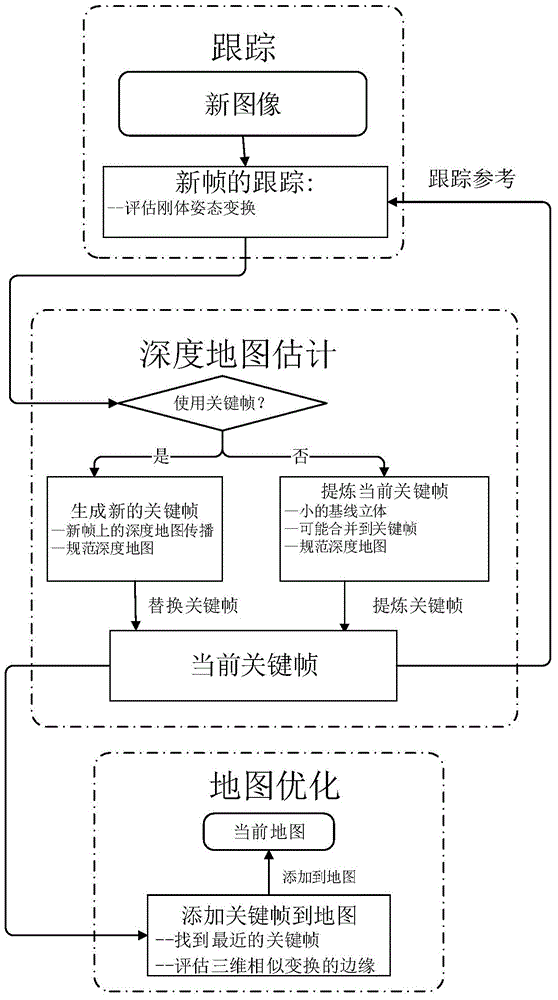
[0034] Such as figure 1 Shown: a kind of monocular SLAM method that can create large-scale map, it is characterized in that: adopt following steps:

[0035] Step 1: Tracking of the new frame: the tracking component continuously tracks the new camera image (640×480 pixels) at a frequency of 30 Hz, and evaluates the rigid body pose of the image relative to the current frame in, Represents a set of Lie-algebra transformations, ξ represents a transformation in the set, initialized with the pose of the previous frame.

[0036] Step 2: Depth map estimation: The component uses the tracked frame to extract or replace the current keyframe, and extracts depth by filtering many frame-by-frame small baseline stereo comparisons plus interleaved spatial orthogonalization; if the camera moves too far, New keyframes are initialized from the existing projected points closest to th...