
Method of adding microorganisms for promoting growth of common andrographis herbs
A technology of microorganisms and microbial systems, which is applied in the field of promoting the growth of bitter grass seedlings, can solve the problems of inability to rapidly build submerged submerged plant communities, no method for the growth of bitter grass seedlings, and low survival rate of seedlings, so as to achieve enhanced nitrification/reaction. The effect of nitrifying ability, increasing photosynthesis rate, and leaf length
- Summary
- Abstract
- Description
- Claims
- Application Information
AI Technical Summary
Problems solved by technology
Method used
Image

Examples
Embodiment 1
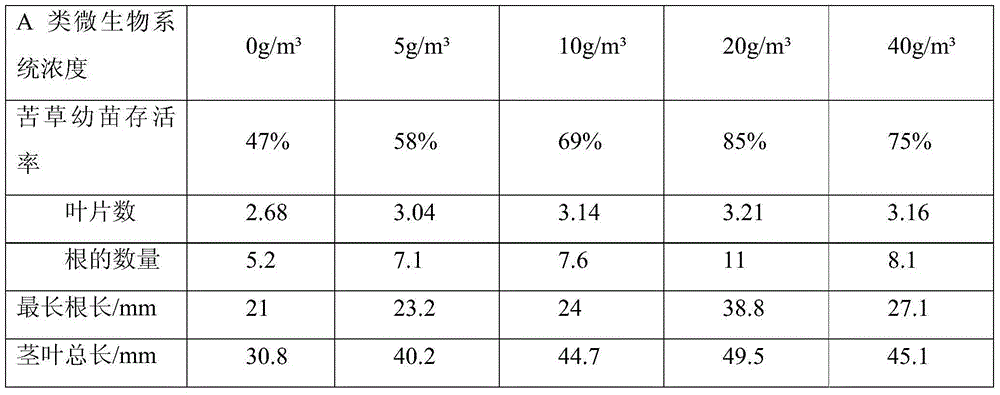
[0032] The promoting action of embodiment 1 class A microorganism system to the growth of Erythrina galerica
[0033] The Class A microbial system used in this example: according to the mass ratio of 5:3:2, take the mixed thallus of cyanobacteria and spirochete, streptomyces and beneficial bacillus to configure the Class A microbial system, and the Class A microorganism The system is placed under the light of 4000lux, the bacteria are shaken by a magnetic stirrer and inoculated every 3-4 days, and can be put into the water body for cultivating bitter grass seedlings after 12 days.
[0034] Put the bitter grass seedlings in 5 incubators respectively, the temperature of the incubators is 20-30°C, the light intensity is 2500lux, distilled water is installed in the incubators, and 0g / m 3 , 5g / m 3 , 10g / m 3 , 20g / m 3 、40g / m 3 In the Class A microbial system, 5 bitter grass seedlings were placed in each incubator, supplemented by a small amount of intermittent aeration. After 1...
Embodiment 2
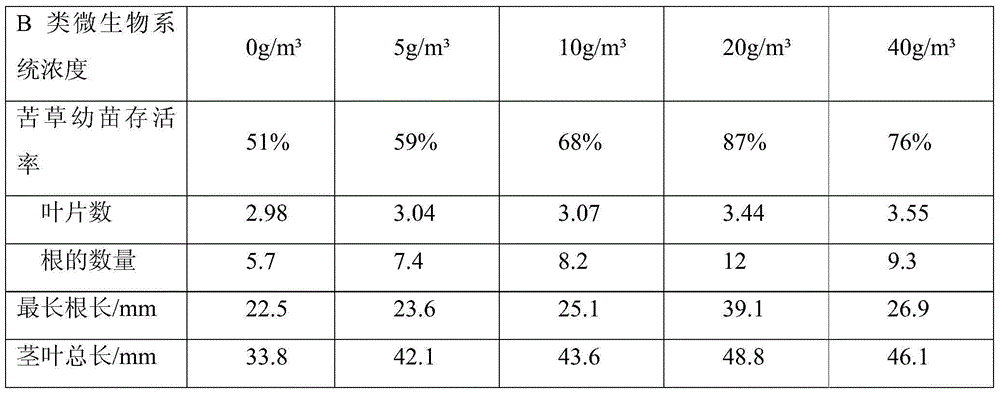
[0038] The promoting action of embodiment 2 B type microbial system to the growth of Erythrina galerica
[0039] Class B microbial system used in this example: Nitrosifying bacteria and denitrifying bacteria with a mass ratio of 4:6 were prepared to form a Class B microbial system. Place the B-type microbial system under the light of 4000 lux, shake the bacteria with a magnetic stirrer and inoculate once every 3-4 days, and put it into the water body for cultivating bitter grass seedlings after 15 days.
[0040] Put the bitter grass seedlings in 5 incubators respectively, the temperature of the incubators is 20-30°C, the light intensity is 2500lux, distilled water is installed in the incubators, and 0g / m 3 , 5g / m 3 , 10g / m 3 , 20g / m 3 、40g / m 3 In the B-type microbial system, five bitter grass seedlings were placed in each incubator, supplemented by a small amount of intermittent aeration. After 12 days of cultivating the bitter grass seedlings, the growth conditions are s...
Embodiment 3
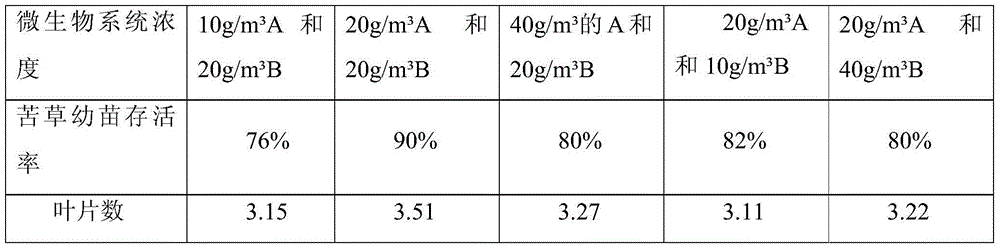
[0044] The promoting action of embodiment 3 Class A microbial system and B class microbial system to the growth of Erythrina fragrans
[0045] The Class A microbial system and the Class B microbial system used in this example are the same as those in Example 1 and Example 2, respectively.
[0046] Place the bitter grass seedlings in 5 incubators respectively, the temperature of the incubators is 20-30°C, the light intensity is 2500lux, distilled water is installed in the incubators, and 10g / m 3 Class A microbial system (hereinafter referred to as A) and 20g / m 3 Type B microbial system (hereinafter referred to as B), 20g / m 3 Class A microbial system and 20g / m 3 Type B microbial system, 40g / m 3 Class A microbial system and 20g / m 3 Type B microbial system, 20g / m 3 Class A microbial system and 10g / m 3 Type B microbial system, 20g / m 3 Class A microbial system and 40g / m 3 In the B-type microbial system, 5 bitter grass seedlings are placed in each incubator, supplemented by a...
PUM
 Login to View More
 Abstract
Description
Claims
Application Information
 Login to View More