
Method for increasing movement stability of driving mechanism of spaceborne antenna with gap
A motion stability, spaceborne antenna technology, applied in the field of machinery, can solve the problems of ignoring the elastic deformation of the contact surface, unable to truly reflect the contact collision characteristics of the moving pair of the mechanism with gaps, etc.
Patent Information
- Authority / Receiving Office
- CN · China
- Current Assignee / Owner
- Publication Date
- 2016-11-02
- Estimated Expiration
- Not applicable · inactive patent
Smart Images
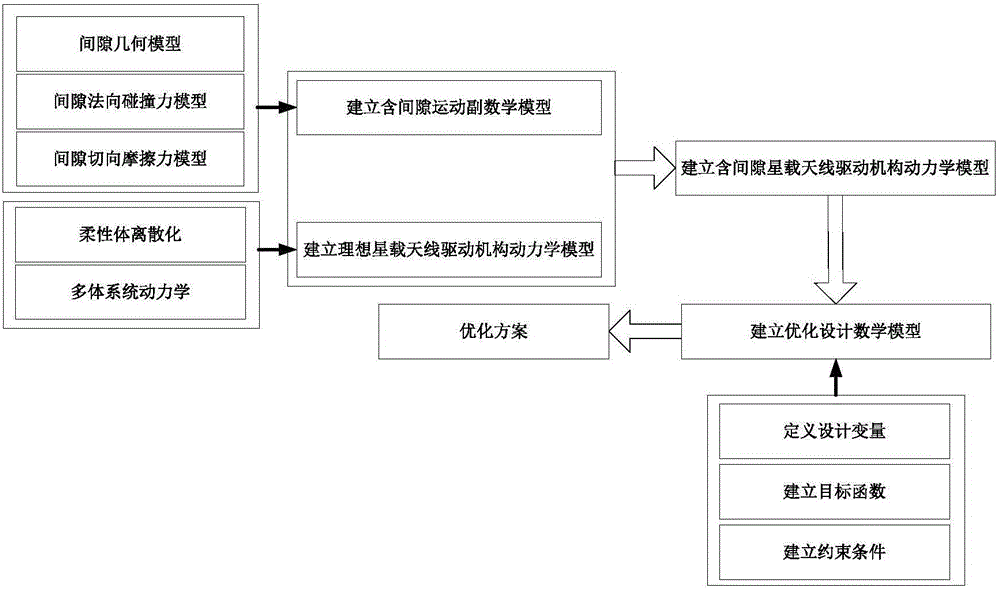
Figure 1 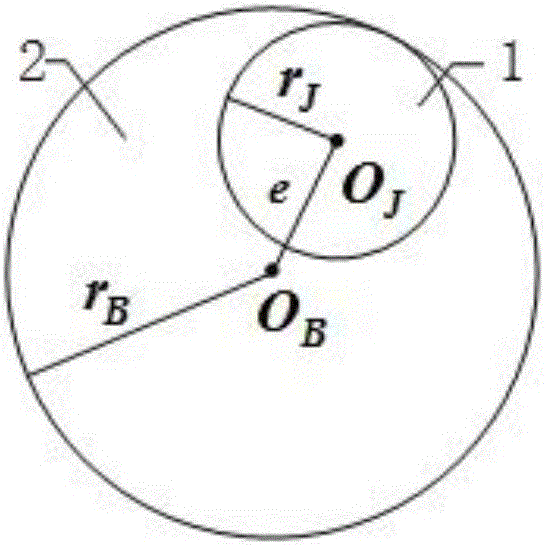
Figure 2 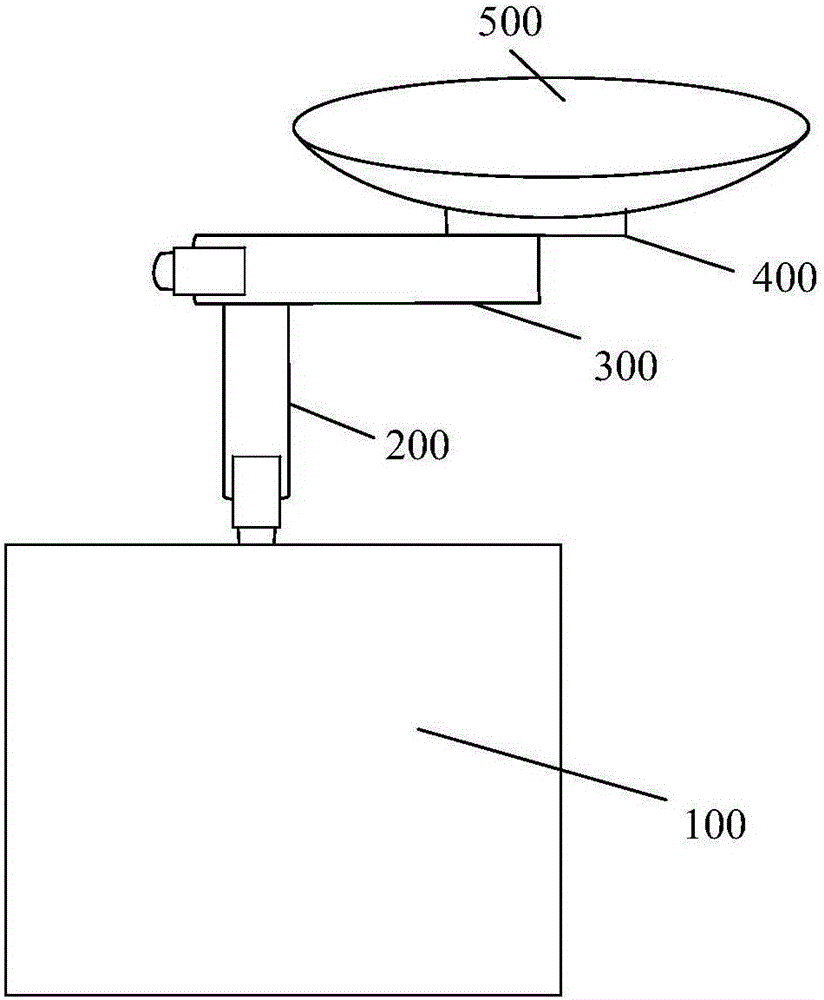
Figure 3
Abstract
Description
technical field
[0001] The invention relates to the field of mechanical technology, in particular to a method for improving the motion stability of a space-borne antenna drive mechanism with a gap. Background technique
[0002] With the continuous development of precision mechanical engineering and aerospace engineering, the mechanism system is moving towards the goals of high precision, high efficiency, high stability and high reliability. In engineering practice, due to the need for dynamic fit, manufacturing errors, friction and wear, etc., Kinematic pair gaps in mechanisms are unavoidable.
[0003] The existence of gaps will cause contact and collision between the moving sub-elements, causing the mechanism to vibrate violently with high amplitude and frequency, resulting in serious vibration, which in turn reduces the motion stability of the mechanism, especially for high-precision In the spacecraft drive mechanism, the influence of the clearance of the kinematic pair c...
Examples
Embodiment example
[0080] The present invention is applicable to various types of space-borne antenna drive mechanisms, and this embodiment only takes a certain type of space-borne antenna dual-axis drive mechanism as an example.
[0081] Such as image 3 As shown, the spaceborne antenna system with gaps in this embodiment is mainly composed of the satellite body 100, the azimuth axis 200, the pitch axis 300 and the flexible antenna reflecting surface 500, and the output end of the pitch axis 300 is directly reflected by the flexible antenna through the flange 400. Surface 500 is connected. Among them, the azimuth axis 200 and the pitch axis 300 constitute the dual-axis drive mechanism of the spaceborne antenna system. The dual-axis drive mechanism is divided into two rotation axes: rotation and azimuth. The antenna rotation axes are perpendicular to each other. Axis, vertical axis and horizontal axis are composed of exactly the same components and adopt the azimuth-pitch layout form, that is, ...