

Method and system for performing flash peer-to-peer networking webcast based on blocking format
A peer-to-peer network and format technology, applied in the field of live webcasting, can solve problems such as peer-to-peer network interaction difficult for other platforms, and achieve the effect of improving user experience and transmission efficiency.
- Summary
- Abstract
- Description
- Claims
- Application Information
AI Technical Summary
Problems solved by technology
Method used
Image



Examples
Embodiment 1
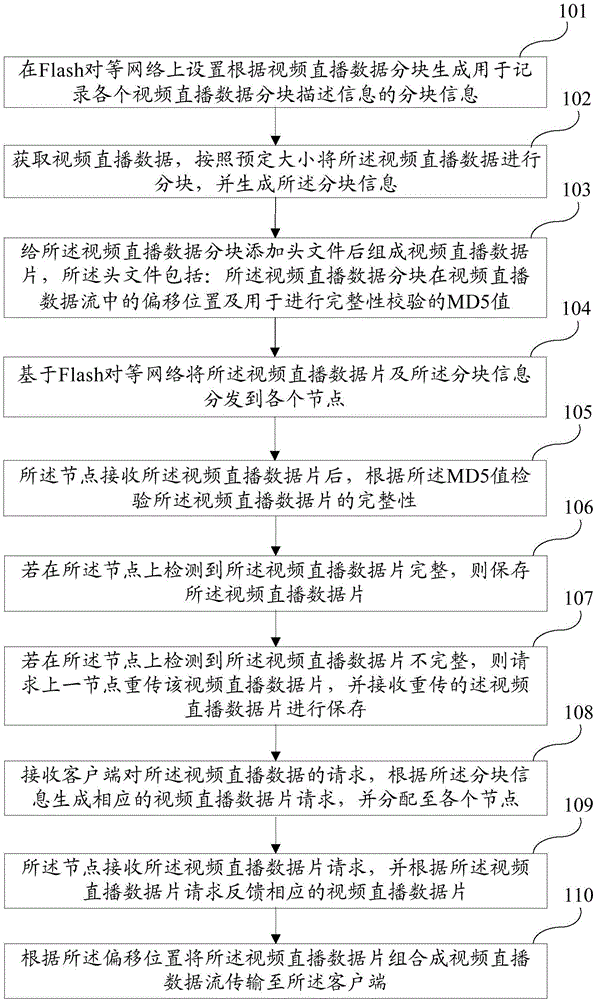
[0059] Such as figure 1 As shown, this is a schematic flow diagram of the method for performing Flash peer-to-peer webcast based on the block format in this embodiment. In this embodiment, the RTMFP transmission protocol integrated with the Flash peer-to-peer network connects each node, divides the live video data into blocks according to a fixed size, and distributes the divided video live data to each node for transmission. Finally, the client receives the data from each node. Obtain live video data in the order of the live video stream for playback. The steps of the method for performing Flash peer-to-peer webcast based on the block format in this embodiment are as follows:
[0060] Step 101: Set block information for recording the description information of each video live data block based on the video live broadcast data block generation on the Flash peer-to-peer network.
[0061] The description of the live video data block includes: the number of the live video data block a...
Embodiment 2
[0075] Such as figure 2 As shown, this embodiment is a schematic flow diagram of the method for performing Flash peer-to-peer webcast based on the block format in this embodiment. This embodiment describes the specific content of encrypted transmission of live video data in blocks on the basis of Embodiment 1. The steps are as follows:
[0076] Step 201: Set block information for recording the description information of each video live data block according to the video live broadcast data block generation on the Flash peer-to-peer network.
[0077] Step 202: Obtain live video data, divide the live video data into blocks according to a predetermined size, and generate the block information.
[0078] Step 203: Add header information to the live video data block to form a live video data piece, where the header information includes: the offset position of the live video data block in the live video data stream, and the video The size of live data blocks, live video status information,...
Embodiment 3
[0088] Such as image 3 As shown, this embodiment is a schematic flow diagram of the method for performing Flash peer-to-peer webcast based on the block format in this embodiment. This embodiment describes the specific content of skipping packet playback when the client's live video is stuck on the basis of Embodiment 1 and Embodiment 2. The steps are as follows:
[0089] Step 301: Set on the Flash peer-to-peer network to generate block information for recording the description information of each video live data block based on the video live data block, and set the freeze time threshold for playing the video live data. Preferably, the The freezing time threshold ranges from 1 second to 5 seconds.
[0090] Step 302: Obtain live video data, divide the live video data into blocks according to a predetermined size, and generate the block information.
[0091] Step 303: Add header information to the live video data block to form a live video data piece, where the header information incl...
PUM
 Login to View More
 Abstract
Description
Claims
Application Information
 Login to View More