Task reliability state-based manufacturing system predictive maintenance method

A manufacturing system and reliability technology, applied in manufacturing computing systems, forecasting, instruments, etc., can solve problems such as failure of enterprises to formulate maintenance strategies, safety accidents, economic losses, etc.

CN106127358AInactive Publication Date: 2016-11-16BEIHANG UNIV
0 Cites 16 Cited by

Patent Information

Authority / Receiving Office
CN · China
Patent Type
Applications(China)
Current Assignee / Owner
Publication Date
2016-11-16
Estimated Expiration
Not applicable · inactive patent

Smart Images

  • Figure 1
    Figure 1
  • Figure 2
    Figure 2
  • Figure 3
    Figure 3
Patent Text Reader

Abstract

A task reliability state-based manufacturing system predictive maintenance method is disclosed and comprises the following steps: in a first step, a manufacturing system underlying database is built; in a second step, device performance variation trends and all relevant parameters are analyzed via use of underlying data; in a third step, corrective maintenance cost of a device is predicted; in a fourth step, planned maintenance cost of the device is predicted; in a fifth step, processing capability loss cost of the device is predicted; in a sixth step, indirect loss cost of the device is predicted; in a seventh step, product quality loss cost of the device is predicted; in an eighth step, comprehensive cost is predicted, a task reliability threshold value of the device is determined, and an optimal predictive maintenance strategy is further determined; in a ninth step, task demand of the last device is determined according to a result of the eighth step, and the second step to the eighth step are repeated till a predictive maintenance strategy of a whole manufacturing system is made; in a tenth step, via the above steps, an aim of combining device performance conditions with production tasks is attained, and problems of conventional neglect of production states and blind periodic maintenance can be solved.
Need to check novelty before this filing date? Find Prior Art

Description

technical field

[0001] The invention provides a predictive maintenance method for a manufacturing system based on task reliability status, which belongs to the field of production management. Background technique

[0002] As a key measure to improve the reliability and usability of the manufacturing system to ensure production efficiency, product quality, and corporate profits, the maintenance strategy of the manufacturing system has always been the focus of manufacturing enterprises. According to statistics, usually equipment maintenance costs account for 15%-40% of manufacturing costs, and with the development of automation and intelligent technology, its annual increase rate is as high as 10%-15%. Therefore, formulating a reasonable predictive maintenance strategy for manufacturing systems has become an important means for enterprises to reduce operating costs and improve market competitiveness.

[0003] With the rapid development of information technology and computing ...

Examples

Embodiment Construction

[0074] The present invention will be described in further detail below in conjunction with accompanying drawings and examples.

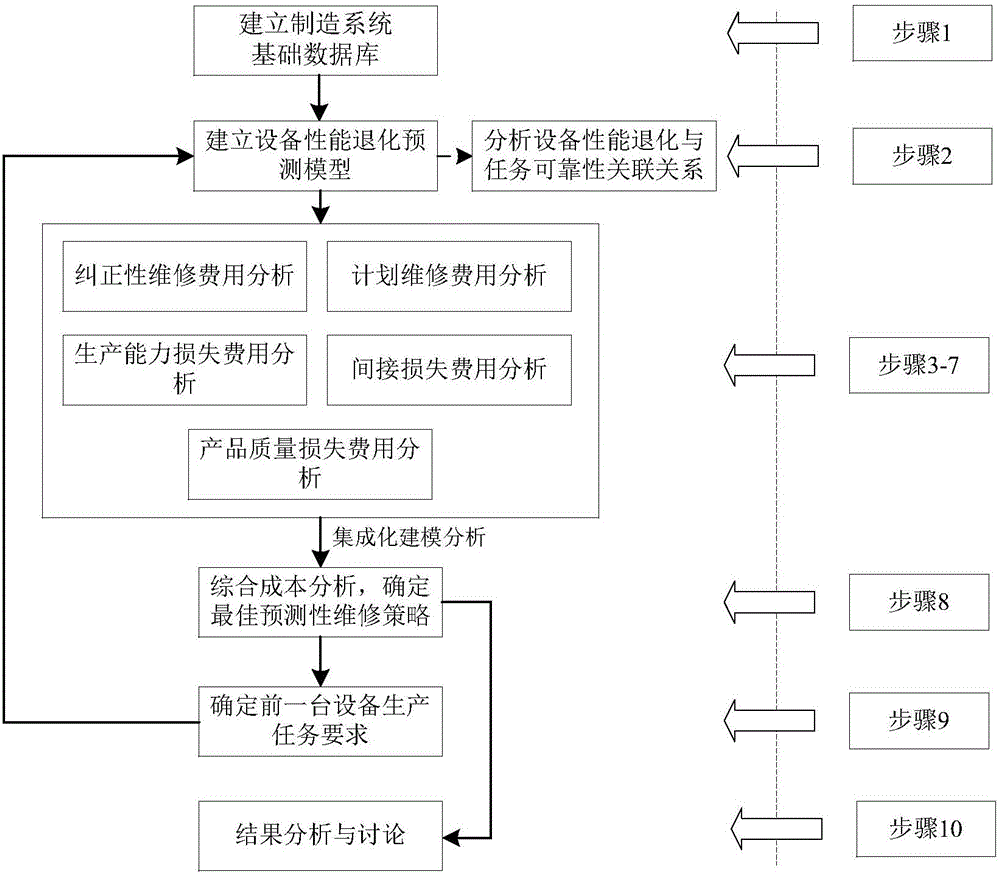
[0075] The present invention is a method for predictive maintenance of manufacturing systems based on task reliability status, see figure 2 As shown, its implementation steps are as follows:

[0076] Step 1 Collect the product quality information of the cylinder head of a certain model of four-cylinder diesel engine. Use quality function deployment to decompose and map key quality characteristics, and identify key processes and production equipment related to the engine cylinder head manufacturing system, as shown in Table 1 below. Then collect the failure, maintenance, quality inspection and operation inspection data of each related processing equipment respectively.

[0077] Table 1. Critical quality characteristics and their manufacturing process information

[0078]

[0079] Step 2 on device a 5 Analysis of the basic data, according to th...