Hand intended for being provided on a humanoid robot with improved fingers

A humanoid robot, finger technology, applied in manipulators, program-controlled manipulators, manufacturing tools, etc., can solve problems such as increasing the complexity of robots

CN106132640AActive Publication Date: 2016-11-16ALDEBARAN ROBOTICS SA
7 Cites 5 Cited by

Patent Information

Authority / Receiving Office
CN · China
Patent Type
Applications(China)
Current Assignee / Owner
Publication Date
2016-11-16

Smart Images

  • Figure 1
    Figure 1
  • Figure 2
    Figure 2
  • Figure 3
    Figure 3
Patent Text Reader

Abstract

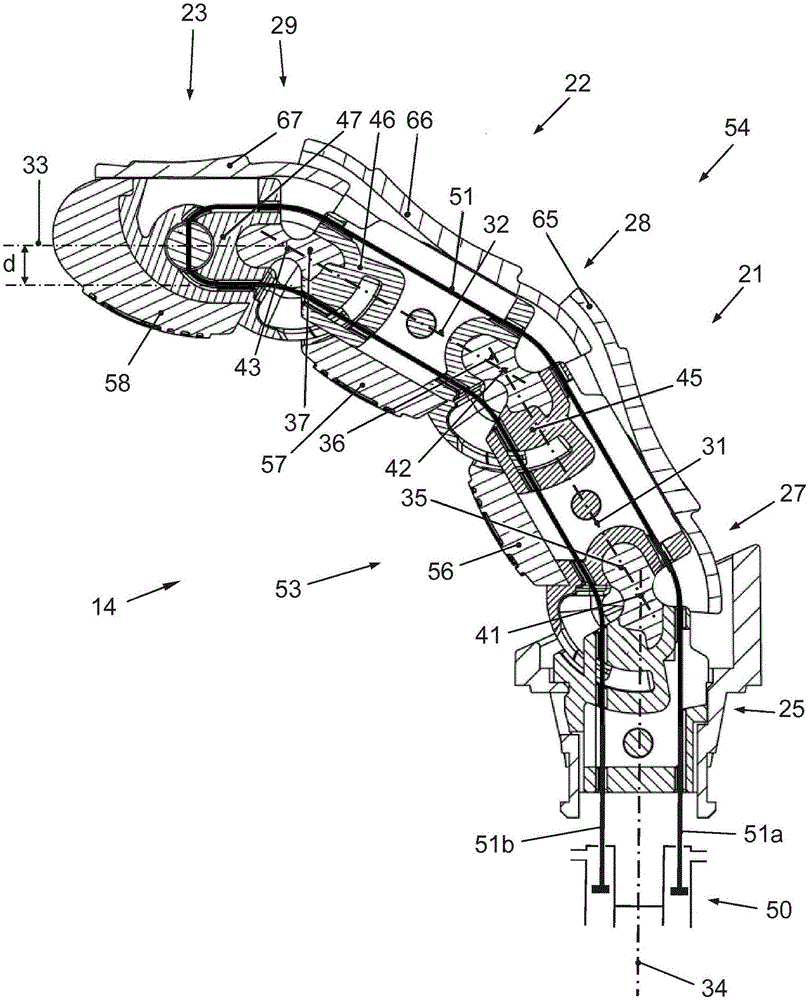
The invention relates to a hand intended for being provided on a humanoid robot. The hand comprises a palm and at least one finger (14) articulated to the palm, the finger (14) comprising at least one phalanx (21, 22, 23) and an articulation (27, 28, 29) connecting the phalanx (21, 22, 23) to the palm, the phalanx (21, 22, 23) extending in a main direction (31, 32, 33). According to the invention, the articulation (27, 28, 29) comprises a resilient joining part (35, 36, 37) that allows several degrees of freedom. The hand comprises motorisation means (50, 51) for motorising one degree of rotational freedom among the degrees of freedom made possible by the joining part (35, 36, 37), the motorised degree of rotational freedom allowing a relative movement about a shaft (41, 42, 43) perpendicular to the main direction (31, 32, 33) of the phalanx (21, 22, 23). The other degrees of freedom among the degrees of freedom made possible by the joining part (35, 36, 37) are not motorised.
Need to check novelty before this filing date? Find Prior Art

Description

technical field

[0001] The present invention relates to hands for humanoid robots. Background technique

[0002] The human hand is an extremely complex part of the human body. The human hand includes a plurality of fingers that articulate around the palm. Also, each finger has multiple phalanges that articulate with one another. Each joint can be motorized by muscles. The different joints of the hand in particular enable the grasping of objects of various shapes. Several attempts have been made in humanoid robots to best approximate human functionality. Reproducing hand movements in a robot requires a large number of independent actuators to ensure grasping of various objects. This increases the complexity of the robot both in terms of the number of independent actuators to be provided and the drive of these different actuators which have to be controlled in a coordinated manner. Contents of the invention

[0003] The purpose of the invention is to simplify the produ...

Examples

Embodiment Construction

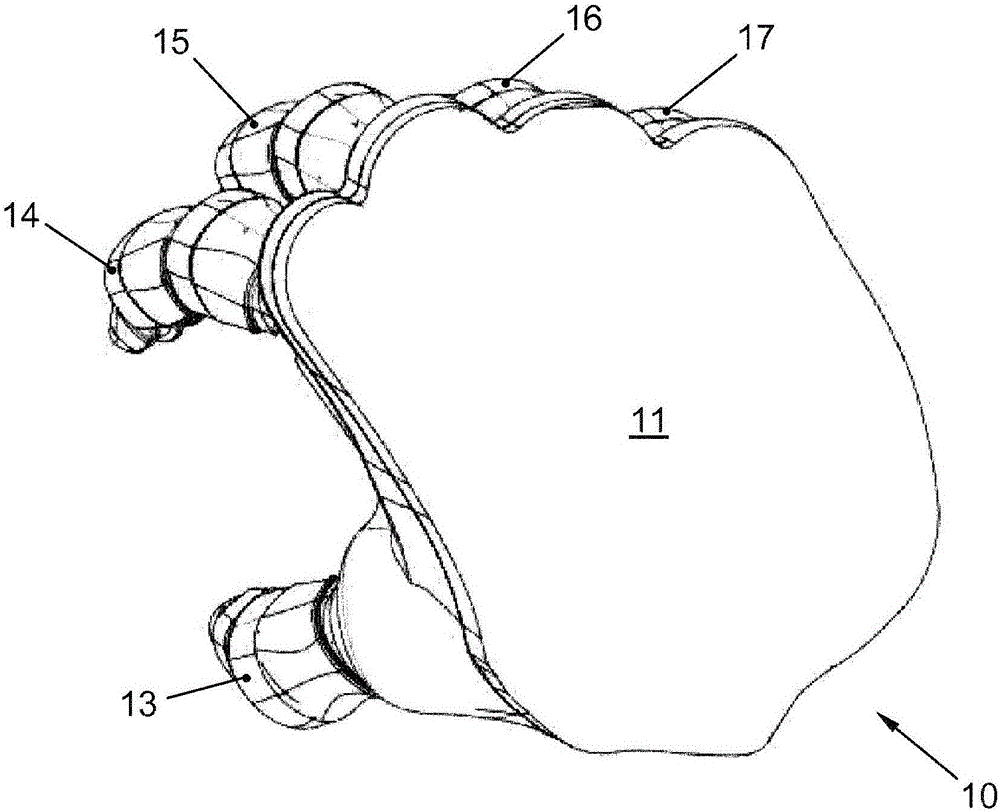
[0015] For clarity, the same elements will be given the same designations in different drawings.

[0016] figure 1 Denotes a hand 10 for a humanoid robot. The hand 10 includes a palm 11 and five fingers 13 to 17 . The fingers articulate about the palm 11 in a manner that allows objects to be grasped between the fingers 13-17. Similar to a human hand, finger 13 is the thumb. The object grasped by the hand remains between the thumb 13 and the other fingers 14 to 17 . The invention is not limited to hands with five fingers. The number of fingers can be reduced to simplify the design of the hand, and the number of fingers can even be increased to allow grasping of specific objects.

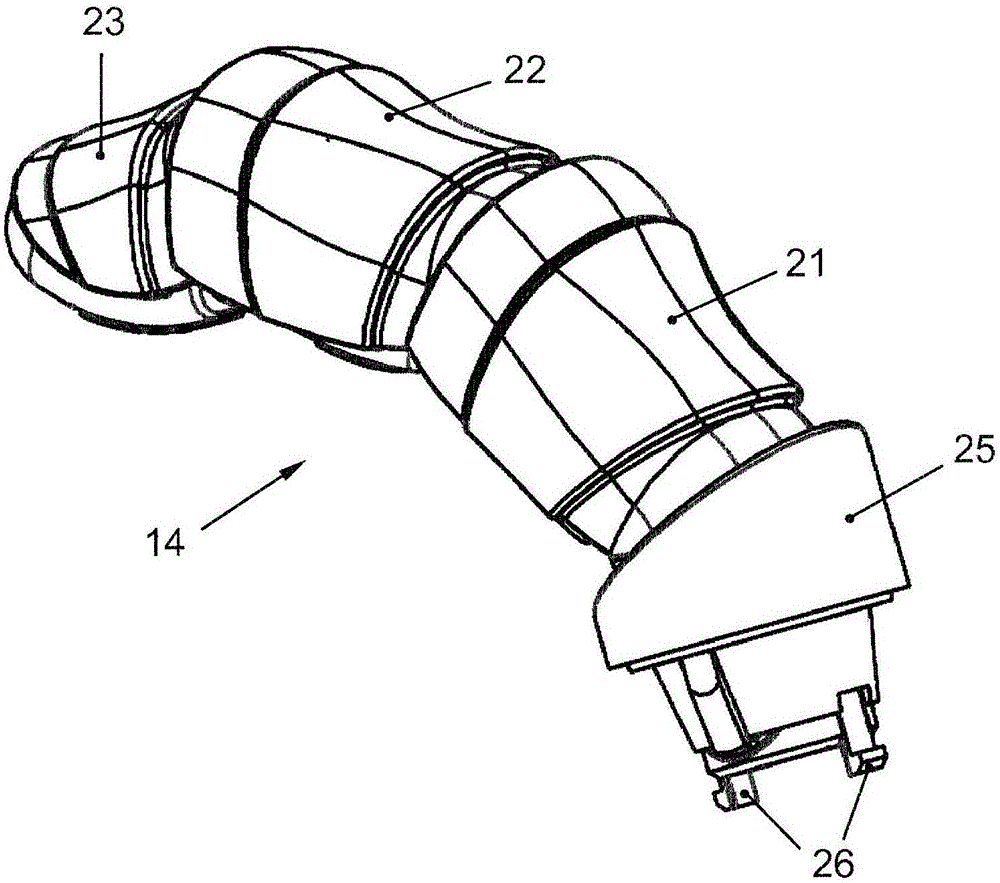
[0017] figure 2 A perspective representation of the fingers equipped with the hand 10 is shown. The finger is the index finger 14 comprising three phalanges 21 , 22 and 23 arranged in succession. The phalanges are serially articulated relative to the palm 11 of the hand 10 . More specificall...